Showing posts with label scotland. Show all posts

Tuesday, March 17, 2026

My Annual Über-Celtic Moment

Today we remember Saint Patrick (387-493), the patron saint of Ireland. It is on the Emerald Isle that today is both a national and religious holiday. At one time, the bars would close and the churches would be full out of obligation. Only in recent years has the feast seen a more rebellious spirit, complete with parades and green beer (not to mention green hair). Naturally (if ironically), they have the Americans to thank for this.

And, since the feast usually takes place during Lent, there are times such as a couple of years ago, when some of us are permitted on a day of abstinence to indulge a wee bit more than others. But this year it's on a Tuesday, so it's all good craic.

+    +    +

Growing up in a postwar Catholic environment, those of us who attended the parish schools in the United States, were taught that there were two kinds of people; those who were Irish, and those who wish they were. My own family appeared to fall into neither category. There were the Irish nuns who favored the Irish kids, including the unforgettable Sister Mary Mel (yes, her real name), who wasn't above calling some miscreant a "jackass" (including my kid brother, as evesdropping on a phone call with Mom gave away). But at least she was colorful. The rest of all things that were allegedly Irish were just so much blarney. I came to dismiss the whole notion of St Paddy's Day -- indeed, the whole notion of being Irish -- as a license for certain people to be more arrogant and obnoxious than they already were.

"Hail glorious Saint Patrick dear saint of our isle
On us thy poor children look down with a smile —"
But I'm not singing hymns and I'm not saying prayers
No, I'm gritting my teeth as I walk down the stairs

And into the street with these louts fiercely drinking
And screeching and lurching, and here's what I'm thinking —
They're using a stereotype, a narrow example,
A fraction, not even a marketing sample

To imitate Ireland, from which they don't come!
So unless that's just stupid, unless it's plain dumb,
All these kids from New Jersey and the five boroughs
And hundreds of cities, all drowning their sorrows,

With bottles and glasses and heads getting broken
(Believe me, just ask the mayor of Hoboken)
All that mindlessness, shouting and getting plain stocious —
That isn't Irish, that's simply atrocious.

I've another word too for it, this one's more stinging
I call it "racism." See, just 'cause you're singing
Some drunken old ballad on Saint Patrick's Day
Does that make you Irish? Oh, no — no way.

Nor does a tee-shirt that asks you to kiss them —
If they never come back I surely won't miss them
Or their beer cans and badges and wild maudlin bawling
And hammered and out of it, bodies all sprawling.

They're not of Joyce or of Yeats, Wilde, or Shaw.
How many Nobel Laureates does Dublin have? Four!
Think of this as you wince through Saint Patrick's guano.
Not every Italian is Tony Soprano.

+    +    +

Eventually I went to college, where I discovered Irish music. I mean the real thing, not the over-romanticized "Christmas-in-Killarney-on-St-Patrick's-in-June" that passed itself off as genuine the whole time, and I couldn't get enough of it. I used to watch the Saint Patrick's Day parade in Cincinnati, which included the carrying of the statue of the Saint, which the local chapter of the Ancient Order of Hibernians would "steal" in the middle of night, from what was once the German parish in Mount Adams. (Long story.) There was also the local Irish dance school, with boys and girls who never imagined that, decades later, they could do it for fame and fortune in shows like "Riverdance."

Who knew?

By the end of the 1970s I spent Sunday evenings working at a coffeehouse, and I helped broker a deal that brought Clannad to Cincinnati on their first American tour. I even gave harpist/vocalist Máire Brennan (pronounced MOY-uh) a ride back to where she was staying. Otherwise shy and aloof, I got her to laugh at my jokes. That seemed to matter at the time.

I saw Máire again in 1987, in a music video on VH1, for a song entitled "Something to Believe In." She was also the haunting voice in the Volkswagen commercials. Naturally she's world-famous now, and probably wouldn't return my calls, although she did write me a long and possibly heartfelt note when she autographed my copy of their album. I say "possibly" because it was in Gaelic, so I'll never know for sure, especially since it was among my collection that was stolen from my apartment in Georgetown back in 1994. (Bob, if you're reading this, tell your rich white trash buddies that I'd really like to have it back. And before you get your boxers in a bunch, the neighbors all thought YOU did it!) Máire also came out with a book in 2001 entitled "The Other Side of the Rainbow." She continues to tour and so on, but I knew her when.

(Sigh ...) Anyway, back to the '70s. While the whole world (including my now-beloved Celia on the other side of it) was going bananas over disco, the feast became an annual ritual, of spending most of the accompanying weekend hanging out at Hap's Irish Pub in the Hyde Park section of Cincinnati, or at Arnold's Bar and Grill downtown. Even when I moved to Washington in 1980, I learned Irish dancing (if not quite what appears in the above video), Irish folk tales, and the like. But the upscale bars in the Nation's capital weren't as quaint as the neighborhood pubs in my old hometown. I was under no illusions that this heritage was one that I could claim for my own.

In 1982, that claim became even more elusive. I married a girl whose grandparents came over from Slovakia, and who grew up hearing Slovak around the house. This pretty much killed any enthusiasm for all things Irish around our house.

You see, I learned a piece of American Catholic history that the mostly Irish-American church historians back then didn't exactly wear on their sleeves.

By the time eastern Europeans came to America in the late 19th and early 20th century, the Irish were already the big fish in the little blue-collar pond, and didn't mind letting the "Hunkies" in the coal towns and factory neighborhoods know it. Going up the food chain, it got worse. Catholics of Eastern Rites -- with customs and liturgy similar to the Orthodox, but in communion with Rome -- had married priests. The mostly-Irish bishops assumed they were either schismatics, or worse. Their wives couldn't be treated in Catholic hospitals, and their children were barred from Catholic schools. Confused as these bishops were, they concluded that the faithful would be even more confused by the presence of married Catholic priests. Thus, by the 1920s, The (mostly Irish-)American bishops pressured Rome to bar the (legitimately) married priests from coming to America, let alone ministering.

It has been shown that most of the growth of Eastern Orthodoxy in North America can be attributed to the damned ignorance of the mitred Micks at the time. (Hey, guys, nice work!)

This latency towards all things Irish got a reprieve when the marriage tanked in 1992. Then one night -- it was about 1998, as I remember -- I was interviewed for a writing job by a priest who edited a major Catholic periodical. A native of Dublin, he reminded me of what really mattered:

“Patrick was not Irish, and on his Feast Day, we do not celebrate being Irish; we celebrate being Catholic.”

I knew that the Alexanders came from a small town near Verdun, in the Lorraine province of northeastern France. But in recent years we learned that, before the 18th century, the "Alexandre" line was expatriated from Scotland, the result of the rebellion when the Scottish nationalists who were followers of the French "Bonnie Prince Charles" were defeated. I was also to learn that the man known by the Roman name of Maganus Sucatus (Maewyn Succat in Gaelic) was of a Roman family, born in Kilpatrick, near Dumbarton, in that part of Great Britain that is now Scotland. Sooooo ... if not being Irish were not enough, Patricius (in modern English, Patrick) -- as he was known in later years, being of the Roman "patrician" class, and a "patriarch" to his spiritual charges -- might just as easily be claimed by the Scots as one of their own.

+    +    +

For years, one highlight of the day was the Annual Irish Poetry Reading. That was when I'd call my folks in Ohio on this day every year, and with their speakerphone on, recite the following piece by Benjamin Hapgood Burt in my very bad Irish brogue:

One evening in October, when I was one-third sober,
    An' taking home a "load" with manly pride;
My poor feet began to stutter, so I lay down in the gutter,
    And a pig came up an' lay down by my side;
Then we sang "It's all fair weather when good fellows get together,"
    Till a lady passing by was heard to say:
"You can tell a man who 'boozes' by the company he chooses"
    And the pig got up and slowly walked away.


Since then, both have entered into eternity with better things to do.

+    +    +

Today, those who are Irish, who wish they were, or who don't give a rat's arse either way, will dine on Irish lamb stew. When I can ever find it amidst my stuff, I use this occasion to wear a button with the words of William Butler Yeats: “I will arise and go now, and go to Innisfree.” (Yes, that's the poem above.) Usually, I listen to Celtic music the entire day, and at an opportune time and place, I dine on corned beef and cabbage, an admittedly an American innovation for the Irish, as poor immigrants from the "auld sod" found corned beef (a substitute used by their Jewish neighbors in place of bacon) to be much cheaper than lamb.

Then about ten years ago, I got lucky, because right down the street from me, they opened an Irish pub. It seems that three Thai restaurants within a half mile of each other was one too many, and the one closest to me was replaced with the watering hole of my dreams. The Celtic House is situated on the corner of Columbia Pike and South Barton Street, right at the end of the latter street, which would be my street, a mere ten-minute walk away.

Earlier today, my beloved and I dined there amidst the usual record crowd, as if my fond memories of discovering real Irish culture have come full circle. True, it's not as small and crowded as Hap's in Hyde Park, not nearly as weather-beaten as Arnold's downtown, and they won't be selling raffle tickets for NORAID under the table, but I can ignore that long enough to enjoy a lamb stew, or a rueben sandwich with sauerkraut, if I'm in the mood.

I'll also probably watch Mel Gibson in Braveheart later tonight, while enjoying a Guinness float (which is like a root beer float, with the obvious exception). Who cares if William Wallace was Scottish? No one cares if Patrick isn't Irish, do they? After all, "The Apostle of Ireland" is properly claimed by Catholics everywhere, whether a bunch of Micks care to admit it or not.

“Agus fagaimid siud mar ata se.”

Monday, March 17, 2025

My Annual Über-Celtic Moment

Sorry, kids, it's on a Monday this year.

Today the Church celebrates the feast of Saint Patrick (387-493), the patron saint of Ireland. It is on the Emerald Isle that today is both a national and religious holiday. At one time, the bars would close and the churches would be full out of obligation. Only in recent years has the feast seen a more rebellious spirit, complete with parades and green beer (not to mention green hair). Naturally (if ironically), they have the Americans to thank for this.

And, since the feast usually takes place during Lent, there are times such as shown above, when some of us are permitted on a day of abstinence to indulge a wee bit more than others.

+    +    +

Growing up in a postwar Catholic environment, those of us who attended the parish schools in the United States, were taught that there were two kinds of people; those who were Irish, and those who wish they were. My own family appeared to fall into neither category. There were the Irish nuns who favored the Irish kids, including the unforgettable Sister Mary Mel (yes, her real name), who wasn't above calling some miscreant a "jackass" (including my kid brother, as evesdropping on a phone call with Mom gave away).

But hey, at least she was colorful.

The rest of all things that were allegedly Irish were just so much blarney. I came to dismiss the whole notion of St Paddy's Day -- indeed, the whole notion of being Irish -- as a license for certain people to be more arrogant and obnoxious than they already were.

"Hail glorious Saint Patrick dear saint of our isle
On us thy poor children look down with a smile —"
But I'm not singing hymns and I'm not saying prayers
No, I'm gritting my teeth as I walk down the stairs

And into the street with these louts fiercely drinking
And screeching and lurching, and here's what I'm thinking —
They're using a stereotype, a narrow example,
A fraction, not even a marketing sample

To imitate Ireland, from which they don't come!
So unless that's just stupid, unless it's plain dumb,
All these kids from New Jersey and the five boroughs
And hundreds of cities, all drowning their sorrows,

With bottles and glasses and heads getting broken
(Believe me, just ask the mayor of Hoboken)
All that mindlessness, shouting and getting plain stocious —
That isn't Irish, that's simply atrocious.

I've another word too for it, this one's more stinging
I call it "racism." See, just 'cause you're singing
Some drunken old ballad on Saint Patrick's Day
Does that make you Irish? Oh, no — no way.

Nor does a tee-shirt that asks you to kiss them —
If they never come back I surely won't miss them
Or their beer cans and badges and wild maudlin bawling
And hammered and out of it, bodies all sprawling.

They're not of Joyce or of Yeats, Wilde, or Shaw.
How many Nobel Laureates does Dublin have? Four!
Think of this as you wince through Saint Patrick's guano —
Not every Italian is Tony Soprano.

Eventually I went to college, where I discovered Irish music. I mean the real thing, not the over-romanticized "Christmas-in-Killarney-on-St-Patrick's-in-June" that passed itself off as genuine the whole time, and I couldn't get enough of it. I used to watch the Saint Patrick's Day parade in Cincinnati, which included the carrying of the statue of the Saint, which the local chapter of the Ancient Order of Hibernians would "steal" in the middle of night, from what was once the German parish in Mount Adams. (Long story.) There was also the local Irish dance school, with boys and girls who never imagined that, decades later, they could do it for fame and fortune in shows like "Riverdance."

Who knew?

By the end of the 1970s I spent Sunday evenings working at a coffeehouse, and I helped broker a deal that brought Clannad to Cincinnati on their first American tour. I even gave harpist/vocalist Máire Brennan (pronounced MOY-uh) a ride back to where she was staying. Otherwise shy and aloof, I got her to laugh at my jokes. That seemed to matter at the time.

I saw Máire again in 1987, in a music video on VH1, for a song entitled "Something to Believe In." She was also the haunting voice in the Volkswagen commercials. Naturally she's world-famous now, and probably wouldn't return my calls, although she did write me a long and possibly heartfelt note when she autographed my copy of their album. I say "possibly" because it was in Gaelic, so I'll never know for sure, especially since it was among my collection that was stolen from my apartment in Georgetown back in 1994.

(Bob, if you're reading this, tell your rich white trash buddies that I'd really like to have it back. And before you get your boxers in a bunch, the neighbors all thought YOU did it!)


Máire also came out with a book in 2001 entitled "The Other Side of the Rainbow." She continues to tour and so on, but I knew her when.

(Sigh ...) Anyway, back to the '70s.

While the whole world (including my now-beloved Celia on the other side of it) was going bananas over disco, the feast became an annual ritual, of spending most of the accompanying weekend hanging out at Hap's Irish Pub in the Hyde Park section of Cincinnati, or at Arnold's Bar and Grill downtown. Even when I moved to Washington in 1980, I learned Irish dancing (if not quite what appears in the above video), Irish folk tales, and the like. But the upscale bars in the Nation's capital weren't as quaint as the neighborhood pubs in my old hometown. I was under no illusions that this heritage was one that I could claim for my own.

In 1982, that claim became even more elusive. I married a girl whose grandparents came over from Slovakia, and who grew up hearing Slovak around the house. This pretty much killed any enthusiasm for all things Irish around our house.

You see, I learned a piece of American Catholic history that the mostly Irish-American church historians didn't exactly wear on their sleeves.

By the time eastern Europeans came to America in the late 19th and early 20th century, the Irish were already the big fish in the little blue-collar pond, and didn't mind letting the "Hunkies" in the coal towns and factory neighborhoods know it. Going up the food chain, it got worse. Catholics of Eastern Rites -- with customs and liturgy similar to the Orthodox, but in communion with Rome -- had married priests. The mostly-Irish bishops assumed they were either schismatics, or worse. Their wives were barred from treatment in Catholic hospitals, and their children were barred from Catholic schools. Confused as these bishops were, they concluded that the faithful would be even more confused by the presence of married Catholic priests. Thus, by the 1920s, The (Irish-)American bishops pressured Rome to bar the (legitimately) married priests from coming to America, let alone ministering.

It has been shown that most of the growth of Eastern Orthodoxy in North America can be attributed to the damned ignorance of the (Irish-)American bishops of the time. (Hey, Mickey, nice work!)

This latency towards all things Irish got a reprieve when the marriage tanked in 1992. Then one night -- it was about 1998, as I remember -- I was interviewed for a writing job by a priest who edited a major Catholic periodical. A native of Dublin, he reminded me of what really mattered:

“Patrick was not Irish, and on his Feast Day, we do not celebrate being Irish; we celebrate being Catholic.”

I knew that the Alexanders came from a small town near Verdun, in the Lorraine province of northeastern France. But in recent years we learned that, before the 18th century, the Alexandre line was expatriated from Scotland, a result of the Rebellion when England overtook them. I was also to learn that the man known by the Roman name of Maganus Sucatus (Maewyn Succat in Gaelic) was of a Roman family, born in Kilpatrick, near Dumbarton, in that part of Great Britain that is now Scotland.

Sooooo ... if not being Irish were not enough, Patricius (in modern English, Patrick) -- as he was known in later years, being of the Roman "patrician" class, and a "patriarch" to his spiritual charges -- might just as easily be claimed by the Scots as one of their own.

For years, one highlight of the day would be the Annual Irish Poetry Reading. That was when I'd call my folks in Ohio on this day every year, and with their speakerphone on, recite the following piece by Benjamin Hapgood Burt in a very bad Irish brogue:

One evening in October, when I was one-third sober,
    An' taking home a "load" with manly pride;
My poor feet began to stutter, so I lay down in the gutter,
    And a pig came up an' lay down by my side;
Then we sang "It's all fair weather when good fellows get together,"
    Till a lady passing by was heard to say:
"You can tell a man who 'boozes' by the company he chooses"
    And the pig got up and slowly walked away.


Since then, both have entered into eternity, most likely with better things to do.

Today, those who are Irish, who wish they were, or who don't give a rat's arse either way, will dine on Irish lamb stew. When I can ever find it amidst my stuff, I use this occasion to wear a button with the words of William Butler Yeats: “I will arise and go now, and go to Innisfree.” Usually, I listen to Celtic music the entire day, and at an opportune time and place, I dine on corned beef and cabbage. This is admittedly an American innovation for the Irish, as poor immigrants from the "auld sod" found corned beef (a substitute used by their Jewish neighbors in place of bacon) to be much cheaper than lamb.

Then about eight or nine years ago, I got lucky, because right down the street from me, they opened an Irish pub. It seems that three Thai restaurants within a half mile of each other was one too many, and the one closest to me was replaced with the watering hole of my dreams. The Celtic House is situated on the corner of Columbia Pike and South Barton Street, right on the corner, a mere five-or-ten-minute walk away from my home on South Barton. Sometime today I'm making a point of being there, as if my fond memories of discovering real Irish culture have come full circle. True, it's not as small and crowded as Hap's Irish Pub in Hyde Park, not nearly as weather-beaten as Arnold's downtown, and they won't be selling raffle tickets for NORAID under the table, but I can ignore that long enough to enjoy a lamb stew.

I'll also probably watch Mel Gibson in Braveheart later tonight, while enjoying a Guinness float (which is like a root beer float, except you have Guinness, right?). Who cares if William Wallace was Scottish? No one cares if Patrick isn't Irish, do they? After all, "The Apostle of Ireland" is properly claimed by Catholics everywhere, whether a bunch of Micks care to admit it or not.

“Agus fagaimid siud mar ata se.”

Sunday, March 17, 2024

My Annual Über-Celtic Moment

Today the Church celebrates the feast of Saint Patrick (387-493), the patron saint of Ireland. It is on the Emerald Isle that today is both a national and religious holiday. At one time, the bars would close and the churches would be full out of obligation. Only in recent years has the feast seen a more rebellious spirit, complete with parades and green beer (not to mention green hair). Naturally (if ironically), they have the Americans to thank for this.

And, since the feast usually takes place during Lent, there are times such as last year, when some of us are permitted on a day of abstinence to indulge a wee bit more than others.

+    +    +

Growing up in a postwar Catholic environment, those of us who attended the parish schools in the United States, were taught that there were two kinds of people; those who were Irish, and those who wish they were. My own family appeared to fall into neither category. There were the Irish nuns who favored the Irish kids, including the unforgettable Sister Mary Mel (yes, her real name), who wasn't above calling some miscreant a "jackass" (including my kid brother, as evesdropping on a phone call with Mom gave away). But at least she was colorful. The rest of all things that were allegedly Irish were just so much blarney. I came to dismiss the whole notion of St Paddy's Day -- indeed, the whole notion of being Irish -- as a license for certain people to be more arrogant and obnoxious than they already were.

"Hail glorious Saint Patrick dear saint of our isle
On us thy poor children look down with a smile —"
But I'm not singing hymns and I'm not saying prayers
No, I'm gritting my teeth as I walk down the stairs
And into the street with these louts fiercely drinking
And screeching and lurching, and here's what I'm thinking —
They're using a stereotype, a narrow example,
A fraction, not even a marketing sample
To imitate Ireland, from which they don't come!
So unless that's just stupid, unless it's plain dumb,
All these kids from New Jersey and the five boroughs
And hundreds of cities, all drowning their sorrows,
With bottles and glasses and heads getting broken
(Believe me, just ask the mayor of Hoboken)
All that mindlessness, shouting and getting plain stocious —
That isn't Irish, that's simply atrocious.
I've another word too for it, this one's more stinging
I call it "racism." See, just 'cause you're singing
Some drunken old ballad on Saint Patrick's Day
Does that make you Irish? Oh, no — no way.
Nor does a tee-shirt that asks you to kiss them —
If they never come back I surely won't miss them
Or their beer cans and badges and wild maudlin bawling
And hammered and out of it, bodies all sprawling.

They're not of Joyce or of Yeats, Wilde, or Shaw.
How many Nobel Laureates does Dublin have? Four!
Think of this as you wince through Saint Patrick's guano —
Not every Italian is Tony Soprano.

Eventually I went to college, where I discovered Irish music. I mean the real thing, not the over-romanticized "Christmas-in-Killarney-on-St-Patrick's-in-June" that passed itself off as genuine the whole time, and I couldn't get enough of it. I used to watch the Saint Patrick's Day parade in Cincinnati, which included the carrying of the statue of the Saint, which the local chapter of the Ancient Order of Hibernians would "steal" in the middle of night, from what was once the German parish in Mount Adams. (Long story.) There was also the local Irish dance school, with boys and girls who never imagined that, decades later, they could do it for fame and fortune in shows like "Riverdance."

Who knew?

By the end of the 1970s I spent Sunday evenings working at a coffeehouse, and I helped broker a deal that brought Clannad to Cincinnati on their first American tour. I even gave harpist/vocalist Máire Brennan (pronounced MOY-uh) a ride back to where she was staying. Otherwise shy and aloof, I got her to laugh at my jokes. That seemed to matter at the time.

I saw Máire again in 1987, in a music video on VH1, for a song entitled "Something to Believe In." She was also the haunting voice in the Volkswagen commercials. Naturally she's world-famous now, and probably wouldn't return my calls, although she did write me a long and possibly heartfelt note when she autographed my copy of their album. I say "possibly" because it was in Gaelic, so I'll never know for sure, especially since it was among my collection that was stolen from my apartment in Georgetown back in 1994. (Bob, if you're reading this, tell your rich white trash buddies that I'd really like to have it back. And before you get your boxers in a bunch, the neighbors all thought YOU did it!) Máire also came out with a book in 2001 entitled "The Other Side of the Rainbow." She continues to tour and so on, but I knew her when.

(Sigh ...) Anyway, back to the '70s. While the whole world (including my now-beloved Celia on the other side of it) was going bananas over disco, the feast became an annual ritual, of spending most of the accompanying weekend hanging out at Hap's Irish Pub in the Hyde Park section of Cincinnati, or at Arnold's Bar and Grill downtown. Even when I moved to Washington in 1980, I learned Irish dancing (if not quite what appears in the above video), Irish folk tales, and the like. But the upscale bars in the Nation's capital weren't as quaint as the neighborhood pubs in my old hometown. I was under no illusions that this heritage was one that I could claim for my own.

In 1982, that claim became even more elusive. I married a girl whose grandparents came over from Slovakia, and who grew up hearing Slovak around the house. This pretty much killed any enthusiasm for all things Irish around our house.


You see, I learned a piece of American Catholic history that the mostly Irish-American church historians didn't exactly wear on their sleeves.

By the time eastern Europeans came to America in the late 19th and early 20th century, the Irish were already the big fish in the little blue-collar pond, and didn't mind letting the "Hunkies" in the coal towns and factory neighborhoods know it. Going up the food chain, it got worse. Catholics of Eastern Rites -- with customs and liturgy similar to the Orthodox, but in communion with Rome -- had married priests. The mostly-Irish bishops assumed they were either schismatics, or worse. Their wives couldn't be treated in Catholic hospitals, and their children were barred from Catholic schools. Confused as these bishops were, they concluded that the faithful would be even more confused by the presence of married Catholic priests. Thus, by the 1920s, The (Irish-)American bishops pressured Rome to bar the (legitimately) married priests from coming to America, let alone ministering.

It has been shown that most of the growth of Eastern Orthodoxy in North America can be attributed to the damned ignorance of the (Irish-)American bishops of the time. (Hey, guys, nice work!)

This latency towards all things Irish got a reprieve when the marriage tanked in 1992. Then one night -- it was about 1998, as I remember -- I was interviewed for a writing job by a priest who edited a major Catholic periodical. A native of Dublin, he reminded me of what really mattered:

“Patrick was not Irish, and on his Feast Day, we do not celebrate being Irish; we celebrate being Catholic.”

I knew that the Alexanders came from a small town near Verdun, in the Lorraine province of northeastern France. But in recent years we learned that, before the 18th century, the Alexandre line was expatriated from Scotland, a result of the Rebellion when England overtook them. I was also to learn that the man known by the Roman name of Maganus Sucatus (Maewyn Succat in Gaelic) was of a Roman family, born in Kilpatrick, near Dumbarton, in that part of Great Britain that is now Scotland. Sooooo ... if not being Irish were not enough, Patricius (in modern English, Patrick) -- as he was known in later years, being of the Roman "patrician" class, and a "patriarch" to his spiritual charges -- might just as easily be claimed by the Scots as one of their own.
For years, one highlight of the day would be the Annual Irish Poetry Reading. That was when I'd call my folks in Ohio on this day every year, and with their speakerphone on, recite the following piece by Benjamin Hapgood Burt in a very bad Irish brogue:

One evening in October, when I was one-third sober,
    An' taking home a "load" with manly pride;
My poor feet began to stutter, so I lay down in the gutter,
    And a pig came up an' lay down by my side;
Then we sang "It's all fair weather when good fellows get together,"
    Till a lady passing by was heard to say:
"You can tell a man who 'boozes' by the company he chooses"
    And the pig got up and slowly walked away.


Since then, both have entered into eternity, most likely with better things to do.

Today, those who are Irish, who wish they were, or who don't give a rat's arse either way, will dine on Irish lamb stew. When I can ever find it amidst my stuff, I use this occasion to wear a button with the words of William Butler Yeats: “I will arise and go now, and go to Innisfree.” Usually, I listen to Celtic music the entire day, and at an opportune time and place, I dine on corned beef and cabbage. This is admittedly an American innovation for the Irish, as poor immigrants from the "auld sod" found corned beef (a substitute used by their Jewish neighbors in place of bacon) to be much cheaper than lamb.

Then about seven years ago, I got lucky, because right down the street from me, they opened an Irish pub. It seems that three Thai restaurants within a half mile of each other was one too many, and the one closest to me was replaced with the watering hole of my dreams. The Celtic House is situated on the corner of Columbia Pike and South Barton Street, right at the end of the latter street, which would be my street, a mere ten-minute walk away. Sometime today I'm making a point of being there, as if my fond memories of discovering real Irish culture have come full circle. True, it's not as small and crowded as Hap's in Hyde Park, not nearly as weather-beaten as Arnold's downtown, and they won't be selling raffle tickets for NORAID under the table, but I can ignore that long enough to enjoy a lamb stew.

I'll also probably watch Mel Gibson in Braveheart later tonight, while enjoying a Guinness float (which is like a root beer float, with the obvious exception). Who cares if William Wallace was Scottish? No one cares if Patrick isn't Irish, do they? After all, "The Apostle of Ireland" is properly claimed by Catholics everywhere, whether a bunch of Micks care to admit it or not.

“Agus fagaimid siud mar ata se.”
Friday, March 17, 2023

My Annual Über-Celtic Moment

Today the Church celebrates the feast of Saint Patrick (387-493), the patron saint of Ireland. It is on the Emerald Isle that today is both a national and religious holiday. At one time, the bars would close and the churches would be full out of obligation. Only in recent years has the feast seen a more rebellious spirit, complete with parades and green beer (not to mention green hair). Naturally (if ironically), they have the Americans to thank for this.

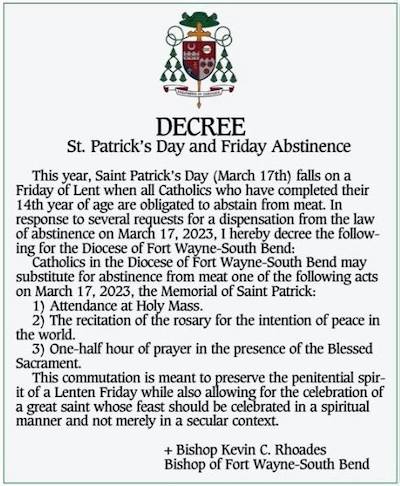
And, since the feast usually takes place during Lent, the announcement above shows that some of us can indulge a wee bit more than others.

+    +    +

Growing up in a postwar Catholic environment, those of us who attended the parish schools in the United States, were taught that there were two kinds of people; those who were Irish, and those who wish they were. My own family appeared to fall into neither category. There were the Irish nuns who favored the Irish kids, including the unforgettable Sister Mary Mel (yes, her real name), who wasn't above calling some miscreant a "jackass." But at least she was colorful. The rest of all things that were allegedly Irish were just so much blarney. I came to dismiss the whole notion of St Paddy's Day -- indeed, the whole notion of being Irish -- as a license for certain people to be more arrogant and obnoxious than they already were.

"Hail glorious Saint Patrick dear saint of our isle
On us thy poor children look down with a smile —"
But I'm not singing hymns and I'm not saying prayers
No, I'm gritting my teeth as I walk down the stairs
And into the street with these louts fiercely drinking
And screeching and lurching, and here's what I'm thinking —
They're using a stereotype, a narrow example,
A fraction, not even a marketing sample
To imitate Ireland, from which they don't come!
So unless that's just stupid, unless it's plain dumb,
All these kids from New Jersey and the five boroughs
And hundreds of cities, all drowning their sorrows,
With bottles and glasses and heads getting broken
(Believe me, just ask the mayor of Hoboken)
All that mindlessness, shouting and getting plain stocious —
That isn't Irish, that's simply atrocious.
I've another word too for it, this one's more stinging
I call it "racism." See, just 'cause you're singing
Some drunken old ballad on Saint Patrick's Day
Does that make you Irish? Oh, no — no way.
Nor does a tee-shirt that asks you to kiss them —
If they never come back I surely won't miss them
Or their beer cans and badges and wild maudlin bawling
And hammered and out of it, bodies all sprawling.

They're not of Joyce or of Yeats, Wilde, or Shaw.
How many Nobel Laureates does Dublin have? Four!
Think of this as you wince through Saint Patrick's guano —
Not every Italian is Tony Soprano.

Eventually I went to college, where I discovered Irish music. I mean the real thing, not the over-romanticized "Christmas-in-Killarney-on-St-Patrick's-in-June" that passed itself off as genuine the whole time. I simply couldn't get enough of it. I used to watch the Saint Patrick's Day parade in Cincinnati, which included the carrying of the statue of the Saint, which the local chapter of the Ancient Order of Hibernians would "steal" in the middle of night, from what was once the German parish in Mount Adams. (Long story.) There was also the local Irish dance school, with boys and girls who never imagined that, three decades later, they could do it for fame and fortune in shows like "Riverdance."

Who knew?

By the end of the 1970s I spent Sunday evenings working at a coffeehouse, and I helped broker a deal that brought Clannad to Cincinnati on their first American tour. I even gave harpist/vocalist Máire Brennan (pronounced MOY-uh) a ride back to where she was staying. Otherwise shy and aloof, I got her to laugh at my jokes. That seemed to matter at the time.

I saw Máire again in 1987, in a music video on VH1, for a song entitled "Something to Believe In." She was also the haunting voice in the Volkswagen commercials. Naturally she's world-famous now, and probably wouldn't return my calls, although she did write me a long and possibly heartfelt note when she autographed my copy of their album. I say "possibly" because it was in Gaelic, so I'll never know for sure, especially since it was among my collection that was stolen from my apartment in Georgetown back in 1994. (Bob, if you're reading this, tell your rich white trash buddies that I'd really like to have it back. And before you get your boxers in a bunch, the neighbors all thought YOU did it!) Máire also came out with a book in 2001 entitled "The Other Side of the Rainbow." She continues to tour and so on, but I knew her when.

(Sigh ...) Anyway, back to the '70s. While the whole world (including my now-beloved Celia on the other side of it) was going bananas over disco, the feast became an annual ritual, of spending most of the accompanying weekend hanging out at Hap's Irish Pub in the Hyde Park section of Cincinnati, or at Arnold's Bar and Grill downtown. Even when I moved to Washington in 1980, I learned Irish dancing (if not quite what appears in the above video), Irish folk tales, and the like. But the upscale bars in the Nation's capital weren't as quaint as the neighborhood pubs in my old hometown. I was under no illusions that this heritage was one that I could claim for my own.

In 1982, that claim became even more elusive. I married a girl whose grandparents came over from Slovakia, and who grew up hearing Slovak around the house. This pretty much killed any enthusiasm for all things Irish around our house.

You see, I learned a piece of American Catholic history that the mostly Irish-American church historians didn't exactly wear on their sleeves. By the time eastern Europeans came to America in the late 19th and early 20th century, the Irish were already the big fish in the little blue-collar pond, and didn't mind letting the "Hunkies" in the coal towns and factory neighborhoods know it. Going up the food chain, it got worse. Catholics of Eastern Rites -- with customs and liturgy similar to the Orthodox, but in communion with Rome -- had married priests. The mostly-Irish bishops assumed they were either schismatics, or worse. Their wives couldn't be treated in Catholic hospitals, and their children were barred from Catholic schools. Confused as these bishops were, they concluded that the faithful would be even more confused by the presence of married Catholic priests. Thus, by the 1920s, The (Irish-)American bishops pressured Rome to bar the (legitimately) married priests from coming to America, let alone ministering.

It has been shown that most of the growth of Eastern Orthodoxy in North America can be attributed to the damned ignorance of the (Irish-)American bishops of the time. (Hey, guys, nice work!)

This latency towards all things Irish got a reprieve when the marriage tanked in 1990. Then one night -- it was about 1998, as I remember -- I was interviewed for a writing job by a priest who edited a major Catholic periodical. A native of Dublin, he reminded me of what really mattered:

“Patrick was not Irish, and on his Feast Day, we do not celebrate being Irish; we celebrate being Catholic.”

I knew that the Alexanders came from a small town near Verdun, in the Lorraine province of northeastern France. But in recent years we learned that, before the 18th century, the Alexandre line was expatriated from Scotland, a result of the Rebellion when England overtook them. I was also to learn that the man known by the Roman name of Maganus Sucatus (Maewyn Succat in Gaelic) was of a Roman family, born in Kilpatrick, near Dumbarton, in that part of Great Britain that is now Scotland. Sooooo ... if not being Irish were not enough, Patricius (in modern English, Patrick) -- as he was known in later years, being of the Roman "patrician" class, and a "patriarch" to his spiritual charges -- might just as easily be claimed by the Scots as one of their own.
For years, one highlight of the day would be the Annual Irish Poetry Reading. That was when I'd call my folks in Ohio on this day every year, and with their speakerphone on, recite the following piece by Benjamin Hapgood Burt in a very bad Irish brogue:

One evening in October, when I was one-third sober,
    An' taking home a "load" with manly pride;
My poor feet began to stutter, so I lay down in the gutter,
    And a pig came up an' lay down by my side;
Then we sang "It's all fair weather when good fellows get together,"
    Till a lady passing by was heard to say:
"You can tell a man who 'boozes' by the company he chooses"
    And the pig got up and slowly walked away.


Since then, both have entered into eternity, most likely with better things to do.

Today, those who are Irish, who wish they were, or who don't give a rat's arse either way, will dine on Irish lamb stew. When I can ever find it amidst my stuff, I use this occasion to wear a button with the words of William Butler Yeats: “I will arise and go now, and go to Innisfree.” Usually, I listen to Celtic music the entire day, and at an opportune time and place, I dine on corned beef and cabbage. This is admittedly an American innovation for the Irish, as poor immigrants from the "auld sod" found corned beef (a substitute used by their Jewish neighbors in place of bacon) to be much cheaper than lamb.

Beginning this year, I got lucky, because right down the street from me, they opened an Irish pub. It seems that three Thai restaurant within a half mile of each other was one too many, and the one closest to me was replaced with the watering hole of my dreams. The Celtic House is situated on the corner of Columbia Pike and South Barton Street, right at the end of the latter street, which would be my street, a mere ten-minute walk away. Sometime today I'm making a point of being there, as if my fond memories of discovering real Irish culture have come full circle. True, it's not as small and crowded as Hap's, not nearly as weather-beaten as Arnold's, and they won't be selling raffle tickets for NORAID under the table, but I can ignore that long enough to enjoy a lamb stew.

I'll also probably watch Mel Gibson in Braveheart later tonight, while enjoying a Guiness float (which is like a root beer float, only ... well, you know). Who cares if William Wallace was Scottish? No one cares if Patrick isn't Irish, do they? After all, "The Apostle of Ireland" is properly claimed by Catholics everywhere, whether a bunch of micks care to admit it or not.

“Agus fagaimid siud mar ata se.”

Wednesday, March 17, 2021

My Annual Über-Celtic Moment

Today the Church celebrates the feast of Saint Patrick (387-493), the patron saint of Ireland. It is on the Emerald Isle that today is both a national and religious holiday. At one time, the bars would close and the churches would be full out of obligation. Only in recent years has the feast seen a more rebellious spirit, complete with parades and green beer (not to mention green hair). Naturally (if ironically), they have the Americans to thank for this.

Growing up in a postwar Catholic environment, those of us who attended the parish schools in the United States, were taught that there were two kinds of people; those who were Irish, and those who wish they were. My own family appeared to fall into neither category. There were the Irish nuns who favored the Irish kids, including the unforgettable Sister Mary Mel (yes, her real name), who wasn't above calling some miscreant a "jackass." But at least she was colorful. The rest of all things that were allegedly Irish were just so much blarney. I came to dismiss the whole notion of St Paddy's Day -- indeed, the whole notion of being Irish -- as a license for certain people to be more arrogant and obnoxious than they already were.

"Hail glorious Saint Patrick dear saint of our isle
On us thy poor children look down with a smile —"
But I'm not singing hymns and I'm not saying prayers
No, I'm gritting my teeth as I walk down the stairs
And into the street with these louts fiercely drinking
And screeching and lurching, and here's what I'm thinking —
They're using a stereotype, a narrow example,
A fraction, not even a marketing sample
To imitate Ireland, from which they don't come!
So unless that's just stupid, unless it's plain dumb,
All these kids from New Jersey and the five boroughs
And hundreds of cities, all drowning their sorrows,
With bottles and glasses and heads getting broken
(Believe me, just ask the mayor of Hoboken)
All that mindlessness, shouting and getting plain stocious —
That isn't Irish, that's simply atrocious.
I've another word too for it, this one's more stinging
I call it "racism." See, just 'cause you're singing
Some drunken old ballad on Saint Patrick's Day
Does that make you Irish? Oh, no — no way.
Nor does a tee-shirt that asks you to kiss them —
If they never come back I surely won't miss them
Or their beer cans and badges and wild maudlin bawling
And hammered and out of it, bodies all sprawling.

They're not of Joyce or of Yeats, Wilde, or Shaw.
How many Nobel Laureates does Dublin have? Four!
Think of this as you wince through Saint Patrick's guano —
Not every Italian is Tony Soprano.

Eventually I went to college, where I discovered Irish music. I mean the real thing, not the over-romanticized "Christmas-in-Killarney-on-St-Patrick's-in-June" that passed itself off as genuine the whole time. I simply couldn't get enough of it. I used to watch the Saint Patrick's Day parade in Cincinnati, which included the carrying of the statue of the Saint, which the local chapter of the Ancient Order of Hibernians would "steal" in the middle of night, from what was once the German parish in Mount Adams. (Long story.) There was also the local Irish dance school, with boys and girls who never imagined that, three decades later, they could do it for fame and fortune in shows like "Riverdance."

Who knew?

By the end of the 1970s I spent Sunday evenings working at a coffeehouse, and I helped broker a deal that brought Clannad to Cincinnati on their first American tour. I even gave harpist/vocalist Máire Brennan (pronounced MOY-uh) a ride back to where she was staying. Otherwise shy and aloof, I got her to laugh at my jokes. That seemed to matter at the time.

I saw Máire again in 1987, in a music video on VH1, for a song entitled "Something to Believe In." She was also the haunting voice in the Volkswagen commercials. Naturally she's world-famous now, and probably wouldn't return my calls, although she did write me a long and possibly heartfelt note when she autographed my copy of their album. I say "possibly" because it was in Gaelic, so I'll never know for sure, especially since it was among my collection that was stolen from my apartment in Georgetown back in 1994. (Bob, if you're reading this, tell your rich white trash buddies that I'd really like to have it back. And before you get your boxers in a bunch, the neighbors all thought YOU did it!) Máire also came out with a book in 2001 entitled "The Other Side of the Rainbow." She continues to tour and so on, but I knew her when.

(Sigh ...) Anyway, back to the '70s. While the whole world (including my now-beloved Celia on the other side of it) was going bananas over disco, the feast became an annual ritual, of spending most of the accompanying weekend hanging out at Hap's Irish Pub in the Hyde Park section of Cincinnati, or at Arnold's Bar and Grill downtown. Even when I moved to Washington in 1980, I learned Irish dancing (if not quite what appears in the above video), Irish folk tales, and the like. But the upscale bars in the Nation's capital weren't as quaint as the neighborhood pubs in my old hometown. I was under no illusions that this heritage was one that I could claim for my own.

In 1982, that claim became even more elusive. I married a girl whose grandparents came over from Slovakia, and who grew up hearing Slovak around the house. This pretty much killed any enthusiasm for all things Irish around our house.

You see, I learned a piece of American Catholic history that the mostly Irish-American church historians didn't exactly wear on their sleeves. By the time eastern Europeans came to America in the late 19th and early 20th century, the Irish were already the big fish in the little blue-collar pond, and didn't mind letting the "Hunkies" in the coal towns and factory neighborhoods know it. Going up the food chain, it got worse. Catholics of Eastern Rites -- with customs and liturgy similar to the Orthodox, but in communion with Rome -- had married priests. The mostly-Irish bishops assumed they were either schismatics, or worse. Their wives couldn't be treated in Catholic hospitals, and their children were barred from Catholic schools. Confused as these bishops were, they concluded that the faithful would be even more confused by the presence of married Catholic priests. Thus, by the 1920s, The (Irish-)American bishops pressured Rome to bar the (legitimately) married priests from coming to America, let alone ministering.

It has been shown that most of the growth of Eastern Orthodoxy in North America can be attributed to the damned ignorance of the (Irish-)American bishops of the time. (Hey, guys, nice work!)

This latency towards all things Irish got a reprieve when the marriage tanked in 1990. Then one night -- it was about 1998, as I remember -- I was interviewed for a writing job by a priest who edited a major Catholic periodical. A native of Dublin, he reminded me of what really mattered:

“Patrick was not Irish, and on his Feast Day, we do not celebrate being Irish; we celebrate being Catholic.”

I knew that the Alexanders came from a small town near Verdun, in the Lorraine province of northeastern France. But in recent years we learned that, before the 18th century, the Alexandre line was expatriated from Scotland, a result of the Rebellion when England overtook them. I was also to learn that the man known by the Roman name of Maganus Sucatus (Maewyn Succat in Gaelic) was of a Roman family, born in Kilpatrick, near Dumbarton, in that part of Great Britain that is now Scotland. Sooooo ... if not being Irish were not enough, Patricius (in modern English, Patrick) -- as he was known in later years, being of the Roman "patrician" class, and a "patriarch" to his spiritual charges -- might just as easily be claimed by the Scots as one of their own.
For years, one highlight of the day would be the Annual Irish Poetry Reading. That was when I'd call my folks in Ohio on this day every year, and with their speakerphone on, recite the following piece by Benjamin Hapgood Burt in a very bad Irish brogue:

One evening in October, when I was one-third sober,
    An' taking home a "load" with manly pride;
My poor feet began to stutter, so I lay down in the gutter,
    And a pig came up an' lay down by my side;
Then we sang "It's all fair weather when good fellows get together,"
    Till a lady passing by was heard to say:
"You can tell a man who 'boozes' by the company he chooses"
    And the pig got up and slowly walked away.


Since then, both have entered into eternity, most likely with better things to do.

Today, those who are Irish, who wish they were, or who don't give a rat's arse either way, will dine on Irish lamb stew. When I can ever find it amidst my stuff, I use this occasion to wear a button with the words of William Butler Yeats: “I will arise and go now, and go to Innisfree.” Usually, I listen to Celtic music the entire day, and at an opportune time and place, I dine on corned beef and cabbage. This is admittedly an American innovation for the Irish, as poor immigrants from the "auld sod" found corned beef (a substitute used by their Jewish neighbors in place of bacon) to be much cheaper than lamb.

Beginning this year, I got lucky, because right down the street from me, they opened an Irish pub. It seems that three Thai restaurant within a half mile of each other was one too many, and the one closest to me was replaced with the watering hole of my dreams. The Celtic House is situated on the corner of Columbia Pike and South Barton Street, right at the end of the latter street, which would be my street, a mere ten-minute walk away. Sometime today I'm making a point of being there, as if my fond memories of discovering real Irish culture have come full circle. True, it's not as small and crowded as Hap's, not nearly as weather-beaten as Arnold's, and they won't be selling raffle tickets for NORAID under the table, but I can ignore that long enough to enjoy a lamb stew.

I'll also probably watch Mel Gibson in Braveheart later tonight, while enjoying a Guiness float (which is like a root beer float, only ... well, you know). Who cares if William Wallace was Scottish? No one cares if Patrick isn't Irish, do they? After all, "The Apostle of Ireland" is properly claimed by Catholics everywhere, whether a bun ch of micks care to admit it or not.

“Agus fagaimid siud mar ata se.”

Tuesday, August 22, 2017

Bourbon and Branches

We've seen the ads for Ancestry.com and other similar products, allowing us to discover what we never knew about where our ancestors came from, and what makes each of us what we are today. (Some people are more surprised than others. You remember Kyle, don't you?)

In the years before the internet made the job much easier, my family had been rather thoroughly researched on both the Alexander and Rosselot (pronounced ROSS-uh-low) sides. This piece recounts them both, leading to at least one interesting discovery.

+    +    +

In 1988, I, along with several generations on my mother's side, received a large spiral-bound book called "The Henry Rosselot Family History." It tells of Pierre Henri Rousselot his wife, the former Francoise Bermont, and their six children, migrating to America from Belfort, Alsace, France, in 1838. They arrived in Cincinnati, and in search of farmable land, went east into Clermont County, settling near the town of New Boston (now Owensville) in the surrounding township of Stonelick. Their descendants spread throughout the northern part of the county, and farther east into Brown County.

Saint Philomela Church, "the little church in the valley" established in 1839, and the parish of many of the Rosselot clan who settled there.

In January of 1900, Henri's great-grandson, Walter James Rosselot, was born in a log cabin just east of Newtonsville, Clermont County. Dropping out of high school shortly after his freshman year began (as the story goes that he found it lacking in intellectual stimulation), he continued his education on his own. His first date with Frances Gertrude Evans was in 1919, at a crossroads of Brown County known as Vera Cruz, at the little Holy Ghost Church. They married in 1923 at nearby Saint Patrick Church in Fayetteville, Ohio. In what may have been unusual twist those days, our high school dropout won the heart of a college graduate. "Gertie" had graduated from a two-year "normal school," or teacher's college, affiliated with Miami University in Oxford, Ohio, and was teaching at a one-room schoolhouse near Vera Cruz. After renting in two other places, they eventually bought a farm in 1925 at the edge of a valley near the East Fork of the Little Miami River.

The Evans family originated from just north of Johnstown, Pennsylvania, and were predominantly Methodists. Among those who migrated to Ohio, some converted to the Catholic Faith, others did not. Among the branches comprising the latter, settling in southern Clermont County, Ohio, was one born with the name Hiram Ulysses Grant. He was later and better known as Ulysses S Grant, the great Union general in the War Between the States, and later the 18th President of the United States. This was always a part of the Rosselot family folklore, and subsequent research in recent years confirmed it.

So, this writer is an indirect descendant of an American President, making every fifty-dollar bill in circulation a kind of family memento.

But ... that's not the interesting discovery. This gets better.

+    +    +

The commune of Hannonville-sous-les-Côtes as it appears today.

In 1961, I was given a pamphlet entitled "The History of the Andre Alexandre Family." While the narrative is rather sparse, we learned that my great-great-grandfather came to Ohio around 1840, from France, a little town north of Verdun in the Lorraine province (the Meuse department in Grand Est in north-eastern France) known as Hannonville-sous-les-Côtes. He first went to Cleveland, and worked on the railroad, finally settling in Darke County, in west central Ohio, where many from his part of France, even the same town, had already settled. It was there, in a region known today as the “Land of the Cross-Tipped Churches” he met a young lady from his former hometown, one Marie Couchot. They married in a little church named for Saint Louis in North Star, Wabash Township, a few miles from the birthplace of Annie Oakley. From there, at least eight generations of progeny have grown to the present day.

Nearly twenty years ago, my cousin Angela Alexander served with the Air Force as part of the peacekeeping mission in Bosnia. It was during her various occasions on leave that she journeyed to other parts of the continent, and eventually to the United Kingdom. It was there that she learned that the Alexandre line was descended from Scottish highlanders, more precisely Clan Donald of the Isle of Skye among Na h-Eileanan a-staigh ("the inner isles") along the western coast of Scotland. They fought with the Jacobite rebellion for restoration of the Scottish crown, and independence from England. When the cause was lost, many of those of Clan Donald had sufficient means to find exile in France, the result of their alliance with "Bonnie Prince Charles" and a mutual disdain for the English. Much of this part of our heritage was lost to the mists of time until the present.

Now we get to the really good part.

+    +    +

One of Andre's sons, Albert, married Ann Katherine Grilliot (originally "Grillot," pronounced "GRILL-oh," before some idiot at Ellis Island inserted a typo), and they eventually bought a farm elsewhere in Wabash Township.

In my encomium to my father, written six years ago, there is related a bit of family folklore.

Leonard had been a teetotaler before getting into "the family business" operated by his mother, the former Ann Katherine Grilliot (Grillot), a feisty and formidable woman, who produced a byproduct of corn in the bathtub of their farmhouse, and had husband and sons on the payroll of her enterprise.

Annie Kate's mother was a woman named Marie Anne Aubry, a family that originated elsewhere in Meuse, in a town known as Herbeuville. It is from here, that our lineage can be traced back to King Louis XIV, also known as Louis the Great, also known as "The Sun King" who ruled France from 1643 until his death in 1715, as well as his grandson, Louis XVI, who reigned from 1774, until his overthrow in 1792 in the French Revolution, and his execution the following year. By extension, this links our family to the House of Bourbon, the rightful claimants to the French throne, currently in the person of one Prince Louis Alphonse of Bourbon, Duke of Bourbon and Anjou, who would assume the regnal name of Louis XX.


So, not only is this writer descended from a President, but also from royalty!

Of course, we'd probably just call him "Cousin Louie" if he shows up at reunions.

As if that were not enough, our lineage through the Aubry-Grillot line has been traced all the way back to Charlemagne (Charles the Great), born in 742, who ruled as King of the Franks from 768, King of the Lombards from 774, and Emperor of the Romans from 800, until his death in 814. Under his rule, much of Europe was united, enabling the rise of Christendom in the Middle Ages.

Further records have traced our lineage as far back as 600. Our ancestors held title to lands in the provinces of Burgundy, Brittany, and Normandy, all at one time separate realms, until brought together under a united France as the centuries came and went.

+    +    +

So, what to make of all this?

When I was a little boy, and first heard I was descended from the French, it sounded glamorous, as some Americans might grow up imagining the French to be. I drew pictures of myself riding in a horse-drawn carriage, imagining that I was the lost Dauphin, awaiting the entourage that would rescue me from my dull existence, and return to me the crown and scepter that were rightfully mine. It was then that Grandpa Alexander told me the awful truth, that his own Grandpa and Grandma were poor. Andre was a wagon-wheel maker with a shop in North Star, who spoke very little English. His children, on the other hand, spoke very little French, having already acclimated themselves to the new world, and certainly having forgotten a long-buried heritage, only to be uncovered by a descendant more than a century later.

Paul David Alexander, posing with a fellow cast member, on the set of a remake of George Orwell's Animal Farm.

Then there was my son, Paul, to whom I first broke the news. Judging from his announcement in social media, he didn't take it in quite the way I expected.

Just found out I'm a descendant of the House of Bourbon on my dad's side, so I have to behead myself now.
I'm also descended from Jacobites on my dad's side. My forefathers gave zero f***s about my leftist cred.

It's tough to be a card-carrying socialist, only to discover that you're descended from the very flower of the bourgeoisie. Imagine no longer being invited to all the right (or should I say left) parties. I only hope he can move on with his life.

In recent years, I have managed to make the acquaintance of a number of aficionados from the arcane world of Catholic Monarchism. There are the usual congratulations, of course, and one of them telling me simply to "enjoy it." (Obviously I already am.) One of them told me of more than one account, of friends discovering they were descended from some figure of history. All this (and the potential invasion of privacy) is possible through the magic of DNA testing.

My siblings are finding out along with the rest of you, dear readers. They probably think I'm just showing off. Then again, I also wonder how my “Cousin Hiram” would react. Maybe this proves that we really are all descended from Adam and Eve, don't you think?

Or don't you?

+    +    +

This writer extends the most heartfelt gratitude to his cousin, Angela Alexander, of Fairborn, Ohio, for her years spent in genealogical research. It is her tireless efforts that have contributed greatly to this account.
 

Tuesday, March 17, 2015

My Annual Über-Celtic Moment

Today the Church celebrates the feast of Saint Patrick (387-493), the patron saint of Ireland. It is on the Emerald Isle that today is both a national and religious holiday. At one time, the bars would close and the churches would be full out of obligation. Only in recent years has the feast seen a more rebellious spirit, complete with parades and green beer. Naturally (if ironically), they have the Americans to thank for that.

Growing up in a postwar Catholic environment, we were taught that there were two kinds of people; those who were Irish, and those who wish they were. My own family fell into neither category. There were the Irish nuns who favored the Irish kids, including the unforgettable Sister Mary Mel (yes, her real name), who wasn't above calling some miscreant a "jackass." But at least she was colorful. The rest of all things that were allegedly Irish were just so much blarney. I came to dismiss the whole notion of St Paddy's Day -- indeed, the whole notion of being Irish -- as a license for certain people to be more arrogant and obnoxious than they already were.

"Hail glorious Saint Patrick dear saint of our isle
On us thy poor children look down with a smile —"
But I'm not singing hymns and I'm not saying prayers
No, I'm gritting my teeth as I walk down the stairs
And into the street with these louts fiercely drinking
And screeching and lurching, and here's what I'm thinking —
They're using a stereotype, a narrow example,
A fraction, not even a marketing sample
To imitate Ireland, from which they don't come!
So unless that's just stupid, unless it's plain dumb,
All these kids from New Jersey and the five boroughs
And hundreds of cities, all drowning their sorrows,
With bottles and glasses and heads getting broken
(Believe me, just ask the mayor of Hoboken)
All that mindlessness, shouting and getting plain stocious —
That isn't Irish, that's simply atrocious.
I've another word too for it, this one's more stinging
I call it "racism." See, just 'cause you're singing
Some drunken old ballad on Saint Patrick's Day
Does that make you Irish? Oh, no — no way.
Nor does a tee-shirt that asks you to kiss them —
If they never come back I surely won't miss them
Or their beer cans and badges and wild maudlin bawling
And hammered and out of it, bodies all sprawling.

They're not of Joyce or of Yeats, Wilde, or Shaw.
How many Nobel Laureates does Dublin have? Four!
Think of this as you wince through Saint Patrick's guano —
Not every Italian is Tony Soprano.

Eventually I went to college, where I discovered Irish music. I mean the real thing, not the over-romanticized "Christmas-in-Killarney-on-St-Patrick's-in-June" that passed itself off as genuine the whole time. I simply couldn't get enough of it. I used to watch the Saint Patrick's Day parade in Cincinnati, which included the carrying of the statue of the Saint, which the local chapter of the Ancient Order of Hibernians would "steal" in the middle of night, from what was once the German parish in Mount Adams. (Long story.) There was also the local Irish dance school, with boys and girls who never imagined that, three decades later, they could do it for fame and fortune in shows like "Riverdance."

Who knew?

By the end of the 1970s I spent Sunday evenings working at a coffeehouse, and I helped broker a deal that brought Clannad to Cincinnati on their first American tour. I even gave harpist/vocalist Máire Brennan (pronounced MOY-uh) a ride back to where she was staying. Otherwise shy and aloof, I got her to laugh at my jokes. That seemed to matter at the time.

I saw Máire again in 1987, in a music video on VH1, for a song entitled "Something to Believe In." She was also the haunting voice in the Volkswagen commercials. Naturally she's world-famous now, and probably wouldn't return my calls, although she did write me a long and possibly heartfelt note when she autographed my copy of their album. I say "possibly" because it was in Gaelic, so I'll never know for sure, especially since it was among my collection that was stolen from my apartment in Georgetown back in 1994. (Bob, if you're reading this, tell your rich white trash buddies that I'd really like to have it back. And before you get defensive, the neighbors all thought YOU did it!) Máire also came out with a book in 2001 entitled "The Other Side of the Rainbow." She continues to tour and so on, but I knew her when.

(Sigh ...) Anyway, back to the '70s. While the whole world (including "Sal" on the other side of it) was going bananas over disco, the feast became an annual ritual, of spending most of the accompanying weekend hanging out at Hap's Irish Pub in the Hyde Park section of Cincinnati, or at Arnold's Bar and Grill downtown. Even when I moved to Washington in 1980, I learned Irish dancing (if not quite what appears in the above video), Irish folk tales, and the like. But the upscale bars in the Nation's capital weren't as quaint as the neighborhood pubs in my old hometown. I was under no illusions that this heritage was one that I could claim for my own.

In 1982, that claim became even more elusive. I married a girl whose grandparents came over from Slovakia, and who grew up hearing Slovak around the house. This pretty much killed any enthusiasm for all things Irish around our house.

You see, I learned a piece of American Catholic history that the mostly Irish-American church historians didn't exactly wear on their sleeves. By the time eastern Europeans came to America in the late 19th and early 20th century, the Irish were already the big fish in the little blue-collar pond, and didn't mind letting the "hunkies" in the coal towns and factory neighborhoods know it. Going up the food chain, it got worse. Catholics of Eastern Rites -- with customs and liturgy similar to the Orthodox, but in communion with Rome -- had married priests. The mostly-Irish bishops assumed they were either schismatics, or worse. Their wives couldn't be treated in Catholic hospitals, and their children were barred from Catholic schools. Confused as these bishops were, they concluded that the faithful would be even more confused by the presence of married Catholic priests. Thus, by the 1920s, The (Irish-)American bishops pressured Rome to bar the (legitimately) married priests from coming to America, let alone ministering.

It has been shown that most of the growth of Eastern Orthodoxy in North America can be attributed to the stubbornness and downright ignorance of the (Irish-)American bishops of the time. (Hey, guys, nice work!)

This latency towards all things Irish got a reprieve when the marriage tanked in 1990. Then one night -- it was about 1998, as I remember -- I was interviewed for a writing job by a priest who edited a major Catholic periodical. A native of Dublin, he reminded me of what really mattered:

“Patrick was not Irish, and on his Feast Day, we do not celebrate being Irish; we celebrate being Catholic.”

VIDEO: When a film crew arrives at an inner city Dublin National School to record the children, the result is a warm, funny and spontaneous animated documentary, featuring young children telling the story of John the Baptist, The birth of Jesus, the Crucifixion, Saint Patrick and others. Give Up Yer Aul Sins combines simple humour with clever animation to create films with a timeless quality and appeal to a family audience.

I always knew that the Alexanders came from a small town near Verdun, in the Lorraine province of France. But in recent years, we learned that before the 18th century, the Alexandre line was expatriated from Scotland, a result of the Rebellion when England overtook them. I was later to find out, that the man known by the Roman name of Maganus Sucatus (Maewyn Succat in Gaelic) was of a Roman family, born in Kilpatrick, near Dumbarton, in that part of Great Britain that is now Scotland. Sooooo ... if not being Irish were not enough, Patricius (in modern English, Patrick) -- as he was known in later years, being of the Roman "patrician" class, and a "patriarch" to his spiritual charges -- might well be claimed by the Scots as one of their own.

For years, one highlight of the day would be the Annual Irish Poetry Reading. This was when I'd call my folks in Ohio on this day every year, and with their speakerphone on, recite the following piece by Benjamin Hapgood Burt in a very bad Irish brogue:

One evening in October, when I was one-third sober,
    An' taking home a "load" with manly pride;
My poor feet began to stutter, so I lay down in the gutter,
    And a pig came up an' lay down by my side;
Then we sang "It's all fair weather when good fellows get together,"
    Till a lady passing by was heard to say:
"You can tell a man who 'boozes' by the company he chooses"
    And the pig got up and slowly walked away.


Alas, it won't be the same now that the Old Man has passed on.

THIS JUST IN: “Pardon us, Eminence, but are they with the Irish mafia, or the lavender mafia?”

What will also not be the same, is the annual Saint Patrick's Day parade in major cities of America, thanks to the likes of His Immenseness Timothy Cardinal Dolan, Archbishop of New York, who cannot fathom that being the grand marshal of a parade that allows Irish gay and lesbian groups, but not an Irish pro-life group, would trouble the Saint of Ireland in the least. Quite to the contrary, no less than Father George Rutler has said:

If Patrick, whom the archdiocese of New York is privileged to invoke as its patron, could witness what has become of his feast in the streets of our city, he might think that the Druids were having their revenge.

But at least some Catholics have taken the high road, like the ones who pulled out of the parade in Boston. But then the Knights of Columbus Council in Norfolk, Virginia, is going to march with our ostensibly Catholic governor who is pro-abortion and pro-gay "marriage." They will do it, even though the parish that sponsors them is disassociating themselves from the parade, and the Knights council, and even though the Knights as an organization has condemned it at the state level (which will keep the two parties occupied for some time in the future, as this third-degree Knight can assure you).

Today, those who are Irish, who wish they were, or who don't give a rat's @$$ either way, will dine on Irish lamb stew. When I can ever find it amidst my stuff, I use this occasion to wear a button with the words of William Butler Yeats: “I will arise and go now, and go to Innisfree.” Usually, I listen to Celtic music the entire day, and at an opportune time and place, I dine on corned beef and cabbage. This is admittedly an American innovation for the Irish, as poor immigrants from the "auld sod" found corned beef (a substitute used by their Jewish neighbors in place of bacon) to be much cheaper than lamb.

Beginning this year, I got lucky, because right down the street from me, they opened an Irish pub. It seems that three Thai restaurant within a half mile of each other was one too many, and the one closest to me was replaced with the watering hole of my dreams. The Celtic House is situated on the corner of Columbia Pike and South Barton Street, right at the end of the latter street, which would be my street, a mere ten-minute walk away. Tonight I'm making a point of being there, and they'll be likely to make room for me, since I went to the damn trouble of being both the first customer to walk through the door when they opened, and a regular ever since. It is as if my fond memories of discovering real Irish culture has come full circle. True, it's not as small and crowded as Hap's, not quite as weather-beaten, and they won't be selling raffle tickets for NORAID under the table, but I can ignore that long enough to enjoy a lamb stew, or whatever their board of fare.

I'll also probably watch Mel Gibson in Braveheart later that night. Who cares if William Wallace was Scottish? No one cares if Patrick isn't Irish, do they? After all, "The Apostle of Ireland" is properly claimed by Catholics everywhere, whether those crazy-@$$ "micks" like it or not.

“Agus fagaimid siud mar ata se.”