It was the spring of 1965, when the third- and fourth-graders at Saint Andrew's School were assembled in the parish church, having received the Sacrament of Confirmation several months before. Each of us was ceremoniously given two small pieces of brown wool with little images on them, connected by two lengths of brown rope, to be hung around the our necks.
It was what Catholics refer to as an "Enrollment in the Brown Scapular."
+ + +
Today, the western Church celebrates the Feast of Our Lady of Mount Carmel. It is one of the most popular feasts in honor of the Blessed Mother, if only for its association with the Brown Scapular.
In its original form, a "scapular" is a tunic-like garment worn over the habit of male or female members of religious orders. In its more popular form, it is two small pieces of cloth connected by two cords, worn over the neck.
The so-called “Brown Scapular” identified with the Carmelite Order and their traditional brown apparel, originated in the appearance of the Blessed Mother to Saint Simon Stock in 1251. She is said to have told him, upon granting him the Scapular:
“Take, beloved son this scapular of thy order as a badge of my confraternity and for thee and all Carmelites a special sign of grace; whoever dies in this garment, will not suffer everlasting fire. It is the sign of salvation, a safeguard in dangers, a pledge of peace and of the covenant.”
Of course, this does not make the Brown Scapular some sort of magic talisman, which would amount to superstition, and thus objectively sinful in practice. The "Sabbatine Privilege" associated with wearing the Brown Scapular requires that the person: 1) Wear the Brown Scapular continuously, 2) Observe chastity according to one’s state in life (married/single/whatever), 3) Recite daily the Little Office of the Blessed Virgin, OR observe the fasts of the Church together with abstaining from meat on Wednesdays and Saturdays, OR with permission of a priest, say five decades of Our Lady’s Most Holy Rosary OR With permission of a priest, substitute some other good work.
Pope Benedict XV also said you could knock 500 days off Purgatory if you kissed it, devoutly (if you're into that sort of thing).
+ + +
Also popular (and arguably more common) is the wearing of the "scapular medal." This is a small medal worn in lieu of the Brown Scapular, although not really a replacement. The minimum requirements, laid down by Pope Saint Pius X in 1910, is that the medal must "show the image of Our Most Holy Redeemer, Jesus Christ, showing His Sacred Heart, and the obverse that of the Most Blessed Virgin Mary." Most of them have a rather common appearance, but yours truly once found a remarkably uncommon choice on eBay.
The devotion remains popular today, as a new generation of Catholics discover tradition. One can spot a Catholic "kickin' it old skool" from across a crowded room, bearing the telltale sign around their neck that peers out from underneath the neckline of their clothing. More information about the Brown Scapular, the devotion attached to it, and the ceremony for its reception (which is how yours truly got his as a fourth grader in the spring of 1965) can be found here.
Of course, once you are enrolled, you don't have to enroll again, nor does your Scapular have to be blessed. (See above.)
Devotion to this title of Our Lady takes other forms in Italian communities throughout North America. Most notable is the annual patronal celebration of Our Lady of Mount Carmel, a 129-year-old parish located in the Williamsburg section of Brooklyn, New York. Every year at this time, a giant tower topped by an image of Saint Paulinus of Nola is carried aloft in procession on a giant platform, accompanied by a brass band. For the boys of the parish who participate in carrying the statue, this event symbolizes a manly rite of passage.
+ + +
Meanwhile, elsewhere in the Catholic world, we remember Saint Marie-Madeleine (baptismal name Julie) Postel, born in France in 1756. Entering into religious life under Franciscan rule, she went on to found the Sisters of Christian Schools. During the French Revolution and the subsequent Reign of Terror, not only did she hide fugative priests at the risk of her own life, but was charged with carrying the Holy Eucharist to others in hiding at the direction of her bishop. Such measures have long been common during times of persecution, and was the original intention of Extraordinary Ministers of Holy Communion, as opposed to ... well, you know.
Today, Catholics of the Western tradition celebrate the Feast of the Sacred Heart.
Outside of devotions to the Blessed Virgin Mary, there is none more popular or more identified with the traditional piety of Catholic life than this feast, occurring on Friday of the week following the Feast of Corpus Christi. It was on that earlier feast when a Novena to the Sacred Heart would begin, culminating in the Mass and Office of today.
“Christ’s open side and the mystery of blood and water were meditated upon, and the Church was beheld issuing from the side of Jesus, as Eve came forth from the side of Adam. It is in the eleventh and twelfth centuries that we find the first unmistakable indications of devotion to the Sacred Heart. Through the wound in the side, the wounded Heart was gradually reached, and the wound in the Heart symbolized the wound of love.” (1917 Catholic Encyclopedia)
Various monastic communities took up the devotion since the eleventh century, but the real tip of the biretta has always gone to St Margaret Mary Alacoque (1647-90), a Visitation nun who had a vision. While praying before the Blessed Sacrament, she saw Our Lord with his heart beating openly, and the sight of it all sent her into a spell of ecstasy. “He disclosed to me the marvels of his Love and the inexplicable secrets of his Sacred Heart.” And so it was, with local approval, that the Feast itself was first officially celebrated in Rennes, France. This was followed by papal approval, with official texts for the Mass and Office, in Poland and Portugal. Its popularity spread across Europe. Then in 1856, Pope Pius IX established the Feast of the Sacred Heart as obligatory for the whole Church, to be celebrated on the Friday after the Octave of Corpus Christi. The octave was suppressed during the 1955 calendar reforms of Pope Pius XII, along with most existing octaves*, and yet the novena that precedes this feast is rising in popularity among traditional Catholics in the West.
+ + +
But perhaps the finest explanation of this vision can be found in an episode of The X-Files, a detective series that ran on The Fox Network for nine years, and to this day has a formidable cult following. It is from the series' sixth season and is entitled "Milagro" (6X18), originally airing on April 18, 1999. In the story, there are people murdered with their hearts mysteriously removed by hand. FBI Special Agent Dana Scully (Gillian Anderson) visits a Catholic church, and coming across the image of the Sacred Heart, she runs into this unsavory fellow who explains the story behind the image to her. A piece of the dialogue, from the mysterious writer named Philip Padgett (John Hawkes), describes a vision:
His account portrays an almost sensuous quality to the Saint's reaction to this vision, in a way that one might rarely hear or read anywhere else. It is a sign that perhaps the influence of Christendom has not entirely faded from the popular culture, not to mention the realm of folk religion, including images created in tattoo parlors.
A common practice in many Catholic homes until the mid-20th century (including mine), was the "Enthronement of the Sacred Heart," in which the family placed the appropriate image of Christ on the wall, and together recited the necessary prayers, pledging the consecration of the family and the home to Him, in return for special graces. Fisheaters has a good explanation of the complete package.
+ + +
This year, the feast has taken on more significance in North America. With the entire month of June traditionally associated with the Sacred Heart, we note the rise of the so-called "Pride Month," where persons of alternative sexual identification celebrate their actions against the laws of God and nature, and coerce businesses and communities to do the same. In recognition of our nation's semisesquicentennial, the bishops of the United States have dedicated the nation to the Sacred Heart.
+ + +
*The suppression of most octaves in the liturgical calendar by Pius XII has recently become a matter of much debate, attributing it to an overzealous agenda within the Liturgical Movement. However, it may have also been the result of conflicts between at least some of those octaves, and commemorations of equal or greater rank occurring at the same time -- but, that's another story.
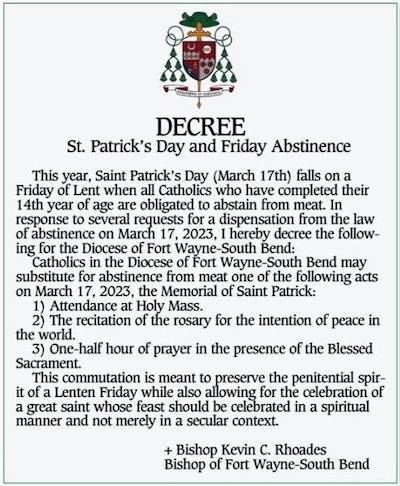
Today we remember Saint Patrick (387-493), the patron saint of Ireland. It is on the Emerald Isle that today is both a national and religious holiday. At one time, the bars would close and the churches would be full out of obligation. Only in recent years has the feast seen a more rebellious spirit, complete with parades and green beer (not to mention green hair). Naturally (if ironically), they have the Americans to thank for this.
And, since the feast usually takes place during Lent, there are times such as a couple of years ago, when some of us are permitted on a day of abstinence to indulge a wee bit more than others. But this year it's on a Tuesday, so it's all good craic.
+ + +
Growing up in a postwar Catholic environment, those of us who attended the parish schools in the United States, were taught that there were two kinds of people; those who were Irish, and those who wish they were. My own family appeared to fall into neither category. There were the Irish nuns who favored the Irish kids, including the unforgettable Sister Mary Mel (yes, her real name), who wasn't above calling some miscreant a "jackass" (including my kid brother, as evesdropping on a phone call with Mom gave away). But at least she was colorful. The rest of all things that were allegedly Irish were just so much blarney. I came to dismiss the whole notion of St Paddy's Day -- indeed, the whole notion of being Irish -- as a license for certain people to be more arrogant and obnoxious than they already were.
Eventually I went to college, where I discovered Irish music. I mean the real thing, not the over-romanticized "Christmas-in-Killarney-on-St-Patrick's-in-June" that passed itself off as genuine the whole time, and I couldn't get enough of it. I used to watch the Saint Patrick's Day parade in Cincinnati, which included the carrying of the statue of the Saint, which the local chapter of the Ancient Order of Hibernians would "steal" in the middle of night, from what was once the German parish in Mount Adams. (Long story.) There was also the local Irish dance school, with boys and girls who never imagined that, decades later, they could do it for fame and fortune in shows like "Riverdance."
Who knew?
By the end of the 1970s I spent Sunday evenings working at a coffeehouse, and I helped broker a deal that brought Clannad to Cincinnati on their first American tour. I even gave harpist/vocalist Máire Brennan (pronounced MOY-uh) a ride back to where she was staying. Otherwise shy and aloof, I got her to laugh at my jokes. That seemed to matter at the time.
I saw Máire again in 1987, in a music video on VH1, for a song entitled "Something to Believe In." She was also the haunting voice in the Volkswagen commercials. Naturally she's world-famous now, and probably wouldn't return my calls, although she did write me a long and possibly heartfelt note when she autographed my copy of their album. I say "possibly" because it was in Gaelic, so I'll never know for sure, especially since it was among my collection that was stolen from my apartment in Georgetown back in 1994. (Bob, if you're reading this, tell your rich white trash buddies that I'd really like to have it back. And before you get your boxers in a bunch, the neighbors all thought YOU did it!) Máire also came out with a book in 2001 entitled "The Other Side of the Rainbow." She continues to tour and so on, but I knew her when.
(Sigh ...) Anyway, back to the '70s. While the whole world (including my now-beloved Celia on the other side of it) was going bananas over disco, the feast became an annual ritual, of spending most of the accompanying weekend hanging out at Hap's Irish Pub in the Hyde Park section of Cincinnati, or at Arnold's Bar and Grill downtown. Even when I moved to Washington in 1980, I learned Irish dancing (if not quite what appears in the above video), Irish folk tales, and the like. But the upscale bars in the Nation's capital weren't as quaint as the neighborhood pubs in my old hometown. I was under no illusions that this heritage was one that I could claim for my own.
In 1982, that claim became even more elusive. I married a girl whose grandparents came over from Slovakia, and who grew up hearing Slovak around the house. This pretty much killed any enthusiasm for all things Irish around our house.
You see, I learned a piece of American Catholic history that the mostly Irish-American church historians back then didn't exactly wear on their sleeves.
By the time eastern Europeans came to America in the late 19th and early 20th century, the Irish were already the big fish in the little blue-collar pond, and didn't mind letting the "Hunkies" in the coal towns and factory neighborhoods know it. Going up the food chain, it got worse. Catholics of Eastern Rites -- with customs and liturgy similar to the Orthodox, but in communion with Rome -- had married priests. The mostly-Irish bishops assumed they were either schismatics, or worse. Their wives couldn't be treated in Catholic hospitals, and their children were barred from Catholic schools. Confused as these bishops were, they concluded that the faithful would be even more confused by the presence of married Catholic priests. Thus, by the 1920s, The (mostly Irish-)American bishops pressured Rome to bar the (legitimately) married priests from coming to America, let alone ministering.
It has been shown that most of the growth of Eastern Orthodoxy in North America can be attributed to the damned ignorance of the mitred Micks at the time. (Hey, guys, nice work!)
This latency towards all things Irish got a reprieve when the marriage tanked in 1992. Then one night -- it was about 1998, as I remember -- I was interviewed for a writing job by a priest who edited a major Catholic periodical. A native of Dublin, he reminded me of what really mattered:
“Patrick was not Irish, and on his Feast Day, we do not celebrate being Irish; we celebrate being Catholic.”
I knew that the Alexanders came from a small town near Verdun, in the Lorraine province of northeastern France. But in recent years we learned that, before the 18th century, the "Alexandre" line was expatriated from Scotland, the result of the rebellion when the Scottish nationalists who were followers of the French "Bonnie Prince Charles" were defeated. I was also to learn that the man known by the Roman name of Maganus Sucatus (Maewyn Succat in Gaelic) was of a Roman family, born in Kilpatrick, near Dumbarton, in that part of Great Britain that is now Scotland. Sooooo ... if not being Irish were not enough, Patricius (in modern English, Patrick) -- as he was known in later years, being of the Roman "patrician" class, and a "patriarch" to his spiritual charges -- might just as easily be claimed by the Scots as one of their own.
+ + +
For years, one highlight of the day was the Annual Irish Poetry Reading. That was when I'd call my folks in Ohio on this day every year, and with their speakerphone on, recite the following piece by Benjamin Hapgood Burt in my very bad Irish brogue:
One evening in October, when I was one-third sober,
An' taking home a "load" with manly pride;
My poor feet began to stutter, so I lay down in the gutter,
And a pig came up an' lay down by my side;
Then we sang "It's all fair weather when good fellows get together,"
Till a lady passing by was heard to say:
"You can tell a man who 'boozes' by the company he chooses"
And the pig got up and slowly walked away.
Since then, both have entered into eternity with better things to do.
+ + +
Today, those who are Irish, who wish they were, or who don't give a rat's arse either way, will dine on Irish lamb stew. When I can ever find it amidst my stuff, I use this occasion to wear a button with the words of William Butler Yeats: “I will arise and go now, and go to Innisfree.” (Yes, that's the poem above.) Usually, I listen to Celtic music the entire day, and at an opportune time and place, I dine on corned beef and cabbage, an admittedly an American innovation for the Irish, as poor immigrants from the "auld sod" found corned beef (a substitute used by their Jewish neighbors in place of bacon) to be much cheaper than lamb.
Then about ten years ago, I got lucky, because right down the street from me, they opened an Irish pub. It seems that three Thai restaurants within a half mile of each other was one too many, and the one closest to me was replaced with the watering hole of my dreams. The Celtic House is situated on the corner of Columbia Pike and South Barton Street, right at the end of the latter street, which would be my street, a mere ten-minute walk away.
Earlier today, my beloved and I dined there amidst the usual record crowd, as if my fond memories of discovering real Irish culture have come full circle. True, it's not as small and crowded as Hap's in Hyde Park, not nearly as weather-beaten as Arnold's downtown, and they won't be selling raffle tickets for NORAID under the table, but I can ignore that long enough to enjoy a lamb stew, or a rueben sandwich with sauerkraut, if I'm in the mood.
I'll also probably watch Mel Gibson in Braveheart later tonight, while enjoying a Guinness float (which is like a root beer float, with the obvious exception). Who cares if William Wallace was Scottish? No one cares if Patrick isn't Irish, do they? After all, "The Apostle of Ireland" is properly claimed by Catholics everywhere, whether a bunch of Micks care to admit it or not.
Today the Church celebrates the feast of Saint Patrick (387-493), the patron saint of Ireland. It is on the Emerald Isle that today is both a national and religious holiday. At one time, the bars would close and the churches would be full out of obligation. Only in recent years has the feast seen a more rebellious spirit, complete with parades and green beer (not to mention green hair). Naturally (if ironically), they have the Americans to thank for this.
And, since the feast usually takes place during Lent, there are times such as shown above, when some of us are permitted on a day of abstinence to indulge a wee bit more than others.
+ + +
Growing up in a postwar Catholic environment, those of us who attended the parish schools in the United States, were taught that there were two kinds of people; those who were Irish, and those who wish they were. My own family appeared to fall into neither category. There were the Irish nuns who favored the Irish kids, including the unforgettable Sister Mary Mel (yes, her real name), who wasn't above calling some miscreant a "jackass" (including my kid brother, as evesdropping on a phone call with Mom gave away).
But hey, at least she was colorful.
The rest of all things that were allegedly Irish were just so much blarney. I came to dismiss the whole notion of St Paddy's Day -- indeed, the whole notion of being Irish -- as a license for certain people to be more arrogant and obnoxious than they already were.
Eventually I went to college, where I discovered Irish music. I mean the real thing, not the over-romanticized "Christmas-in-Killarney-on-St-Patrick's-in-June" that passed itself off as genuine the whole time, and I couldn't get enough of it. I used to watch the Saint Patrick's Day parade in Cincinnati, which included the carrying of the statue of the Saint, which the local chapter of the Ancient Order of Hibernians would "steal" in the middle of night, from what was once the German parish in Mount Adams. (Long story.) There was also the local Irish dance school, with boys and girls who never imagined that, decades later, they could do it for fame and fortune in shows like "Riverdance."
Who knew?
By the end of the 1970s I spent Sunday evenings working at a coffeehouse, and I helped broker a deal that brought Clannad to Cincinnati on their first American tour. I even gave harpist/vocalist Máire Brennan (pronounced MOY-uh) a ride back to where she was staying. Otherwise shy and aloof, I got her to laugh at my jokes. That seemed to matter at the time.
I saw Máire again in 1987, in a music video on VH1, for a song entitled "Something to Believe In." She was also the haunting voice in the Volkswagen commercials. Naturally she's world-famous now, and probably wouldn't return my calls, although she did write me a long and possibly heartfelt note when she autographed my copy of their album. I say "possibly" because it was in Gaelic, so I'll never know for sure, especially since it was among my collection that was stolen from my apartment in Georgetown back in 1994.
(Bob, if you're reading this, tell your rich white trash buddies that I'd really like to have it back. And before you get your boxers in a bunch, the neighbors all thought YOU did it!)
Máire also came out with a book in 2001 entitled "The Other Side of the Rainbow." She continues to tour and so on, but I knew her when.
(Sigh ...) Anyway, back to the '70s.
While the whole world (including my now-beloved Celia on the other side of it) was going bananas over disco, the feast became an annual ritual, of spending most of the accompanying weekend hanging out at Hap's Irish Pub in the Hyde Park section of Cincinnati, or at Arnold's Bar and Grill downtown. Even when I moved to Washington in 1980, I learned Irish dancing (if not quite what appears in the above video), Irish folk tales, and the like. But the upscale bars in the Nation's capital weren't as quaint as the neighborhood pubs in my old hometown. I was under no illusions that this heritage was one that I could claim for my own.
In 1982, that claim became even more elusive. I married a girl whose grandparents came over from Slovakia, and who grew up hearing Slovak around the house. This pretty much killed any enthusiasm for all things Irish around our house.
You see, I learned a piece of American Catholic history that the mostly Irish-American church historians didn't exactly wear on their sleeves.
By the time eastern Europeans came to America in the late 19th and early 20th century, the Irish were already the big fish in the little blue-collar pond, and didn't mind letting the "Hunkies" in the coal towns and factory neighborhoods know it. Going up the food chain, it got worse. Catholics of Eastern Rites -- with customs and liturgy similar to the Orthodox, but in communion with Rome -- had married priests. The mostly-Irish bishops assumed they were either schismatics, or worse. Their wives were barred from treatment in Catholic hospitals, and their children were barred from Catholic schools. Confused as these bishops were, they concluded that the faithful would be even more confused by the presence of married Catholic priests. Thus, by the 1920s, The (Irish-)American bishops pressured Rome to bar the (legitimately) married priests from coming to America, let alone ministering.
It has been shown that most of the growth of Eastern Orthodoxy in North America can be attributed to the damned ignorance of the (Irish-)American bishops of the time. (Hey, Mickey, nice work!)
This latency towards all things Irish got a reprieve when the marriage tanked in 1992. Then one night -- it was about 1998, as I remember -- I was interviewed for a writing job by a priest who edited a major Catholic periodical. A native of Dublin, he reminded me of what really mattered:
“Patrick was not Irish, and on his Feast Day, we do not celebrate being Irish; we celebrate being Catholic.”
I knew that the Alexanders came from a small town near Verdun, in the Lorraine province of northeastern France. But in recent years we learned that, before the 18th century, the Alexandre line was expatriated from Scotland, a result of the Rebellion when England overtook them. I was also to learn that the man known by the Roman name of Maganus Sucatus (Maewyn Succat in Gaelic) was of a Roman family, born in Kilpatrick, near Dumbarton, in that part of Great Britain that is now Scotland.
Sooooo ... if not being Irish were not enough, Patricius (in modern English, Patrick) -- as he was known in later years, being of the Roman "patrician" class, and a "patriarch" to his spiritual charges -- might just as easily be claimed by the Scots as one of their own.
For years, one highlight of the day would be the Annual Irish Poetry Reading. That was when I'd call my folks in Ohio on this day every year, and with their speakerphone on, recite the following piece by Benjamin Hapgood Burt in a very bad Irish brogue:
One evening in October, when I was one-third sober,
An' taking home a "load" with manly pride;
My poor feet began to stutter, so I lay down in the gutter,
And a pig came up an' lay down by my side;
Then we sang "It's all fair weather when good fellows get together,"
Till a lady passing by was heard to say:
"You can tell a man who 'boozes' by the company he chooses"
And the pig got up and slowly walked away.
Since then, both have entered into eternity, most likely with better things to do.
Today, those who are Irish, who wish they were, or who don't give a rat's arse either way, will dine on Irish lamb stew. When I can ever find it amidst my stuff, I use this occasion to wear a button with the words of William Butler Yeats: “I will arise and go now, and go to Innisfree.” Usually, I listen to Celtic music the entire day, and at an opportune time and place, I dine on corned beef and cabbage. This is admittedly an American innovation for the Irish, as poor immigrants from the "auld sod" found corned beef (a substitute used by their Jewish neighbors in place of bacon) to be much cheaper than lamb.
Then about eight or nine years ago, I got lucky, because right down the street from me, they opened an Irish pub. It seems that three Thai restaurants within a half mile of each other was one too many, and the one closest to me was replaced with the watering hole of my dreams. The Celtic House is situated on the corner of Columbia Pike and South Barton Street, right on the corner, a mere five-or-ten-minute walk away from my home on South Barton. Sometime today I'm making a point of being there, as if my fond memories of discovering real Irish culture have come full circle. True, it's not as small and crowded as Hap's Irish Pub in Hyde Park, not nearly as weather-beaten as Arnold's downtown, and they won't be selling raffle tickets for NORAID under the table, but I can ignore that long enough to enjoy a lamb stew.
I'll also probably watch Mel Gibson in Braveheart later tonight, while enjoying a Guinness float (which is like a root beer float, except you have Guinness, right?). Who cares if William Wallace was Scottish? No one cares if Patrick isn't Irish, do they? After all, "The Apostle of Ireland" is properly claimed by Catholics everywhere, whether a bunch of Micks care to admit it or not.
“When the days were completed for their purification according to the law of Moses, Mary and Joseph took Jesus up to Jerusalem to present him to the Lord, just as it is written in the law of the Lord, Every male that opens the womb shall be consecrated to the Lord, and to offer the sacrifice of a pair of turtledoves or two young pigeons, in accordance with the dictate in the law of the Lord.” (Luke 2:22-24)
Today, both the Eastern and Western churches observe the Feast of the Purification of the Blessed Virgin Mary (known as "Candlemas" in the West), and traditionally cited as the fortieth day of Christmas. (Yes, I counted them the other day, and with Christmas itself as Day 1, this is Day 40.) In the Catholic tradition, the Christmas Cycle officially ends with this day, and preparation for Lent can begin, which includes the "Carnival" season in much of South America. But today, and throughout the world, the faithful will process in and around their churches bearing lighted candles, which are blessed for the coming year.
It's on a Sunday, which should make it easier, don't you think?
Or don't you?
+ + +
The origin of this feast is described in detail, in this excerpt from the classic work of Dom Prosper Guéranger, OSB, entitled The Liturgical Year.
The mystery of today's ceremony has frequently been explained by liturgists, dating from the 7th century. According to Ivo of Chartres, the wax, which is formed from the juice of flowers by the bee, always considered as the emblem of virginity, signifies the virginal flesh of the Divine Infant, who diminished not, either by His conception or His birth, the spotless purity of His Blessed Mother. The same holy bishop would have us see, in the flame of our Candle, a symbol of Jesus who came to enlighten our darkness. St Anselm, Archbishop of Canterbury, speaking on the same mystery, bids us consider three things in the blessed Candle: the wax, the wick, and the flame. The wax, he says, which is the production of the virginal bee, is the Flesh of our Lord; the wick, which is within, is His Soul; the flame, which burns on top, is His divinity.
In Catholic Europe, especially in Germany where the practice originated, this feat of prediction was ascribed to German badgers. But since badgers are not found in the eastern United States, German immigrants to this country were obliged to depend for meteorological guidance on a species of marmot called by the Indians "weejak" or woodchuck, also known as ... a groundhog. This year's formality is depicted here, courtesy of WKYC Channel 3.
After all, he sort of looks like a badger, right? And he even sticks his head out to check the weather.
Today begins the lunar new year in China -- to be more exact, “The Year of the Snake.” The title for this entry is what they are saying in the Philippines (where the occasion is known as "Bagong Taong Tsino"), as well as in any country with a large Chinese population, not to mention Chinatowns all over the world.
+ + +
My beloved Celia is one-eighth Cantonese, and so the above title is the traditional greeting in that language, as opposed to the more common Mandarin, so the former is the one I'd hear around the house, as opposed to the latter. Meanwhile, learn more than you could possibly want to know about the occasion on Wikipedia.
I took my son Paul to his first "dragon festival" in DC's Chinatown back in 1987. He was one and a half years old, and fit right in with his bright red snowsuit. Such would be the culmination of a fifteen-day celebration that begins today (or yesterday, depending on your side of the planet).
Oh, and there's one more thing.
The video clip at the top was taken at the National Building Museum back in 2007 with a phone camera. That was the Year of the Pig, but at least a dragon showed up. Obviously camera phones have come a long way since then, don't you think?
The next day, John saw Jesus coming to him, and he saith: Behold the Lamb of God, behold Him Who taketh away the sin of the world. This is He, of whom I said: After me there cometh a man, who is preferred before me: because He was before me. And I knew Him not, but that He may be made manifest in Israel, therefore am I come baptizing with water.
And John gave testimony, saying: I saw the Spirit coming down, as a dove from heaven, and He remained upon him. And I knew Him not; but He Who sent me to baptize with water, said to me: He upon Whom thou shalt see the Spirit descending, and remaining upon Him, He it is that baptizeth with the Holy Ghost. And I saw, and I gave testimony, that this is the Son of God. (John 1:29-34)
Given the significance of this "twentieth day," it seemed only appropriate that there be a hymn devoted to John baptizing in the Jordan, one designed to highlight the occasion specifically in the context of Christmastide. Alas, none could be found.
So, using the familiar tune "St Flavian," I wrote one. (Somebody cue the organ in the video already.)
Lord, halfway through these forty days,
Unto the Jordan came.
There, John the Baptist saw His light,
And called Him out by name.
"This is the One, the Lamb of God,
Who takes our sins away."
And then did water pour on Him
To hear the Father say.
"Behold, hear my beloved Son,
In whom I am well pleased."
And Andrew when he heard of this,
Upon the moment seized.
"Oh Master, say where dost thou dwell,
That I may follow thee."
Our blessed Lord then did reply
To Andrew: "Come and see."
Praise to the Father and the Son
And to the Spirit be,
As all three Persons are as One,
Unto the Trinity.
Copyright 2024 by David Lawrence Alexander. All rights reserved.
Today is the traditional start of the agricultural year in England, and so is known as Plough Monday, or, the day after Plough Sunday (you remember from yesterday, right?) which is the Sunday following the traditional observance of Epiphany on the sixth of January. This was the Monday when everyone would end the Christmas revelry and get back to work.
In his 1777 book Observations on Popular Antiquities, the English antiquarian and clergyman John Brand (1744–1806) gives an account of the formalities:
The FOOL PLOUGH goes about: a pageant consisting of a number of sword dancers dragging a plough, with music; one, sometimes two, in very strange attire; the Bessy, in the grotesque habit of an old woman, and the Fool, almost covered with skins, a hairy cap on, and the tail of some animal hanging from his back. The office of one of these characters, in which he is very assiduous, is to go about rattling a box amongst the spectators of the dance, in which he receives their little donations.
Well, okay, maybe not directly ending and getting back to work. Personally, I'd rather be molly dancing.
What is that, you ask?
VIDEO: A 2016 performance of "Black Sheet" by the Ouse Washes Molly Dancers. Following a bit of narrative, the dancing actually starts at 2:07.
“Molly dancing” traditionally only appeared during the depths of winter and is regarded by many people as the East Anglian form of Morris dancing. It is characterized by blackened faces, heavy boots (usually hobnailed) and the presence of a "Lord" and a "Lady", two of the men specially attired respectively as a gentleman and his consort, who lead the dances. Blackening faces was a form of disguise since the dancers could not afford to be recognized. (No, not for that other reason. Remain calm.) Some of those people from whom they had demanded money with menaces would have been their employers. Molly dancing is by nature robust and, some would say, aggressive. These qualities are emphasized by the sound of the hobnailed boots worn by the dancers, which were the normal form of footwear for farm workers in the East of England right up until the second half of the twentieth century. (Information courtesy of Alex Sanders.)
“On the fourth day of Christmas, my true love gave to me, four calling birds ...”
No, you didn’t time travel back to the 2014 Christmas Price Index. The Four Calling Birds just haven’t changed prices since then (still 0.0 percent, at $599.96). While remaining the same for ten years can be boring, in this case it makes for reliable planning in True Love’s budget.
+ + +
Actually, they would have been referred to as "colly birds," meaning a form of blackbird. This is one of a number of lines that had become corrupted over the centuries. But enough about the song. Today is the Feast of the Holy Innocents, the infant males in Bethlehem under the age of two years, that King Herod had put to death, in the hopes of doing away with the newborn King, which he saw as a threat to his power (Matthew 2:16-18).
In this 1611 painting by Guido Reni, we see the depiction of that which fulfilled the prophecy: “A voice is heard in Ramah, mourning and great weeping, Rachel weeping for her children and refusing to be comforted, because her children are no more.” (Jeremiah 31:15)
Some historians have debated whether the incident actually occurred, as the ancient historian Josephus fails to mention it, but the consensus of biblical scholars will attest to its authenticity. Tradition has placed the death toll at fourteen thousand, most likely an allusion to the many atrocities committed by Herod, including the killing of his own son. However, given that the "little town of Bethlehem" had a population of only about one thousand at the time, the estimated number of victims has been more realistically placed at around twenty.
In Spanish-speaking countries (including, uh, Spain), as well as former colonies such as the Philippines, this is traditionally a day given to playing practical jokes, much like April Fools' Day elsewhere. The pranks are known as "inocentadas" and either the pranksters or their victims are referred to as "inocentes."
I suppose it depends on which ones you ask.
+ + +
It is also a day of remembrance for yours truly, as an entry scheduled for later today will attest. Stay tuned ...
“On the third day of Christmas, my true love gave to me, three French hens ...”
It’s another modest increase for the French Hens in 2024. They rose in price by 5 percent this year, to $346.50, but they’re still the second least expensive gift in the index, making them a brilliant bargain!
+ + +
“The disciple whom Jesus loved” (“ο μαθητης ον ηγαπα ο Ιησους”) was, for a time, banished under Emperor Domition to the island of Patmos in the Aegean Sea. This was before returning to Ephesus to remain for the rest of his days. John was the only one of the Twelve to die a natural death. Tradition says he lived to be nearly one hundred years old, yet it was not for want of his enemies trying. Upon an attempt to kill John by poisoning his wine, the evil substance miraculously took the form of a serpent, as it dissipated from his cup.
Here he is in a circa 1610 painting by El Greco with a look that says:
“Dude, seriously? This is the best you can do?”
Today, families can celebrate the Feast of Saint John by drinking to the health of each other, following a German tradition known as Johannissegen. Fisheaters has a recipe for mulled wine that is customary to the occasion. Before the evening meal begins, the head of the house recites the blessing over the wine, as recorded in the Rituale Romanum:
Lord Jesus Christ, Thou didst call Thyself the vine and Thy holy Apostles the branches; and out of all those who love Thee, Thou didst desire to make a good vineyard. Bless this wine and pour into it the might of Thy benediction so that everyone who drinks or takes of it, may through the intercession of Thy beloved disciple, the holy Apostle and Evangelist John, be freed from every disease or attack of illness and obtain health of body and soul. Who livest and reignest forever. (Amen.)
He then lifts his glass toward the next person (or touches the rim of his glass to theirs), saying, “I drink you the love of Saint John.” The receiver says in response, “I thank you for the love of Saint John.” The second person turns to the third, and the process is repeated all around the table. That's the long form.
The short form is where all present clink their glasses together saying, “Drink the love of Saint John.” This is especially handy for young children who cannot wait to chow down.
"On the second day of Christmas, my true love gave to me, two turtle doves ..."
After a hefty price increase in 2023, the turtledoves are taking a break from sticker-shock this year. Their $750.00 cost reflects their rarity.
+ + +
Every year, I love to show a video of the á capella group Straight No Chaser singing their own unique version of "The Twelve Days of Christmas." This year (just when you thought I couldn't come up with anything else) they gave us a refresh.
Today still feels a little like Christmas, only the stores are open, bustling continued consumer spending in spite of everything. I know, some people may think that's a concession to the over-commercialization of the holiday, but as we mentioned before, it's better than pretending it's anything other than Christmas.
Today is “Boxing Day” in Canada, the UK, and other nations of the present and former British Empire. Traditionally, Christmas Day was when the master of the house would give presents to his family. On the following day, he would arrange for leftovers from his great feast to be given to his domestic staff, in boxes that they could take home. Eventually, it became customary to box other gifts as well.
Whatever works.
Meanwhile, the Irish celebrate this as a national holiday, too, only as Saint Stephen's Day, honoring one of the seven deacons appointed in the Book of Acts, to assist the apostles in their ministry. He was stoned to death by the Jews -- no, not all of the Jews, just some of them, and all of those guys were Jews, alright already??? -- and so is known in the Churches of the East as the "Protomartyr," as he was the first recorded to die for the Faith. And let's not forget that "Good King Welceslas" of Bohemia went out on the feast of Stephen, when the snow lay on ground, yada yada yada ...
It is also when Irish children would go from house to house, begging pennies to bury the wren, a tiny little bird whose size and scale for burial is exaggerated for the occasion, as demonstrated in the above video of "The Cutty Wren" by Nowell Sing We Clear.
“On the first day of Christmas, my true love gave to me, a partridge in a pear tree.”
The Partridge in a Pear Tree climbed 16 percent in 2024, to $370.18, this year’s biggest percentage jump in price. The bird costs the same, but the tree is rooting itself deeper in True Love’s wallet this year.
+ + +
The period known as Christmastide begins with the Feast of the Nativity itself; specifically, with the evening of this first day, and into the dawn of the Feast of the Epiphany. And so the first day of Christmastide is 25-26 December, ending with Twelfth Night on 5-6 January.
By tomorrow, you will stop hearing Christmas music on some radio stations, but here at Chez Alexandre, whether here or on the road, as well as here at man with black hat, the Christmas season is just beginning. Most of us are familiar with the song "The Twelve Days of Christmas" and the significance of the symbolism therein. But for those who are not ...
Twelve Drummers Drumming refers to the twelve points of doctrine in the Apostle's Creed
Eleven Pipers Piping refers to the eleven faithful apostles
Ten Lords A-leaping refers to the ten commandments
Nine Ladies Dancing refers to the nine Fruits of the Holy Spirit
Eight Maids A-milking refers to the eight beatitudes
Seven Swans A-swimming refers to the seven gifts of the Holy Spirit, and/or the seven sacraments
Six Geese A-laying refers to the six days of creation
Five Golden Rings refers to the first Five Books of the Old Testament, the "Pentateuch", which gives the history of man's fall from grace.
Four Calling Birds refers to the Four Gospels and/or the Four Evangelists.
Three French Hens refers to Faith, Hope and Charity, the Theological Virtues.
Two Turtle Doves refers to the Old and New Testaments.
One Partridge in a Pear Tree refers to Christ on Earth being crucified upon a tree.
True Love refers to God, who sent his only son to us.
[NOTA BENE: The use of this song as a "secret catechism" for children, employed by Catholics persecuted in post-Reformation England, is a matter of some dispute, as pointed out in this article from Snopes.com. Leave it to them to bring the party down, especially when they're actually wrong some of the time.]
+ + +
Now then (and this should be a treat for those of you new to us), we present the continuation of a venerable man with black hat tradition.
For over forty years, PNC Bank, one of the largest financial institutions in the United States, has calculated the prices of the twelve gifts from the classic carol “The Twelve Days of Christmas.” The result is the PNC Christmas Price Index, originally the brainchild of Jim Dunigan, the former managing executive of investments with PNC Wealth Management. The result is a unique and whimsical holiday tradition that makes learning about the economy fun.
For many years, Mr Dunigan himself presented the complete rundown of the cost of the entire entourage on video. Closer to the present, we have this report from WITF-FM, public radio for central Pennsylvania.
Even with its small basket of goods and services, the PNC Christmas Price Index is not immune to the rising costs in the broader U.S. economy, as measured by the Bureau of Labor Statistics’ Consumer Price Index, at $49,263.47, or plus 5.4 percent.
In the years following his departure, Mr Dunigan's legacy presses on.
Meanwhile, from all of us at Chez Alexandre, we wish you "Maligayang Pasko at Makabagong Bagong Taon!"
You get the idea. Now, dear minions, go forth and spread joy!
(The illustrations for the PNC Christmas Price Index are from the website of PNC Bank, NA, and are used here without permission or shame. It's the least they can do for charging me twenty-five bucks a month to earn interest off my own damn money.)
VIDEO: The art of making a parol is demonstrated on Filipino-American television based in California (in Tagalog, mostly). A brief documentary follows beginning at 01:38 (in English, mostly).
In a nation where eighty percent of the population is Catholic, Christmas starts early. It has to. After all, you cannot have a feast like Christmas without it being preceded by a novena. That's when you get up to attend Mass just before dawn for nine days before the big day. In the Philippines, it is known as “Simbang Gabi” which is Tagalog for “evening Mass.” It is also known as “Misa de Gallo” which is Spanish for “Rooster’s Mass.”
So why is this series of Masses held in the morning and not the evening, as is customary with Masses for a Christmas novena?
+ + +
The answer can be traced to the early colonial days, when the people would be exhausted from working in the fields all day for their Spanish overlords. The priests and friars who tended to their spiritual needs availed themselves of the people's desire to start the day early, ahead of the tropical heat, and moved the customary Mass and devotion to the early morning, before dawn.
In recent years, the Archdiocese of Manila saw fit to introduce liturgical norms for this novena, in the form of celebrating Simbang Gabi in the evenings. At first this was due to the limitations imposed by curfews during the years of martial law under President Marcos. It has presently accommodated office professionals who can more easily attend after work than before.
+ + +
The popular decoration for Christmas in the Philippines is the “parol” (pronounced “pah-ROLL” with a rolling "r", from the Spanish word for lantern, "farol"), which is as common there as the Christmas tree is here in the States. This star-shaped motif is a cross between a Chinese lantern and the Mexican piñata. It is lit from within; traditionally with candlelights mounted inside, but in the last century with electric lights. They are typically two to three feet wide, but if you go to such renowned events as the Fiesta in San Fernando, Pampanga (north of Metro Manila), there is a huge parade to celebrate the beginning -- no, not of Christmas Day, but of the novena!
Closer to home, at Chez Alexandre, there is a very colorful parol gracing the front door, one that Celia brought back from the Philippines. It is of the modern variety, made with wire and a type of seashell known as capiz, and illuminated with elaborate flashing lights.
+ + +
Now, back to that novena thing.
We here at man with black hat have an annual tradition of honoring the “O Antiphons” the seven chants which introduce the Vesperal Canticle (the “Magnificat”) in the Divine Office. Most people hear paraphrases of them in the hymn "O Come O Come Emmanuel," but they were originally chanted one verse a day, ending with the day before the Vigil. Over time, our annual feature has evolved into its present form, as a comprehensive aid to daily devotion. The video clips for this unique series are from the Church of the Advent (Western Rite Orthodox) of Atlanta, Georgia.
As an added bonus, we will provide links for each Antiphon to Father John Zuhlsdorf's famous commentaries on the same (without permission or shame; nah, he doesn't care), the link for which will be indicated by the letter “Z” at the bottom of each entry.
They will publish at one in the morning, eastern USA time, beginning tomorrow. Stay tuned.
+ + +
"O Shepherd, You Who rule over Israel, hear us; You Who lead Joseph like a sheep: come to guide and comfort us."
There are a number of saints who are commemorated in December (other than Saint Nicholas). Whether by the accident of tradition, or by design, some of them have been awarded with a connection to the Christmastide celebration -- keeping in mind that this happens during the ostensibly sackcloth-and-ashes season known as Advent.
Saint Lucy (283–304) received the crown of martyrdom during the Diocletian persecution. She is one of seven women aside from the Virgin Mary who appears in the Roman Canon. Her name is from the Latin word for "light," and she is remembered on the 13th day of December, the night before which was the longest of the year in the unreformed Julian calendar. As a result, various Germanic pagan feasts associated with the passing of darkness into light were appropriated by Christendom, and sanctified by this commemoration.
Natten går tunga fjät
Night walks with a heavy step rund gård och stuva;
Round yard and hearth, kring jord, som sol förlät,
As the sun departs from earth, skuggorna ruva.
Shadows are brooding. Då i vårt mörka hus,
There in our dark house, stiger med tända ljus,
Walking with lit candles, Sankta Lucia, Sankta Lucia!
Santa Lucia, Santa Lucia! Då i vårt mörka hus,
There in our dark house, stiger med tända ljus,
Walking with lit candles, Sankta Lucia, Sankta Lucia!
Santa Lucia, Santa Lucia!
Saint Lucy is one of the few saints honored in the Lutheran tradition, and the eve of her feast is celebrated throughout Scandanavia, with a procession of young maids bearing candles, led by a chosen one with a lighted wreath on her head (as shown in the first video). The carol Santa Lucia, sung by the girls in procession, was an old Neapolitan melody of the same name. The lyrics in Italian are the song of the boatmen of the waterfront district in Naples. The various Nordic languages (Swedish is featured here) sing of the light that overcomes the darkness.
The second video elaborates. The third video is "the full monty," for when you have a half hour to kill.
+ + +
FOOTNOTE: In a few days, we begin the prayers and songs and stories of the Novena for the Christ-Mass, and continue after the solemnity with the commemoration of the Twelve Days, culminating in the Visit of the Three Kings, and the blessing of the doors to your homes. Please join us as we remember the fast, and celebrate the feast, as we all proclaim as one: "GOD IS WITH US, EMMANUEL!"
I am generally not partial to images of the Blessed Mother without her visibly holding the Christ Child. This has long struck me as edging toward a sort of Catholic goddess-worship -- Mariolatry, if you will.
(NOTE: The aforementioned is a personal opinion, not to be construed as having been rendered with the certainty of the theological virtue of faith. Remain calm.)
But I make one exception, and that's the image used to commemorate today's Feast, that of Our Lady of Guadalupe, Patroness of the Americas.
Contrary to what some imaginary theologian disguised as a pastoral associate ever told your children in CCD or Catholic school, the customs of the indigenous peoples in Central and South America were not suppressed by their Catholic conquerors. Indeed, the natives were all too happy to have been relieved of being victims of human sacrifices, where their hearts were cut out while they were still alive, so much so as to have participated in what may have been the largest single mass conversion in Christendom.
Furthermore, and on a lighter note, when Juan Diego opened his cloak for the bishop, and the venerable image appeared, the roses hidden in the cloak came falling out. But that's not the whole story of the miracle. Years earlier, seeing that Cortez's successors were not nearly as benevolent as he, the bishop found himself powerless to enact reforms, and appealed to Our Lady for a sign of her intercession, in the form of roses from his Spanish home province of Castile. And so, the bishop recognized the roses as a breed only found in ... you guessed it, he got the message.
Mind you, this was in the days before overnight delivery.
The Chieftains and Los Lobos perform "Guadalupe" at the Olympia Theatre, Dublin, Ireland.
Father William Saunders of the Diocese of Arlington has given a fuller account of the real deal in the Arlington Catholic Herald. I don't have the link, or the date of the piece, but I managed to preserve a few extracts:
The Aztec religious practices, which included human sacrifice, play an interesting and integral role in this story. Every major Aztec city had a temple pyramid, about 100 feet high, on top of which was erected an altar. Upon this altar, the Aztec priests offered human sacrifice to their god Huitzilopochtli, called the "Lover of Hearts and Drinker of Blood," by cutting out the beating hearts of their victims, usually adult men but often children. The priests held the beating hearts high for all to see, drank the blood, kicked the lifeless bodies down the pyramid stairs, and later severed the limbs and ate the flesh. Considering that the Aztecs controlled 371 towns and the law required 1,000 human sacrifices for each town with a temple pyramid, over 50,000 human beings were sacrificed each year. Moreover, the early Mexican historian Ixtlilxochitl estimated that one out of every five children fell victim to this bloodthirsty religion.
In 1487, when Juan Diego was just 13 years old, he would have witnessed the most horrible event: Tlacaellel, the 89-year-old Aztec ruler, dedicated the new temple pyramid of the sun, dedicated to the two chief gods of the Aztec pantheon — Huitzilopochtli and Tezcatlipoca, (the god of hell and darkness) — in the center of Tenochtitlan (later Mexico City). The temple pyramid was 100 feet high with 114 steps to reach the top. More than 80,000 men were sacrificed over a period of four days and four nights. One can only imagine the flow of blood and the piles of bodies from this dedication ...
Nevertheless, in 1520, Hernan Cortes outlawed human sacrifice ...
When you look at it that way, giving up meat on Fridays doesn't seem so bad. Even so, the aforementioned process only took about fifteen seconds for each victim -- less time than your average abortion. (If you have to think about the connection, I can't help you.)
And then there are those feminist-theology types who try to see a "goddess" image in the Virgin Mary. They're outa luck there too:
These are also symbols of divine victory over the pagan religion. Sun rays were symbolic of the Aztec god Huitzilopochtle. Therefore, our Blessed Mother, standing before the rays, shows that she proclaims the true God who is greater than Huitzilopochtle and who eclipses his power.
She stands also on the moon. The moon represented night and darkness, and was associated with the god Tezcatlipoca. Here again, the Blessed Mother’s standing on the moon indicates divine triumph over evil.
Note also, that in her dominance over false idols, Our Lady stands in a submissive posture, with head bowed and hands folded, as if to render tribute to an even Higher Power.
+ + +
FOOTNOTE: That commercial opportunists from Spain might have taken undue advantage of a massive cheap labor pool is not in dispute here. Nor is it unique to human history, never mind to Europeans. What it is, rather, is another story for another day ...
 Today, the western Church celebrates the Feast of Our Lady of Mount Carmel. It is one of the most popular feasts in honor of the Blessed Mother, if only for its association with the Brown Scapular.
 Of course, this does not make the Brown Scapular some sort of magic talisman, which would amount to superstition, and thus objectively sinful in practice. The "Sabbatine Privilege" associated with wearing the Brown Scapular requires that the person: 1) Wear the Brown Scapular continuously, 2) Observe chastity according to one’s state in life (married/single/whatever), 3) Recite daily the Little Office of the Blessed Virgin, OR observe the fasts of the Church together with abstaining from meat on Wednesdays and Saturdays, OR with permission of a priest, say five decades of Our Lady’s Most Holy Rosary OR With permission of a priest, substitute some other good work.
 Also popular (and arguably more common) is the wearing of the "scapular medal." This is a small medal worn in lieu of the Brown Scapular, although not really a replacement. The minimum requirements, laid down by Pope Saint Pius X in 1910, is that the medal must "show the image of Our Most Holy Redeemer, Jesus Christ, showing His Sacred Heart, and the obverse that of the Most Blessed Virgin Mary." Most of them have a rather common appearance, but yours truly once found a remarkably uncommon choice on eBay.
 The devotion remains popular today, as a new generation of Catholics discover tradition. One can spot a Catholic "kickin' it old skool" from across a crowded room, bearing the telltale sign around their neck that peers out from underneath the neckline of their clothing. More information about the Brown Scapular, the devotion attached to it, and the ceremony for its reception (which is how yours truly got his as a fourth grader in the spring of 1965) can be found here.
 Meanwhile, elsewhere in the Catholic world, we remember Saint Marie-Madeleine (baptismal name Julie) Postel, born in France in 1756. Entering into religious life under Franciscan rule, she went on to found the Sisters of Christian Schools. During the French Revolution and the subsequent Reign of Terror, not only did she hide fugative priests at the risk of her own life, but was charged with carrying the Holy Eucharist to others in hiding at the direction of her bishop. Such measures have long been common during times of persecution, and was the original intention of Extraordinary Ministers of Holy Communion, as opposed to ... well, you know.