Showing posts with label family history. Show all posts

Tuesday, March 17, 2026

My Annual Über-Celtic Moment

Today we remember Saint Patrick (387-493), the patron saint of Ireland. It is on the Emerald Isle that today is both a national and religious holiday. At one time, the bars would close and the churches would be full out of obligation. Only in recent years has the feast seen a more rebellious spirit, complete with parades and green beer (not to mention green hair). Naturally (if ironically), they have the Americans to thank for this.

And, since the feast usually takes place during Lent, there are times such as a couple of years ago, when some of us are permitted on a day of abstinence to indulge a wee bit more than others. But this year it's on a Tuesday, so it's all good craic.

+    +    +

Growing up in a postwar Catholic environment, those of us who attended the parish schools in the United States, were taught that there were two kinds of people; those who were Irish, and those who wish they were. My own family appeared to fall into neither category. There were the Irish nuns who favored the Irish kids, including the unforgettable Sister Mary Mel (yes, her real name), who wasn't above calling some miscreant a "jackass" (including my kid brother, as evesdropping on a phone call with Mom gave away). But at least she was colorful. The rest of all things that were allegedly Irish were just so much blarney. I came to dismiss the whole notion of St Paddy's Day -- indeed, the whole notion of being Irish -- as a license for certain people to be more arrogant and obnoxious than they already were.

"Hail glorious Saint Patrick dear saint of our isle
On us thy poor children look down with a smile —"
But I'm not singing hymns and I'm not saying prayers
No, I'm gritting my teeth as I walk down the stairs

And into the street with these louts fiercely drinking
And screeching and lurching, and here's what I'm thinking —
They're using a stereotype, a narrow example,
A fraction, not even a marketing sample

To imitate Ireland, from which they don't come!
So unless that's just stupid, unless it's plain dumb,
All these kids from New Jersey and the five boroughs
And hundreds of cities, all drowning their sorrows,

With bottles and glasses and heads getting broken
(Believe me, just ask the mayor of Hoboken)
All that mindlessness, shouting and getting plain stocious —
That isn't Irish, that's simply atrocious.

I've another word too for it, this one's more stinging
I call it "racism." See, just 'cause you're singing
Some drunken old ballad on Saint Patrick's Day
Does that make you Irish? Oh, no — no way.

Nor does a tee-shirt that asks you to kiss them —
If they never come back I surely won't miss them
Or their beer cans and badges and wild maudlin bawling
And hammered and out of it, bodies all sprawling.

They're not of Joyce or of Yeats, Wilde, or Shaw.
How many Nobel Laureates does Dublin have? Four!
Think of this as you wince through Saint Patrick's guano.
Not every Italian is Tony Soprano.

+    +    +

Eventually I went to college, where I discovered Irish music. I mean the real thing, not the over-romanticized "Christmas-in-Killarney-on-St-Patrick's-in-June" that passed itself off as genuine the whole time, and I couldn't get enough of it. I used to watch the Saint Patrick's Day parade in Cincinnati, which included the carrying of the statue of the Saint, which the local chapter of the Ancient Order of Hibernians would "steal" in the middle of night, from what was once the German parish in Mount Adams. (Long story.) There was also the local Irish dance school, with boys and girls who never imagined that, decades later, they could do it for fame and fortune in shows like "Riverdance."

Who knew?

By the end of the 1970s I spent Sunday evenings working at a coffeehouse, and I helped broker a deal that brought Clannad to Cincinnati on their first American tour. I even gave harpist/vocalist Máire Brennan (pronounced MOY-uh) a ride back to where she was staying. Otherwise shy and aloof, I got her to laugh at my jokes. That seemed to matter at the time.

I saw Máire again in 1987, in a music video on VH1, for a song entitled "Something to Believe In." She was also the haunting voice in the Volkswagen commercials. Naturally she's world-famous now, and probably wouldn't return my calls, although she did write me a long and possibly heartfelt note when she autographed my copy of their album. I say "possibly" because it was in Gaelic, so I'll never know for sure, especially since it was among my collection that was stolen from my apartment in Georgetown back in 1994. (Bob, if you're reading this, tell your rich white trash buddies that I'd really like to have it back. And before you get your boxers in a bunch, the neighbors all thought YOU did it!) Máire also came out with a book in 2001 entitled "The Other Side of the Rainbow." She continues to tour and so on, but I knew her when.

(Sigh ...) Anyway, back to the '70s. While the whole world (including my now-beloved Celia on the other side of it) was going bananas over disco, the feast became an annual ritual, of spending most of the accompanying weekend hanging out at Hap's Irish Pub in the Hyde Park section of Cincinnati, or at Arnold's Bar and Grill downtown. Even when I moved to Washington in 1980, I learned Irish dancing (if not quite what appears in the above video), Irish folk tales, and the like. But the upscale bars in the Nation's capital weren't as quaint as the neighborhood pubs in my old hometown. I was under no illusions that this heritage was one that I could claim for my own.

In 1982, that claim became even more elusive. I married a girl whose grandparents came over from Slovakia, and who grew up hearing Slovak around the house. This pretty much killed any enthusiasm for all things Irish around our house.

You see, I learned a piece of American Catholic history that the mostly Irish-American church historians back then didn't exactly wear on their sleeves.

By the time eastern Europeans came to America in the late 19th and early 20th century, the Irish were already the big fish in the little blue-collar pond, and didn't mind letting the "Hunkies" in the coal towns and factory neighborhoods know it. Going up the food chain, it got worse. Catholics of Eastern Rites -- with customs and liturgy similar to the Orthodox, but in communion with Rome -- had married priests. The mostly-Irish bishops assumed they were either schismatics, or worse. Their wives couldn't be treated in Catholic hospitals, and their children were barred from Catholic schools. Confused as these bishops were, they concluded that the faithful would be even more confused by the presence of married Catholic priests. Thus, by the 1920s, The (mostly Irish-)American bishops pressured Rome to bar the (legitimately) married priests from coming to America, let alone ministering.

It has been shown that most of the growth of Eastern Orthodoxy in North America can be attributed to the damned ignorance of the mitred Micks at the time. (Hey, guys, nice work!)

This latency towards all things Irish got a reprieve when the marriage tanked in 1992. Then one night -- it was about 1998, as I remember -- I was interviewed for a writing job by a priest who edited a major Catholic periodical. A native of Dublin, he reminded me of what really mattered:

“Patrick was not Irish, and on his Feast Day, we do not celebrate being Irish; we celebrate being Catholic.”

I knew that the Alexanders came from a small town near Verdun, in the Lorraine province of northeastern France. But in recent years we learned that, before the 18th century, the "Alexandre" line was expatriated from Scotland, the result of the rebellion when the Scottish nationalists who were followers of the French "Bonnie Prince Charles" were defeated. I was also to learn that the man known by the Roman name of Maganus Sucatus (Maewyn Succat in Gaelic) was of a Roman family, born in Kilpatrick, near Dumbarton, in that part of Great Britain that is now Scotland. Sooooo ... if not being Irish were not enough, Patricius (in modern English, Patrick) -- as he was known in later years, being of the Roman "patrician" class, and a "patriarch" to his spiritual charges -- might just as easily be claimed by the Scots as one of their own.

+    +    +

For years, one highlight of the day was the Annual Irish Poetry Reading. That was when I'd call my folks in Ohio on this day every year, and with their speakerphone on, recite the following piece by Benjamin Hapgood Burt in my very bad Irish brogue:

One evening in October, when I was one-third sober,
    An' taking home a "load" with manly pride;
My poor feet began to stutter, so I lay down in the gutter,
    And a pig came up an' lay down by my side;
Then we sang "It's all fair weather when good fellows get together,"
    Till a lady passing by was heard to say:
"You can tell a man who 'boozes' by the company he chooses"
    And the pig got up and slowly walked away.


Since then, both have entered into eternity with better things to do.

+    +    +

Today, those who are Irish, who wish they were, or who don't give a rat's arse either way, will dine on Irish lamb stew. When I can ever find it amidst my stuff, I use this occasion to wear a button with the words of William Butler Yeats: “I will arise and go now, and go to Innisfree.” (Yes, that's the poem above.) Usually, I listen to Celtic music the entire day, and at an opportune time and place, I dine on corned beef and cabbage, an admittedly an American innovation for the Irish, as poor immigrants from the "auld sod" found corned beef (a substitute used by their Jewish neighbors in place of bacon) to be much cheaper than lamb.

Then about ten years ago, I got lucky, because right down the street from me, they opened an Irish pub. It seems that three Thai restaurants within a half mile of each other was one too many, and the one closest to me was replaced with the watering hole of my dreams. The Celtic House is situated on the corner of Columbia Pike and South Barton Street, right at the end of the latter street, which would be my street, a mere ten-minute walk away.

Earlier today, my beloved and I dined there amidst the usual record crowd, as if my fond memories of discovering real Irish culture have come full circle. True, it's not as small and crowded as Hap's in Hyde Park, not nearly as weather-beaten as Arnold's downtown, and they won't be selling raffle tickets for NORAID under the table, but I can ignore that long enough to enjoy a lamb stew, or a rueben sandwich with sauerkraut, if I'm in the mood.

I'll also probably watch Mel Gibson in Braveheart later tonight, while enjoying a Guinness float (which is like a root beer float, with the obvious exception). Who cares if William Wallace was Scottish? No one cares if Patrick isn't Irish, do they? After all, "The Apostle of Ireland" is properly claimed by Catholics everywhere, whether a bunch of Micks care to admit it or not.

“Agus fagaimid siud mar ata se.”

Monday, March 17, 2025

My Annual Über-Celtic Moment

Sorry, kids, it's on a Monday this year.

Today the Church celebrates the feast of Saint Patrick (387-493), the patron saint of Ireland. It is on the Emerald Isle that today is both a national and religious holiday. At one time, the bars would close and the churches would be full out of obligation. Only in recent years has the feast seen a more rebellious spirit, complete with parades and green beer (not to mention green hair). Naturally (if ironically), they have the Americans to thank for this.

And, since the feast usually takes place during Lent, there are times such as shown above, when some of us are permitted on a day of abstinence to indulge a wee bit more than others.

+    +    +

Growing up in a postwar Catholic environment, those of us who attended the parish schools in the United States, were taught that there were two kinds of people; those who were Irish, and those who wish they were. My own family appeared to fall into neither category. There were the Irish nuns who favored the Irish kids, including the unforgettable Sister Mary Mel (yes, her real name), who wasn't above calling some miscreant a "jackass" (including my kid brother, as evesdropping on a phone call with Mom gave away).

But hey, at least she was colorful.

The rest of all things that were allegedly Irish were just so much blarney. I came to dismiss the whole notion of St Paddy's Day -- indeed, the whole notion of being Irish -- as a license for certain people to be more arrogant and obnoxious than they already were.

"Hail glorious Saint Patrick dear saint of our isle
On us thy poor children look down with a smile —"
But I'm not singing hymns and I'm not saying prayers
No, I'm gritting my teeth as I walk down the stairs

And into the street with these louts fiercely drinking
And screeching and lurching, and here's what I'm thinking —
They're using a stereotype, a narrow example,
A fraction, not even a marketing sample

To imitate Ireland, from which they don't come!
So unless that's just stupid, unless it's plain dumb,
All these kids from New Jersey and the five boroughs
And hundreds of cities, all drowning their sorrows,

With bottles and glasses and heads getting broken
(Believe me, just ask the mayor of Hoboken)
All that mindlessness, shouting and getting plain stocious —
That isn't Irish, that's simply atrocious.

I've another word too for it, this one's more stinging
I call it "racism." See, just 'cause you're singing
Some drunken old ballad on Saint Patrick's Day
Does that make you Irish? Oh, no — no way.

Nor does a tee-shirt that asks you to kiss them —
If they never come back I surely won't miss them
Or their beer cans and badges and wild maudlin bawling
And hammered and out of it, bodies all sprawling.

They're not of Joyce or of Yeats, Wilde, or Shaw.
How many Nobel Laureates does Dublin have? Four!
Think of this as you wince through Saint Patrick's guano —
Not every Italian is Tony Soprano.

Eventually I went to college, where I discovered Irish music. I mean the real thing, not the over-romanticized "Christmas-in-Killarney-on-St-Patrick's-in-June" that passed itself off as genuine the whole time, and I couldn't get enough of it. I used to watch the Saint Patrick's Day parade in Cincinnati, which included the carrying of the statue of the Saint, which the local chapter of the Ancient Order of Hibernians would "steal" in the middle of night, from what was once the German parish in Mount Adams. (Long story.) There was also the local Irish dance school, with boys and girls who never imagined that, decades later, they could do it for fame and fortune in shows like "Riverdance."

Who knew?

By the end of the 1970s I spent Sunday evenings working at a coffeehouse, and I helped broker a deal that brought Clannad to Cincinnati on their first American tour. I even gave harpist/vocalist Máire Brennan (pronounced MOY-uh) a ride back to where she was staying. Otherwise shy and aloof, I got her to laugh at my jokes. That seemed to matter at the time.

I saw Máire again in 1987, in a music video on VH1, for a song entitled "Something to Believe In." She was also the haunting voice in the Volkswagen commercials. Naturally she's world-famous now, and probably wouldn't return my calls, although she did write me a long and possibly heartfelt note when she autographed my copy of their album. I say "possibly" because it was in Gaelic, so I'll never know for sure, especially since it was among my collection that was stolen from my apartment in Georgetown back in 1994.

(Bob, if you're reading this, tell your rich white trash buddies that I'd really like to have it back. And before you get your boxers in a bunch, the neighbors all thought YOU did it!)


Máire also came out with a book in 2001 entitled "The Other Side of the Rainbow." She continues to tour and so on, but I knew her when.

(Sigh ...) Anyway, back to the '70s.

While the whole world (including my now-beloved Celia on the other side of it) was going bananas over disco, the feast became an annual ritual, of spending most of the accompanying weekend hanging out at Hap's Irish Pub in the Hyde Park section of Cincinnati, or at Arnold's Bar and Grill downtown. Even when I moved to Washington in 1980, I learned Irish dancing (if not quite what appears in the above video), Irish folk tales, and the like. But the upscale bars in the Nation's capital weren't as quaint as the neighborhood pubs in my old hometown. I was under no illusions that this heritage was one that I could claim for my own.

In 1982, that claim became even more elusive. I married a girl whose grandparents came over from Slovakia, and who grew up hearing Slovak around the house. This pretty much killed any enthusiasm for all things Irish around our house.

You see, I learned a piece of American Catholic history that the mostly Irish-American church historians didn't exactly wear on their sleeves.

By the time eastern Europeans came to America in the late 19th and early 20th century, the Irish were already the big fish in the little blue-collar pond, and didn't mind letting the "Hunkies" in the coal towns and factory neighborhoods know it. Going up the food chain, it got worse. Catholics of Eastern Rites -- with customs and liturgy similar to the Orthodox, but in communion with Rome -- had married priests. The mostly-Irish bishops assumed they were either schismatics, or worse. Their wives were barred from treatment in Catholic hospitals, and their children were barred from Catholic schools. Confused as these bishops were, they concluded that the faithful would be even more confused by the presence of married Catholic priests. Thus, by the 1920s, The (Irish-)American bishops pressured Rome to bar the (legitimately) married priests from coming to America, let alone ministering.

It has been shown that most of the growth of Eastern Orthodoxy in North America can be attributed to the damned ignorance of the (Irish-)American bishops of the time. (Hey, Mickey, nice work!)

This latency towards all things Irish got a reprieve when the marriage tanked in 1992. Then one night -- it was about 1998, as I remember -- I was interviewed for a writing job by a priest who edited a major Catholic periodical. A native of Dublin, he reminded me of what really mattered:

“Patrick was not Irish, and on his Feast Day, we do not celebrate being Irish; we celebrate being Catholic.”

I knew that the Alexanders came from a small town near Verdun, in the Lorraine province of northeastern France. But in recent years we learned that, before the 18th century, the Alexandre line was expatriated from Scotland, a result of the Rebellion when England overtook them. I was also to learn that the man known by the Roman name of Maganus Sucatus (Maewyn Succat in Gaelic) was of a Roman family, born in Kilpatrick, near Dumbarton, in that part of Great Britain that is now Scotland.

Sooooo ... if not being Irish were not enough, Patricius (in modern English, Patrick) -- as he was known in later years, being of the Roman "patrician" class, and a "patriarch" to his spiritual charges -- might just as easily be claimed by the Scots as one of their own.

For years, one highlight of the day would be the Annual Irish Poetry Reading. That was when I'd call my folks in Ohio on this day every year, and with their speakerphone on, recite the following piece by Benjamin Hapgood Burt in a very bad Irish brogue:

One evening in October, when I was one-third sober,
    An' taking home a "load" with manly pride;
My poor feet began to stutter, so I lay down in the gutter,
    And a pig came up an' lay down by my side;
Then we sang "It's all fair weather when good fellows get together,"
    Till a lady passing by was heard to say:
"You can tell a man who 'boozes' by the company he chooses"
    And the pig got up and slowly walked away.


Since then, both have entered into eternity, most likely with better things to do.

Today, those who are Irish, who wish they were, or who don't give a rat's arse either way, will dine on Irish lamb stew. When I can ever find it amidst my stuff, I use this occasion to wear a button with the words of William Butler Yeats: “I will arise and go now, and go to Innisfree.” Usually, I listen to Celtic music the entire day, and at an opportune time and place, I dine on corned beef and cabbage. This is admittedly an American innovation for the Irish, as poor immigrants from the "auld sod" found corned beef (a substitute used by their Jewish neighbors in place of bacon) to be much cheaper than lamb.

Then about eight or nine years ago, I got lucky, because right down the street from me, they opened an Irish pub. It seems that three Thai restaurants within a half mile of each other was one too many, and the one closest to me was replaced with the watering hole of my dreams. The Celtic House is situated on the corner of Columbia Pike and South Barton Street, right on the corner, a mere five-or-ten-minute walk away from my home on South Barton. Sometime today I'm making a point of being there, as if my fond memories of discovering real Irish culture have come full circle. True, it's not as small and crowded as Hap's Irish Pub in Hyde Park, not nearly as weather-beaten as Arnold's downtown, and they won't be selling raffle tickets for NORAID under the table, but I can ignore that long enough to enjoy a lamb stew.

I'll also probably watch Mel Gibson in Braveheart later tonight, while enjoying a Guinness float (which is like a root beer float, except you have Guinness, right?). Who cares if William Wallace was Scottish? No one cares if Patrick isn't Irish, do they? After all, "The Apostle of Ireland" is properly claimed by Catholics everywhere, whether a bunch of Micks care to admit it or not.

“Agus fagaimid siud mar ata se.”

Sunday, March 17, 2024

My Annual Über-Celtic Moment

Today the Church celebrates the feast of Saint Patrick (387-493), the patron saint of Ireland. It is on the Emerald Isle that today is both a national and religious holiday. At one time, the bars would close and the churches would be full out of obligation. Only in recent years has the feast seen a more rebellious spirit, complete with parades and green beer (not to mention green hair). Naturally (if ironically), they have the Americans to thank for this.

And, since the feast usually takes place during Lent, there are times such as last year, when some of us are permitted on a day of abstinence to indulge a wee bit more than others.

+    +    +

Growing up in a postwar Catholic environment, those of us who attended the parish schools in the United States, were taught that there were two kinds of people; those who were Irish, and those who wish they were. My own family appeared to fall into neither category. There were the Irish nuns who favored the Irish kids, including the unforgettable Sister Mary Mel (yes, her real name), who wasn't above calling some miscreant a "jackass" (including my kid brother, as evesdropping on a phone call with Mom gave away). But at least she was colorful. The rest of all things that were allegedly Irish were just so much blarney. I came to dismiss the whole notion of St Paddy's Day -- indeed, the whole notion of being Irish -- as a license for certain people to be more arrogant and obnoxious than they already were.

"Hail glorious Saint Patrick dear saint of our isle
On us thy poor children look down with a smile —"
But I'm not singing hymns and I'm not saying prayers
No, I'm gritting my teeth as I walk down the stairs
And into the street with these louts fiercely drinking
And screeching and lurching, and here's what I'm thinking —
They're using a stereotype, a narrow example,
A fraction, not even a marketing sample
To imitate Ireland, from which they don't come!
So unless that's just stupid, unless it's plain dumb,
All these kids from New Jersey and the five boroughs
And hundreds of cities, all drowning their sorrows,
With bottles and glasses and heads getting broken
(Believe me, just ask the mayor of Hoboken)
All that mindlessness, shouting and getting plain stocious —
That isn't Irish, that's simply atrocious.
I've another word too for it, this one's more stinging
I call it "racism." See, just 'cause you're singing
Some drunken old ballad on Saint Patrick's Day
Does that make you Irish? Oh, no — no way.
Nor does a tee-shirt that asks you to kiss them —
If they never come back I surely won't miss them
Or their beer cans and badges and wild maudlin bawling
And hammered and out of it, bodies all sprawling.

They're not of Joyce or of Yeats, Wilde, or Shaw.
How many Nobel Laureates does Dublin have? Four!
Think of this as you wince through Saint Patrick's guano —
Not every Italian is Tony Soprano.

Eventually I went to college, where I discovered Irish music. I mean the real thing, not the over-romanticized "Christmas-in-Killarney-on-St-Patrick's-in-June" that passed itself off as genuine the whole time, and I couldn't get enough of it. I used to watch the Saint Patrick's Day parade in Cincinnati, which included the carrying of the statue of the Saint, which the local chapter of the Ancient Order of Hibernians would "steal" in the middle of night, from what was once the German parish in Mount Adams. (Long story.) There was also the local Irish dance school, with boys and girls who never imagined that, decades later, they could do it for fame and fortune in shows like "Riverdance."

Who knew?

By the end of the 1970s I spent Sunday evenings working at a coffeehouse, and I helped broker a deal that brought Clannad to Cincinnati on their first American tour. I even gave harpist/vocalist Máire Brennan (pronounced MOY-uh) a ride back to where she was staying. Otherwise shy and aloof, I got her to laugh at my jokes. That seemed to matter at the time.

I saw Máire again in 1987, in a music video on VH1, for a song entitled "Something to Believe In." She was also the haunting voice in the Volkswagen commercials. Naturally she's world-famous now, and probably wouldn't return my calls, although she did write me a long and possibly heartfelt note when she autographed my copy of their album. I say "possibly" because it was in Gaelic, so I'll never know for sure, especially since it was among my collection that was stolen from my apartment in Georgetown back in 1994. (Bob, if you're reading this, tell your rich white trash buddies that I'd really like to have it back. And before you get your boxers in a bunch, the neighbors all thought YOU did it!) Máire also came out with a book in 2001 entitled "The Other Side of the Rainbow." She continues to tour and so on, but I knew her when.

(Sigh ...) Anyway, back to the '70s. While the whole world (including my now-beloved Celia on the other side of it) was going bananas over disco, the feast became an annual ritual, of spending most of the accompanying weekend hanging out at Hap's Irish Pub in the Hyde Park section of Cincinnati, or at Arnold's Bar and Grill downtown. Even when I moved to Washington in 1980, I learned Irish dancing (if not quite what appears in the above video), Irish folk tales, and the like. But the upscale bars in the Nation's capital weren't as quaint as the neighborhood pubs in my old hometown. I was under no illusions that this heritage was one that I could claim for my own.

In 1982, that claim became even more elusive. I married a girl whose grandparents came over from Slovakia, and who grew up hearing Slovak around the house. This pretty much killed any enthusiasm for all things Irish around our house.


You see, I learned a piece of American Catholic history that the mostly Irish-American church historians didn't exactly wear on their sleeves.

By the time eastern Europeans came to America in the late 19th and early 20th century, the Irish were already the big fish in the little blue-collar pond, and didn't mind letting the "Hunkies" in the coal towns and factory neighborhoods know it. Going up the food chain, it got worse. Catholics of Eastern Rites -- with customs and liturgy similar to the Orthodox, but in communion with Rome -- had married priests. The mostly-Irish bishops assumed they were either schismatics, or worse. Their wives couldn't be treated in Catholic hospitals, and their children were barred from Catholic schools. Confused as these bishops were, they concluded that the faithful would be even more confused by the presence of married Catholic priests. Thus, by the 1920s, The (Irish-)American bishops pressured Rome to bar the (legitimately) married priests from coming to America, let alone ministering.

It has been shown that most of the growth of Eastern Orthodoxy in North America can be attributed to the damned ignorance of the (Irish-)American bishops of the time. (Hey, guys, nice work!)

This latency towards all things Irish got a reprieve when the marriage tanked in 1992. Then one night -- it was about 1998, as I remember -- I was interviewed for a writing job by a priest who edited a major Catholic periodical. A native of Dublin, he reminded me of what really mattered:

“Patrick was not Irish, and on his Feast Day, we do not celebrate being Irish; we celebrate being Catholic.”

I knew that the Alexanders came from a small town near Verdun, in the Lorraine province of northeastern France. But in recent years we learned that, before the 18th century, the Alexandre line was expatriated from Scotland, a result of the Rebellion when England overtook them. I was also to learn that the man known by the Roman name of Maganus Sucatus (Maewyn Succat in Gaelic) was of a Roman family, born in Kilpatrick, near Dumbarton, in that part of Great Britain that is now Scotland. Sooooo ... if not being Irish were not enough, Patricius (in modern English, Patrick) -- as he was known in later years, being of the Roman "patrician" class, and a "patriarch" to his spiritual charges -- might just as easily be claimed by the Scots as one of their own.
For years, one highlight of the day would be the Annual Irish Poetry Reading. That was when I'd call my folks in Ohio on this day every year, and with their speakerphone on, recite the following piece by Benjamin Hapgood Burt in a very bad Irish brogue:

One evening in October, when I was one-third sober,
    An' taking home a "load" with manly pride;
My poor feet began to stutter, so I lay down in the gutter,
    And a pig came up an' lay down by my side;
Then we sang "It's all fair weather when good fellows get together,"
    Till a lady passing by was heard to say:
"You can tell a man who 'boozes' by the company he chooses"
    And the pig got up and slowly walked away.


Since then, both have entered into eternity, most likely with better things to do.

Today, those who are Irish, who wish they were, or who don't give a rat's arse either way, will dine on Irish lamb stew. When I can ever find it amidst my stuff, I use this occasion to wear a button with the words of William Butler Yeats: “I will arise and go now, and go to Innisfree.” Usually, I listen to Celtic music the entire day, and at an opportune time and place, I dine on corned beef and cabbage. This is admittedly an American innovation for the Irish, as poor immigrants from the "auld sod" found corned beef (a substitute used by their Jewish neighbors in place of bacon) to be much cheaper than lamb.

Then about seven years ago, I got lucky, because right down the street from me, they opened an Irish pub. It seems that three Thai restaurants within a half mile of each other was one too many, and the one closest to me was replaced with the watering hole of my dreams. The Celtic House is situated on the corner of Columbia Pike and South Barton Street, right at the end of the latter street, which would be my street, a mere ten-minute walk away. Sometime today I'm making a point of being there, as if my fond memories of discovering real Irish culture have come full circle. True, it's not as small and crowded as Hap's in Hyde Park, not nearly as weather-beaten as Arnold's downtown, and they won't be selling raffle tickets for NORAID under the table, but I can ignore that long enough to enjoy a lamb stew.

I'll also probably watch Mel Gibson in Braveheart later tonight, while enjoying a Guinness float (which is like a root beer float, with the obvious exception). Who cares if William Wallace was Scottish? No one cares if Patrick isn't Irish, do they? After all, "The Apostle of Ireland" is properly claimed by Catholics everywhere, whether a bunch of Micks care to admit it or not.

“Agus fagaimid siud mar ata se.”
Friday, May 19, 2023

The Next Day of the Rest of My Life

“Today is the first day of the rest of your life.”

IMAGE: A map of Kings Island Amusement Park, as it appeared in 1973.

Mine was fifty years ago last Friday. We looked into that last week. The next one was fifty years ago today.

+ + +

The picnic grounds that later became known as an amusement park occupied a place east of Cincinnati. First known in 1867 as "Ohio Grove, the Coney Island of the West," it was later known as "Coney Island on the Ohio," and eventually just "Coney Island." Between periodic floods in the spring, and having extended the limits of its property, the Taft Broadcasting Company, which acquired the park by the late 1960s saw the need to expand the concept elsewhere. They found a plot 25 miles northeast of the city, near a little town known as Kings Mills. This explains the otherwise-inexplicable name of “Kings Island” for a theme park. Forty years ago today, I neared the end of one adventure, and began another, one that was to change my outlook on life, and on my self-image.

I had worked at the park briefly the previous autumn -- the "post-season" weekends, as they're called -- in the Rides department. I told them I had experience with canoeing, so they put me at a lake helping people get into and out of canoes. When the weather got too cold, they transferred me to the roller coaster. At the end of October, that was the end of that.

But I wanted more. They had a "Live Shows and Entertainment" department. The money was better, and one of my buds from high school, Chris "Seadog" Seipelt, was one of the animal characters. You know, those guys who walk around in the animal costumes and get their pictures taken with little kids and all that. "You should try out, Dave," he told me. "I'll even help you prepare the audition." He had this costume head which I wore as a prop, and with a 45rpm recording of Elvis Presley's "Blue Suede Shoes," I passed the audition with a presentation of "Bingo Learns to Dance." (Don't ask.)

And I was in.

The money was certainly better. And being in the Shows department had a certain caché that wasn't shared by, say, the ride operators or those who worked the food concession stands. Wearing jumpsuits for most of the day, the guys in our crew would go out for a half-hour or forty-five minutes in these costumes based on Hanna-Barbera cartoon characters -- Yogi Bear, the Flintstones, you know the type -- escorted by these girls known as "guardettes," who would do the talking (since we weren't allowed) and help arrange the kids for photographs. We also had a performance in "Hanna-Barbera Land" of "The Banana Splits Show," which was a fictional rock band composed of four animal characters, and a popular Saturday morning kids show at the time. We pantomimed to a pre-recording of the characters in action. Even as a rookie, I became renowned for my rendition of "Fleagle," the de facto leader of the pack.

It was hot. It was grueling. It was three or four times a day. It was worth every minute.

But the character for which I became best known, was "Templeton the Rat," from the Hanna-Barbera production of "Charlotte's Web." I actually learned how to make the character appear quite real. Once inside the costume, I would bend over slightly, with my head down, and bow my legs when I walked. That made the torso jiggle back and forth, and people actually could imagine seeing a live rodent trying to walk on his hind legs. I can still remember the uproarious laughter from the crowds as I walked away.

IMAGE: The Banana Splits, in an undated publicity photo.

I modeled for children's fashion magazines, and promotions for consumer products. But for all that, my greatest single achievement was being in a movie. After building Kings Island, Taft Broadcasting decided to build a sister park north of Richmond known as "Kings Dominion." They produced a fifteen-minute preview film to promote it in the Richmond area. Some footage was shot at Kings Island, after which the new park would be modeled, while other footage was shot at the construction site. The Banana Splits were the main cast, and I was "Snorky" the elephant, and the only rookie in the cast. We drove to Richmond to film some of it, and Dudley Taft (a descendant of President William Howard Taft) flew us home in his private jet.

Now, back to the ladies.

These girls who accompanied us came from the Guest Relations department, and were hired for their poise, composure, and -- oh yes, their bodaciousness. In fact, they were just about the hottest babes in the whole park. Not only that, but they were the nicest girls you could ever wanna take home to Mama. Most of the guys in the crew were working their way through college, and a few were pretty sure of themselves, especially when it came to the ladies, these ladies in particular. They struck out more often than not, at least at first, which surprised me at the time. After all, high school was nothing like this. I mean, there were rules, you see. You dated within your predestined social class, and never ventured outside of it. There was this one guy -- Tom, I think his name was -- and he told us that he could use every cliché he could think of and still win over the object of his affection. And it actually worked.

There were plenty of opportunities for Tom, of course, and anyone else so bold. We were young, it was summer, and after working hard, we would play hard. There were parties two or three nights a week, just the Characters and the Guardettes. Unlike them, I was not so bold. And one of the first things I learned, is that the girls liked me best for that reason, that I wasn't constantly on the make, which is why they named me "Character of the Year" in an informal poll. Even so, I dated quite a bit that summer, but I usually went for the younger ones, figuring that was all I could, uh, handle. The guys would get on my case for chasing "jailbait," a term someone actually had to explain more than once. I had no idea what they were talking about. I was far from losing my innocence that summer.

But it didn't matter. You see, I could still remember getting beat up by the kids in the neighborhood only ten years earlier. I was physically bullied all through high school. But that summer, for the first time in my nearly nineteen years of a so-called life, I knew what it was like to be ... popular.

IMAGE: George Clooney, yeah, that George Clooney. I knew his dad, sort of.

One week, "The Nick Clooney Show" was broadcast from the park. That was a local variety and talk show back in the 1970s. My buddy Terry and I actually met Nick after work. He was walking around in the park, and against my protestations, Terry called out, "Hey, Nick, over here!" And we talked shop for about five minutes. One day, he brought his family to the park, including a twelve-year-old boy named George. Nick went on to hosting old movies on the American Movie Classics channel. His son has enjoyed a measure of success as well.

Ya think?

I can still remember getting off work at 7:30 in the evening, and going out into the park with a buddy, or a girl I was trying to impress. I remember going on the Alpine Sky Ride as the sun was setting, watching the big band play at the head of the fountain under the fake Eiffel Tower, and being one of the "plants" in the audience for the girl singers. I remember watching the fireworks every evening at ten.

Most of all, I remember never wanting it to end. But it did. We all went off to college, or wherever we were going. Some of my pals went up to Miami University, located in a bucolic college town known as Oxford, northwest of the city. Sometimes when I was there on the weekend for a party, I'd call up my friend Mary Margaret. No, she couldn't join me that night, she was studying. That's right, studying on Friday night. I was disappointed, of course, but I shouldn't have been. I later found out she married a classmate of mine, just after graduating from college.

One of the popular kids. Naturally.

I managed to work at the park for one more summer, but it wasn't the same. I found my only-recently-former girlfriend suddenly "pre-engaged" to some creep who spent three months tormenting me, when he wasn't pretending to be my buddy. He knew how to be everybody else's buddy, too, bringing porn films into the trailer where we took breaks. (Two of us usually left.) I spent the first half of the summer upset that things weren't the same. Why didn't time stand still while I was at college? Where was the magic? And who let all these ***holes in here?

I stayed in touch with some of "the gang" for several years afterwords, but eventually most of them faded away. I am still in touch with two of the guys; one of them a Catholic priest in Cincinnati, the other a retiree in Florida who, like me, married a Filipina. I have not spoken to any of the gals since leaving Ohio more than forty years ago.

It must be a very different experience now. Young women now join the young men in wearing the costumes, and the last time I checked, the characters were from the "Peanuts" comic strip, which can't be nearly as much fun. But most of all, they probably don't get away with half the stuff we pulled off. We had this thing we did to initiate the new girls who escorted us, something called "the squeeze play" ...

I guess you had to be there.

+ + +

I think Frank Sinatra said it best: “Life is like the seasons; after winter comes the spring.” In the summer of 1973, I learned that there was life after high school, a world without a label assigned to you, but one you made for your self. It's hard to believe today that such a thing would never have occurred to me. I also learned that nothing in this world lasts forever. You wait long enough, something changes. People move on, life goes on.

And so did I.
 

Friday, May 12, 2023

The First Day of the Rest of My Life

“Today is the first day of the rest of your life.”

IMAGE: Archbishop McNicholas High School, Cincinnati, Ohio, as it appeared back in the day.

You might remember that expression from when you graduated from high school. It signaled a rite of passage, of moving on in life, whether to college, a job, a marriage, or whatever fate decided to bestow upon you as an adult. Mine actually occurred in the weeks before graduation, in two parts.

The first was fifty years ago this evening.

+    +    +

I spent my senior year of Catholic high school in the advanced placement "Humanities Seminar," which combined the mandatory subjects of English, Religion, and Social Studies, into a unique interdisciplinary symbiosis. It was quite the challenge compared to conventional high school classwork, but one that cultivated a scholarly atmosphere worthy of college. The experience saved me from the boredom of "senioritis," not to mention the occasional degeneracy of whatever upper-class suburban white trash managed to slip through the cracks of the Admissions office four years earlier.

Mary Margaret -- her real first and middle names; I will spare her the disclosure of the rest -- was the quintessential "nice Catholic girl." She was very pretty without being overly glamorous, and had no pretensions about herself. We spent much of the latter part of the school year sitting next to one another. Even then, the way to my heart was for a gal to laugh at all my jokes. I won't say that a romance blossomed, although part of me at the time wished it had. While she was very much down to earth, something about her was inaccessible, untouchable, rendering me almost unworthy. This did not prevent a deep and apparently abiding friendship from developing. I had no steady girlfriend, and would not have known what to do with one anyway (having learned the hard way earlier in the senior year -- twice). So when the equivalent of the senior prom arrived -- we called it the "Spring Formal," don't ask me why -- I called her on the phone and asked her to accompany me, and she accepted. Fortunately for me, she was equally inaccessible to everyone else. She made no attempt to be. Mary wasn't one of those girls who hiked her uniform skirt six inches above the knee when she was a safe distance from the house. Nor was she interested much in "dating," so far as I knew.

I will save the perspective on that for later. Meanwhile, back to our misadventure ...

IMAGE: Some guy named Bill with (bad fashion sense and) his prom date. Used without permission or shame.

When that magic evening came, it was without a tuxedo.

My mother could not fathom my going to the expense of spending twenty dollars (about one hundred and forty dollars in today's currency, oh yes!) to rent a suit that I would only wear once. This was actually a mixed blessing. That meager price would have afforded me a garden-variety black tuxedo, with a plain white shirt and black bow tie, as opposed to the more expensive, and eminently more "stylish" brightly-colored polyester regalia with a ruffled shirt that was popular back then, and the subject of retrospective shame in the present day. So I wore my favorite brick-red Norfolk jacket with grey slacks, and my favorite tie.

Mary's mother was very nice, and took our picture by the fireplace before we left. She seemed to know my parents, my father in particular, but I don't remember how. I also don't remember who the other couple was that we went with that night. But he drove, and Mary and I sat in the back seat, holding hands, her head gently perched on my shoulder, wearing the orchid I bought for her. We had a very grand time, dancing the night away in the suitably decorated school cafeteria, as this was before renting an overpriced hotel ballroom was de rigueur.

When it was over, and I finally took her home, that goodnight kiss that every teenaged boy meets with anticipation and dread, never came. Girls like Mary didn't take kissing lightly, if at all.

I was driven back to Milford, and stumbled into the house at about three in the morning. Naturally, the old man was waiting. Now, in my younger days, there was rarely a euphoric occasion that he couldn't find a way to ruin somehow, at the breach of any infraction. The good news was, it wasn't in front of a crowd (which never stopped him before). The bad news was, I was up for at least an hour (which seemed much longer), admonished in no uncertain terms for keeping a young innocent girl out so late at night, and bringing shame and dishonor to our entire household. Immersed in his own Euripides play that he was, he ordered me to apologize to the poor lass at school on Monday morning, for being such a thoughtless rogue.

Needless to say, she was sufficiently amused by the whole thing.

Before I left high school, I gave her a final token of my affection; a pair of Snoopy earrings I bought at a greeting card store. (It was the early seventies, after all.) She put them on immediately. After I left, we managed to stay in touch during the summer, but not as much as I might otherwise would have wished.

For you see, there were other events on the horizon, and the matter for our sequel, one week from today. Stay tuned ...
 

Friday, March 17, 2023

My Annual Über-Celtic Moment

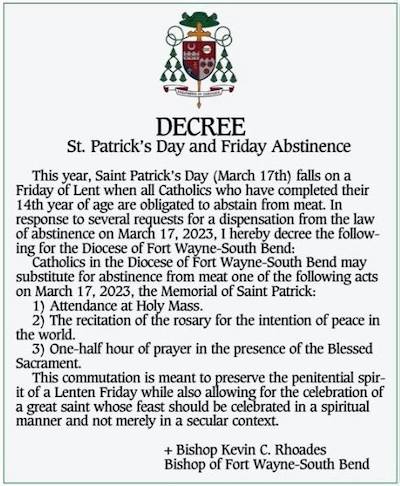
Today the Church celebrates the feast of Saint Patrick (387-493), the patron saint of Ireland. It is on the Emerald Isle that today is both a national and religious holiday. At one time, the bars would close and the churches would be full out of obligation. Only in recent years has the feast seen a more rebellious spirit, complete with parades and green beer (not to mention green hair). Naturally (if ironically), they have the Americans to thank for this.

And, since the feast usually takes place during Lent, the announcement above shows that some of us can indulge a wee bit more than others.

+    +    +

Growing up in a postwar Catholic environment, those of us who attended the parish schools in the United States, were taught that there were two kinds of people; those who were Irish, and those who wish they were. My own family appeared to fall into neither category. There were the Irish nuns who favored the Irish kids, including the unforgettable Sister Mary Mel (yes, her real name), who wasn't above calling some miscreant a "jackass." But at least she was colorful. The rest of all things that were allegedly Irish were just so much blarney. I came to dismiss the whole notion of St Paddy's Day -- indeed, the whole notion of being Irish -- as a license for certain people to be more arrogant and obnoxious than they already were.

"Hail glorious Saint Patrick dear saint of our isle
On us thy poor children look down with a smile —"
But I'm not singing hymns and I'm not saying prayers
No, I'm gritting my teeth as I walk down the stairs
And into the street with these louts fiercely drinking
And screeching and lurching, and here's what I'm thinking —
They're using a stereotype, a narrow example,
A fraction, not even a marketing sample
To imitate Ireland, from which they don't come!
So unless that's just stupid, unless it's plain dumb,
All these kids from New Jersey and the five boroughs
And hundreds of cities, all drowning their sorrows,
With bottles and glasses and heads getting broken
(Believe me, just ask the mayor of Hoboken)
All that mindlessness, shouting and getting plain stocious —
That isn't Irish, that's simply atrocious.
I've another word too for it, this one's more stinging
I call it "racism." See, just 'cause you're singing
Some drunken old ballad on Saint Patrick's Day
Does that make you Irish? Oh, no — no way.
Nor does a tee-shirt that asks you to kiss them —
If they never come back I surely won't miss them
Or their beer cans and badges and wild maudlin bawling
And hammered and out of it, bodies all sprawling.

They're not of Joyce or of Yeats, Wilde, or Shaw.
How many Nobel Laureates does Dublin have? Four!
Think of this as you wince through Saint Patrick's guano —
Not every Italian is Tony Soprano.

Eventually I went to college, where I discovered Irish music. I mean the real thing, not the over-romanticized "Christmas-in-Killarney-on-St-Patrick's-in-June" that passed itself off as genuine the whole time. I simply couldn't get enough of it. I used to watch the Saint Patrick's Day parade in Cincinnati, which included the carrying of the statue of the Saint, which the local chapter of the Ancient Order of Hibernians would "steal" in the middle of night, from what was once the German parish in Mount Adams. (Long story.) There was also the local Irish dance school, with boys and girls who never imagined that, three decades later, they could do it for fame and fortune in shows like "Riverdance."

Who knew?

By the end of the 1970s I spent Sunday evenings working at a coffeehouse, and I helped broker a deal that brought Clannad to Cincinnati on their first American tour. I even gave harpist/vocalist Máire Brennan (pronounced MOY-uh) a ride back to where she was staying. Otherwise shy and aloof, I got her to laugh at my jokes. That seemed to matter at the time.

I saw Máire again in 1987, in a music video on VH1, for a song entitled "Something to Believe In." She was also the haunting voice in the Volkswagen commercials. Naturally she's world-famous now, and probably wouldn't return my calls, although she did write me a long and possibly heartfelt note when she autographed my copy of their album. I say "possibly" because it was in Gaelic, so I'll never know for sure, especially since it was among my collection that was stolen from my apartment in Georgetown back in 1994. (Bob, if you're reading this, tell your rich white trash buddies that I'd really like to have it back. And before you get your boxers in a bunch, the neighbors all thought YOU did it!) Máire also came out with a book in 2001 entitled "The Other Side of the Rainbow." She continues to tour and so on, but I knew her when.

(Sigh ...) Anyway, back to the '70s. While the whole world (including my now-beloved Celia on the other side of it) was going bananas over disco, the feast became an annual ritual, of spending most of the accompanying weekend hanging out at Hap's Irish Pub in the Hyde Park section of Cincinnati, or at Arnold's Bar and Grill downtown. Even when I moved to Washington in 1980, I learned Irish dancing (if not quite what appears in the above video), Irish folk tales, and the like. But the upscale bars in the Nation's capital weren't as quaint as the neighborhood pubs in my old hometown. I was under no illusions that this heritage was one that I could claim for my own.

In 1982, that claim became even more elusive. I married a girl whose grandparents came over from Slovakia, and who grew up hearing Slovak around the house. This pretty much killed any enthusiasm for all things Irish around our house.

You see, I learned a piece of American Catholic history that the mostly Irish-American church historians didn't exactly wear on their sleeves. By the time eastern Europeans came to America in the late 19th and early 20th century, the Irish were already the big fish in the little blue-collar pond, and didn't mind letting the "Hunkies" in the coal towns and factory neighborhoods know it. Going up the food chain, it got worse. Catholics of Eastern Rites -- with customs and liturgy similar to the Orthodox, but in communion with Rome -- had married priests. The mostly-Irish bishops assumed they were either schismatics, or worse. Their wives couldn't be treated in Catholic hospitals, and their children were barred from Catholic schools. Confused as these bishops were, they concluded that the faithful would be even more confused by the presence of married Catholic priests. Thus, by the 1920s, The (Irish-)American bishops pressured Rome to bar the (legitimately) married priests from coming to America, let alone ministering.

It has been shown that most of the growth of Eastern Orthodoxy in North America can be attributed to the damned ignorance of the (Irish-)American bishops of the time. (Hey, guys, nice work!)

This latency towards all things Irish got a reprieve when the marriage tanked in 1990. Then one night -- it was about 1998, as I remember -- I was interviewed for a writing job by a priest who edited a major Catholic periodical. A native of Dublin, he reminded me of what really mattered:

“Patrick was not Irish, and on his Feast Day, we do not celebrate being Irish; we celebrate being Catholic.”

I knew that the Alexanders came from a small town near Verdun, in the Lorraine province of northeastern France. But in recent years we learned that, before the 18th century, the Alexandre line was expatriated from Scotland, a result of the Rebellion when England overtook them. I was also to learn that the man known by the Roman name of Maganus Sucatus (Maewyn Succat in Gaelic) was of a Roman family, born in Kilpatrick, near Dumbarton, in that part of Great Britain that is now Scotland. Sooooo ... if not being Irish were not enough, Patricius (in modern English, Patrick) -- as he was known in later years, being of the Roman "patrician" class, and a "patriarch" to his spiritual charges -- might just as easily be claimed by the Scots as one of their own.
For years, one highlight of the day would be the Annual Irish Poetry Reading. That was when I'd call my folks in Ohio on this day every year, and with their speakerphone on, recite the following piece by Benjamin Hapgood Burt in a very bad Irish brogue:

One evening in October, when I was one-third sober,
    An' taking home a "load" with manly pride;
My poor feet began to stutter, so I lay down in the gutter,
    And a pig came up an' lay down by my side;
Then we sang "It's all fair weather when good fellows get together,"
    Till a lady passing by was heard to say:
"You can tell a man who 'boozes' by the company he chooses"
    And the pig got up and slowly walked away.


Since then, both have entered into eternity, most likely with better things to do.

Today, those who are Irish, who wish they were, or who don't give a rat's arse either way, will dine on Irish lamb stew. When I can ever find it amidst my stuff, I use this occasion to wear a button with the words of William Butler Yeats: “I will arise and go now, and go to Innisfree.” Usually, I listen to Celtic music the entire day, and at an opportune time and place, I dine on corned beef and cabbage. This is admittedly an American innovation for the Irish, as poor immigrants from the "auld sod" found corned beef (a substitute used by their Jewish neighbors in place of bacon) to be much cheaper than lamb.

Beginning this year, I got lucky, because right down the street from me, they opened an Irish pub. It seems that three Thai restaurant within a half mile of each other was one too many, and the one closest to me was replaced with the watering hole of my dreams. The Celtic House is situated on the corner of Columbia Pike and South Barton Street, right at the end of the latter street, which would be my street, a mere ten-minute walk away. Sometime today I'm making a point of being there, as if my fond memories of discovering real Irish culture have come full circle. True, it's not as small and crowded as Hap's, not nearly as weather-beaten as Arnold's, and they won't be selling raffle tickets for NORAID under the table, but I can ignore that long enough to enjoy a lamb stew.

I'll also probably watch Mel Gibson in Braveheart later tonight, while enjoying a Guiness float (which is like a root beer float, only ... well, you know). Who cares if William Wallace was Scottish? No one cares if Patrick isn't Irish, do they? After all, "The Apostle of Ireland" is properly claimed by Catholics everywhere, whether a bunch of micks care to admit it or not.

“Agus fagaimid siud mar ata se.”

Wednesday, March 17, 2021

My Annual Über-Celtic Moment

Today the Church celebrates the feast of Saint Patrick (387-493), the patron saint of Ireland. It is on the Emerald Isle that today is both a national and religious holiday. At one time, the bars would close and the churches would be full out of obligation. Only in recent years has the feast seen a more rebellious spirit, complete with parades and green beer (not to mention green hair). Naturally (if ironically), they have the Americans to thank for this.

Growing up in a postwar Catholic environment, those of us who attended the parish schools in the United States, were taught that there were two kinds of people; those who were Irish, and those who wish they were. My own family appeared to fall into neither category. There were the Irish nuns who favored the Irish kids, including the unforgettable Sister Mary Mel (yes, her real name), who wasn't above calling some miscreant a "jackass." But at least she was colorful. The rest of all things that were allegedly Irish were just so much blarney. I came to dismiss the whole notion of St Paddy's Day -- indeed, the whole notion of being Irish -- as a license for certain people to be more arrogant and obnoxious than they already were.

"Hail glorious Saint Patrick dear saint of our isle
On us thy poor children look down with a smile —"
But I'm not singing hymns and I'm not saying prayers
No, I'm gritting my teeth as I walk down the stairs
And into the street with these louts fiercely drinking
And screeching and lurching, and here's what I'm thinking —
They're using a stereotype, a narrow example,
A fraction, not even a marketing sample
To imitate Ireland, from which they don't come!
So unless that's just stupid, unless it's plain dumb,
All these kids from New Jersey and the five boroughs
And hundreds of cities, all drowning their sorrows,
With bottles and glasses and heads getting broken
(Believe me, just ask the mayor of Hoboken)
All that mindlessness, shouting and getting plain stocious —
That isn't Irish, that's simply atrocious.
I've another word too for it, this one's more stinging
I call it "racism." See, just 'cause you're singing
Some drunken old ballad on Saint Patrick's Day
Does that make you Irish? Oh, no — no way.
Nor does a tee-shirt that asks you to kiss them —
If they never come back I surely won't miss them
Or their beer cans and badges and wild maudlin bawling
And hammered and out of it, bodies all sprawling.

They're not of Joyce or of Yeats, Wilde, or Shaw.
How many Nobel Laureates does Dublin have? Four!
Think of this as you wince through Saint Patrick's guano —
Not every Italian is Tony Soprano.

Eventually I went to college, where I discovered Irish music. I mean the real thing, not the over-romanticized "Christmas-in-Killarney-on-St-Patrick's-in-June" that passed itself off as genuine the whole time. I simply couldn't get enough of it. I used to watch the Saint Patrick's Day parade in Cincinnati, which included the carrying of the statue of the Saint, which the local chapter of the Ancient Order of Hibernians would "steal" in the middle of night, from what was once the German parish in Mount Adams. (Long story.) There was also the local Irish dance school, with boys and girls who never imagined that, three decades later, they could do it for fame and fortune in shows like "Riverdance."

Who knew?

By the end of the 1970s I spent Sunday evenings working at a coffeehouse, and I helped broker a deal that brought Clannad to Cincinnati on their first American tour. I even gave harpist/vocalist Máire Brennan (pronounced MOY-uh) a ride back to where she was staying. Otherwise shy and aloof, I got her to laugh at my jokes. That seemed to matter at the time.

I saw Máire again in 1987, in a music video on VH1, for a song entitled "Something to Believe In." She was also the haunting voice in the Volkswagen commercials. Naturally she's world-famous now, and probably wouldn't return my calls, although she did write me a long and possibly heartfelt note when she autographed my copy of their album. I say "possibly" because it was in Gaelic, so I'll never know for sure, especially since it was among my collection that was stolen from my apartment in Georgetown back in 1994. (Bob, if you're reading this, tell your rich white trash buddies that I'd really like to have it back. And before you get your boxers in a bunch, the neighbors all thought YOU did it!) Máire also came out with a book in 2001 entitled "The Other Side of the Rainbow." She continues to tour and so on, but I knew her when.

(Sigh ...) Anyway, back to the '70s. While the whole world (including my now-beloved Celia on the other side of it) was going bananas over disco, the feast became an annual ritual, of spending most of the accompanying weekend hanging out at Hap's Irish Pub in the Hyde Park section of Cincinnati, or at Arnold's Bar and Grill downtown. Even when I moved to Washington in 1980, I learned Irish dancing (if not quite what appears in the above video), Irish folk tales, and the like. But the upscale bars in the Nation's capital weren't as quaint as the neighborhood pubs in my old hometown. I was under no illusions that this heritage was one that I could claim for my own.

In 1982, that claim became even more elusive. I married a girl whose grandparents came over from Slovakia, and who grew up hearing Slovak around the house. This pretty much killed any enthusiasm for all things Irish around our house.

You see, I learned a piece of American Catholic history that the mostly Irish-American church historians didn't exactly wear on their sleeves. By the time eastern Europeans came to America in the late 19th and early 20th century, the Irish were already the big fish in the little blue-collar pond, and didn't mind letting the "Hunkies" in the coal towns and factory neighborhoods know it. Going up the food chain, it got worse. Catholics of Eastern Rites -- with customs and liturgy similar to the Orthodox, but in communion with Rome -- had married priests. The mostly-Irish bishops assumed they were either schismatics, or worse. Their wives couldn't be treated in Catholic hospitals, and their children were barred from Catholic schools. Confused as these bishops were, they concluded that the faithful would be even more confused by the presence of married Catholic priests. Thus, by the 1920s, The (Irish-)American bishops pressured Rome to bar the (legitimately) married priests from coming to America, let alone ministering.

It has been shown that most of the growth of Eastern Orthodoxy in North America can be attributed to the damned ignorance of the (Irish-)American bishops of the time. (Hey, guys, nice work!)

This latency towards all things Irish got a reprieve when the marriage tanked in 1990. Then one night -- it was about 1998, as I remember -- I was interviewed for a writing job by a priest who edited a major Catholic periodical. A native of Dublin, he reminded me of what really mattered:

“Patrick was not Irish, and on his Feast Day, we do not celebrate being Irish; we celebrate being Catholic.”

I knew that the Alexanders came from a small town near Verdun, in the Lorraine province of northeastern France. But in recent years we learned that, before the 18th century, the Alexandre line was expatriated from Scotland, a result of the Rebellion when England overtook them. I was also to learn that the man known by the Roman name of Maganus Sucatus (Maewyn Succat in Gaelic) was of a Roman family, born in Kilpatrick, near Dumbarton, in that part of Great Britain that is now Scotland. Sooooo ... if not being Irish were not enough, Patricius (in modern English, Patrick) -- as he was known in later years, being of the Roman "patrician" class, and a "patriarch" to his spiritual charges -- might just as easily be claimed by the Scots as one of their own.
For years, one highlight of the day would be the Annual Irish Poetry Reading. That was when I'd call my folks in Ohio on this day every year, and with their speakerphone on, recite the following piece by Benjamin Hapgood Burt in a very bad Irish brogue:

One evening in October, when I was one-third sober,
    An' taking home a "load" with manly pride;
My poor feet began to stutter, so I lay down in the gutter,
    And a pig came up an' lay down by my side;
Then we sang "It's all fair weather when good fellows get together,"
    Till a lady passing by was heard to say:
"You can tell a man who 'boozes' by the company he chooses"
    And the pig got up and slowly walked away.


Since then, both have entered into eternity, most likely with better things to do.

Today, those who are Irish, who wish they were, or who don't give a rat's arse either way, will dine on Irish lamb stew. When I can ever find it amidst my stuff, I use this occasion to wear a button with the words of William Butler Yeats: “I will arise and go now, and go to Innisfree.” Usually, I listen to Celtic music the entire day, and at an opportune time and place, I dine on corned beef and cabbage. This is admittedly an American innovation for the Irish, as poor immigrants from the "auld sod" found corned beef (a substitute used by their Jewish neighbors in place of bacon) to be much cheaper than lamb.

Beginning this year, I got lucky, because right down the street from me, they opened an Irish pub. It seems that three Thai restaurant within a half mile of each other was one too many, and the one closest to me was replaced with the watering hole of my dreams. The Celtic House is situated on the corner of Columbia Pike and South Barton Street, right at the end of the latter street, which would be my street, a mere ten-minute walk away. Sometime today I'm making a point of being there, as if my fond memories of discovering real Irish culture have come full circle. True, it's not as small and crowded as Hap's, not nearly as weather-beaten as Arnold's, and they won't be selling raffle tickets for NORAID under the table, but I can ignore that long enough to enjoy a lamb stew.

I'll also probably watch Mel Gibson in Braveheart later tonight, while enjoying a Guiness float (which is like a root beer float, only ... well, you know). Who cares if William Wallace was Scottish? No one cares if Patrick isn't Irish, do they? After all, "The Apostle of Ireland" is properly claimed by Catholics everywhere, whether a bun ch of micks care to admit it or not.

“Agus fagaimid siud mar ata se.”

Monday, August 10, 2020

Saint Laurence

“With the robe of joyfulness, alleluya,
Our Lord hath this day clothed His soldier, Laurence.
May Thy faithful's joyous assemblage clap their hands
More cheerfully than they have heretofore.”


(from the Mass of Saint Laurence, Old Sarum Rite Missal, 1998, Saint Hilarion Press)

+    +    +

Today the Church celebrates the Feast of Saint Laurence. He was archdeacon of the church of Rome in the third century. When the Emperor Valerian had Pope Sixtus II and six other deacons executed in AD 258, Laurence (also rendered in English as "Lawrence") was left in charge.

Now, back then, for a deacon to be left in charge, this actually meant something, inasmuch as deacons were responsible for the temporal goods and charitable works of the local church. On August 6, Laurence met with Sixtus in the latter's prison cell. The boss laid out the plan; no, we're not leaving forever, you're joining us in four days.

Laurence saw this as a good time to come up with a plan of his own.

Laurence distributed the funds of the local church among the crippled, blind, sick, and indigent of the city. When arrested by the Emperor, Lawrence was commanded to produce the goods. Laurence produced what he called the "true treasure of the Church" -- you guessed it; the crippled, blind, sick, and indigent of the city.

The emperor was not amused.

Legend has it that Laurence was martyred by being roasted on a gridiron. It is also said that, at one point, Laurence told them when he was done on one side, and could be turned over. Modern scholars have suggested that the determination of this method of torture is probably a misreading of the original accounts.

Anything to take the fun outa this, huh, guys?

And so, Laurence is pictured holding a book of records, a money purse, and/or a gridiron. His image is generally found on one of the "deacon's doors" with the iconostasis of any Greek Catholic (Byzantine Rite) or Eastern Orthodox church.

Laurence is also the patron saint of cooks. Not to mention librarians, libraries, lumbago, paupers, poor people, restauranteurs, Rome, schoolchildren, seminarians, Sri Lanka, stained glass workers, students, tanners, vine growers, vineyard owners, wine makers (whew!), and ... me!

That's because I was named for my uncle, Lawrence Rosselot (pronounced "ROSS-uh-low," from the province of Alsace in France, so the "T" at the end is silent), my mother's brother, who died in a farming accident before I was born.

Finally, beginning on or about the eve of his feast, and continuing through most of the week, one may look up into the night sky (at least in the northern hemisphere) for a spectacular meteor shower known as “the burning tears of Saint Laurence” which may be viewed by the naked eye.

Sure, you missed the one last night. But as mentioned before, you've got most of this week to see some action. Especially if you go to a place out in the country where there are no city lights to be found.

But all the stars will be there.
 

Monday, October 14, 2019

Signs of the Times

I saw the work of one sign painter everywhere in the little town of Milford, Ohio, when I was growing up in the 1960s. It was as if the whole town was his client. I don't know what happened to him. And yet, when I visit about once every other year now -- none of the family lives there anymore, and the home was sold several years ago -- I see the remnant of the unknown sign painter, amidst the growing number of antique stores, gourmet restaurants, and ... of all things, microbreweries!

I was finishing high school in 1973, when Dad took me to "Commercial Square," a side street in downtown Cincinnati with a row of old factory warehouse buildings (since razed for what is now the Procter and Gamble headquarters) to visit what he called "a dying art." There, a couple of men ran a sign-painting business. Dad knew I aspired to go to college, but he didn't believe in accumulating massive debts and living on credit. (In fact, he never owned a credit card in his entire life.) If I could find a profession that didn't require a college education, so much the better. I viewed their work with some interest, but little enthusiasm.

I went on to complete my graphic design studies at the University of Cincinnati, graduating in 1978. Looking through old magazines and art manuals, I had a brief flirtation with calligraphy and hand-painted lettering. In the early 1980s, I did calligraphy for special occasions; family, parish, that sort of thing. I left it behind completely once the computer came to our office, and "desktop publishing" was the next big thing.

I came across a 2017 article in Monocle just recently ...

From traditional calligraphy to rare gold-leaf techniques, hand-worked lettering is back in demand. Monocle Films meets three sign painters whose eye-catching signs lend character to cities - and help businesses stand out.

... and I remembered that brief page of my history. Part of the trend may be a reaction to our slavery to technology, as if to lend credence to Newton's Law. Whatever is ancient is new again.

The total cost of my college education, culminating in 1978, has been estimated at around ten thousand dollars. I managed to recover that cost in short order.

And so it goes.
 

Saturday, December 01, 2018

Ghosts of Christmases Past

IMAGE: Glade jul by Viggo Johansen (1891).

Christmas trees are as American as cherry pie, and as German as sauerbraten.

+    +    +

We always had a tree in our house growing up in Ohio, except for 1968, when the ornaments were suspended by red ribbons from the top edge of the front window, and our presents were found in a big cardboard box that morning.

We can only speculate as to why.

In those days, the end of the year was a busy time for Dad at Procter and Gamble, with all the yeoman's work he was doing for the big year-end meeting. And in the few years before his MS was diagnosed, the stress of working for a living was taking quite a toll on him. When these things happen in our lives, something has to give. And maybe this time it did, just this once. But we'll never know for sure.

PHOTO: Paul Alexander at the annual Saint Nicholas Day Pageant, Epiphany of our Lord Byzantine Catholic Church, December 1989.

I lived in the house where I grew up until moving to the DC area thirty-eight years ago this month. With very little furniture (or much of anything) in an efficiency apartment, I might have gone that first year without a tree.

PHOTO: Paul Alexander pays his respects to "Father Nicholas," Epiphany of our Lord Byzantine Catholic Church, December 1989.

I married a Byzantine Rite Catholic in 1982, and our remembrance of the Birth of Our Savior, as Pope John Paul II would have said, breathed with both lungs. We began the celebration on the sixth of December, the Feast of Saint Nicholas, an important one for Eastern Catholics. In keeping with eastern European custom, our tree was not put up until Christmas Eve, when the decorating began as the sun was setting, and the meatless "Holy Supper" was about to begin. We would end the celebration exactly one month later, on the sixth of January, the Epiphany, or "Little Christmas."

When our once-ostensibly-happy home fell apart in 1990, I moved to Georgetown. It was the end of the world as I knew it, but my basement studio had a two-foot-tall artificial tree, suitably decorated, as if to suggest that hope would breed eternal.

PHOTO: 3114 N Street, Northwest, Georgetown, DC, where the author lived in the early 1990s.

In 1994, I left Georgetown for the Virginia suburbs. Moving to the suburbs at all was my first mistake. My second mistake was moving into a group house with three other guys, while approaching the age of forty, and having a son visit every other weekend. They were all okay, except maybe for an unscrupulous landlord whom we later sued to get our security deposits back. I'm still waiting for it. (Patrick Nelson, I know where you live.) But while I was there, I offered to decorate the tree. One of the housemates, besides being an underdeveloped alpha male who ridiculed my listening to Gregorian chant recordings, was crestfallen to learn that I decorated the oversized houseplant rather than obtaining a more conventional evergreen.

It looked pretty sharp, actually.

PHOTO: Home altar of Chez Alexandre without the Christmas tree, Arlington, Virginia.

In the eleven years that I had the good sense to move back into town, within walking distance of everything, and without roommates while in my forties, my basement studio -- that's right, I spent a total of sixteen years living in people's basements -- always had a Christmas tree, if only the usual two-foot-artificial variety. When I finally bought my own townhouse (again) in 2005, the practice would continue, although some years I was sent a real one.

PHOTO: Christmas tree replacing the home altar of Chez Alexandre, from 2005 to 2016, Arlington, Virginia.

Over time, Chez Alexandre was graced with more lights, and was introduced to a cross between a Chinese lantern and Mexican piñata, direct from the Philippines, known as a "parol." And the sixth-to-sixth schedule was expanded to begin with the First Sunday of Advent, beginning with the tree itself, followed by the full monty of decorating just nine days before the feast, and still ending with what was now called "Tres Reyes." For the longest time, the mini-tree itself would replace the home altar in the living room.

In the mid-1980s, I was invited to a Christmas reception at the Vatican Embassy. They had a number of magnificently decorated trees, one of them graced only with miniature Nativity scenes. For many years, I have building a collection of little creche decorations of my own. Then last year, I got a taller tree; still artificial, but at least five feet tall, already pre-lit, and proudly occupying the landing of the stairs. It is only now that I can display the full array of Nativity ornaments, inspired by or originating from all over the world, from South America to Southeast Asia, and places all around and in between. I make a few exceptions to the rule for sentimental reasons. The guitar is one indicator.

VIDEO: The present Christmas tree of Chez Alexandre, Arlington, Virginia, since 2017. The ancient German carol "O Tannenbaum" performed by the United States Army Band Chorus.

+    +    +

As the tree follows us through the years, it tells the story of ourselves, and of our lives. Its evergreen branches are a sign of hope when all is cold and dark, with the promise of the Light that is to come.

But still, it all comes down on the sixth of January.