Showing posts with label slavonic. Show all posts

Friday, December 06, 2024

Father Nicholas: The REAL Santa Claus

When I was young and growing up in Ohio, some of my classmates would leave their shoes outside the bedroom door on the night of the fifth of December, so that Saint Nicholas would leave them treats for the next morning.

We never did that at our house, but I did ask Mom how it was that Saint Nicholas got to be called "Santa Claus." By this time I had already determined a connection between the two. But while my mother was salutatorian of her high school class -- one of a grand total of fifteen students, but I digress -- she was not one to wear her erudition on her sleeve. So, rather than go into an entymological treatise on the subject, she simply told me: “Say ‘Saint Nicholas’ three times real fast.”

That carried me over for at least a few years.

No good Catholic home is without an answer to the question of whether there is such a thing as Santa Claus. There is, but we are accustomed to the corruption of his real name, one that developed over the centuries. By the time devotion to Saint Nicholas reached Europe, he was known by different names. In the British Isles, he was "Father Christmas." In the Netherlands, he was "Sinterklaas." By the 19th century, periodicals such as Harper's Bazaar, and promoters of a fountain beverage known as Coca-Cola, had not only transformed the name, but the bright red costume with the white-fur trim, both of which we recognize today.

Whatever people call him, or however they depict him, the Bishop of Myra in the fourth century is a real person, and he presently dwells in Heaven with the Communion of Saints. Our Mother the Church celebrates his feast on the sixth of December, in both the East and the West.

VIDEO: A variation on a theme.

Nicholas was no lightweight. He was in attendance at the Council of Nicaea in the year 325, when the Arian heresy was being debated. At one point, he became so enraged with the Bishop Arius (whose errors were supported by the majority of bishops up to that time, remember?), that he supposedly punched Arius in the nose.

That's right, kids, Jolly Olde Saint Nick cold-cocked a heretic! (Some accounts say that he merely slapped Aruis, but that's so pantywaist, who'd believe it?)

Anyway, many of the bishops there, including the Emperor Constantine, were outraged by the assault, and given their sympathies, had Nicholas thrown in the dungeon. That night, the Emperor had a dream where Nicholas appeared to him, adorned in his finest liturgical vesture, and holding the Book of the Gospels. Awakened with a fright, the Emperor summoned his guards, who joined him as he raced to the dungeon, to find Nicholas unchained, adorned in ... you guessed it.

The story varies in certain details. Some accounts tell of Our Lord and Our Lady appearing to Nicholas in the dungeon. I heard the one above from an "Old Calendar" Russian Orthodox priest. It is also said that Nicholas, being restored to his rightful place in the council, slept through the rest of the proceedings.

I can't say I blame him.

Michael Foley provides more details about the life and legacy of Nicholas.

+    +    +

At the little Greek Catholic parish where my son learned the Faith, as it had been taught to his mother, the Feast of Saint Nicholas is a particular cause for celebration. He is the patron of Greek Catholics, and his image graces the iconostasis on the far left side as viewed from the assembly. There is a special hymn dedicated to him ...

O kto kto, Nikolaja l'ubit,
O kto kto, Nikolaju sluzit.
    Tomu svjatyj Nikolaj,
    Na vsjakij cas pomahaj.
    Nikolaj, Nikolaj!

O who loves Nicholas the Saintly,
O who loves Nicholas the Saintly.
    Him will Nicholas receive,
    and give help in time of need.
    Nicholas, Nicholas!

... and the children in the School of Religion program do a pageant in his honor every Sunday closest to the sixth of December. It culminates in the arrival of an elderly man with a long white beard, dressed in the robes of a Greek Catholic bishop, with whom the children meet in much the same manner as they would his commercialized (and most inauthentic) counterpart.

Paul used to get special icon cookies to take home, much like the ones that appear in the photos, emblazoned with the words "O Holy Nicholas" in Slavonic. These unique gingerbread cookies are from a recipe which appears at the stnicholascenter.org website.

I dearly miss that little parish. It has changed over the last four decades. In 2012, they completed a new and larger house of worship, one that emulates the style common to Eastern Europe. But with every successful building project they have -- the parish hall, the rectory -- the place seems a little less homey, a little larger than life. Still, the spirit of Saint Nicholas reminds them every year, of the things that are passed on, and that remain the same.

And for those parishes of the Roman Rite, whose priests would hold off any celebration of Christmas until the day itself, and the days thereafter when everyone is out of town, they too might have at least one reason to reconsider, as Advent is not only a season of penitence, but of expectation. (This venue will provide other reasons soon, so stay tuned.)

And on that note, let's go bake some cookies already!
 

Wednesday, December 06, 2023

Father Nicholas: The REAL Santa Claus

When I was young and growing up in Ohio, some of my classmates would leave their shoes outside the bedroom door on the night of the fifth of December, so that Saint Nicholas would leave them treats for the next morning.

We never did that at our house, but I did ask Mom how it was that Saint Nicholas got to be called "Santa Claus." By this time I had already determined a connection between the two. But while my mother was salutatorian of her high school class -- there were only about a dozen students in her class, but I digress -- she was not one to wear her erudition on her sleeve. So, rather than go into an entymological treatise on the subject, she simply told me: “Say ‘Saint Nicholas’ three times real fast.”

That carried me over for at least a few years.

No good Catholic home is without an answer to the question of whether there is such a thing as Santa Claus. There is, but we are accustomed to the corruption of his real name, one that developed over the centuries. By the time devotion to Saint Nicholas reached Europe, he was known by different names. In the British Isles, he was "Father Christmas." In the Netherlands, he was "Sinterklaas." By the 19th century, periodicals such as Harper's Bazaar, and promoters of a fountain beverage known as Coca-Cola, had not only transformed the name, but the bright red costume with the white-fur trim, both of which we recognize today.

Whatever people call him, or however they depict him, the Bishop of Myra in the fourth century is a real person, and he presently dwells in Heaven with the Communion of Saints. Our Mother the Church celebrates his feast on the sixth of December, in both the East and the West.

VIDEO: A variation on a theme.

Nicholas was no lightweight. He was in attendance at the Council of Nicaea in the year 325, when the Arian heresy was being debated. At one point, he became so enraged with the Bishop Arius (whose errors were supported by the majority of bishops up to that time, remember?), that he supposedly punched Arius in the nose.

That's right, kids, Jolly Olde Saint Nick cold-cocked a heretic! (Some accounts say that he merely slapped Aruis, but that's so pantywaist, who'd believe it?)

Anyway, many of the bishops there, including the Emperor Constantine, were outraged by the assault, and given their sympathies, had Nicholas thrown in the dungeon. That night, the Emperor had a dream where Nicholas appeared to him, adorned in his finest liturgical vesture, and holding the Book of the Gospels. Awakened with a fright, the Emperor summoned his guards, who joined him as he raced to the dungeon, to find Nicholas unchained, adorned in ... you guessed it.

The story varies in certain details. Some accounts tell of Our Lord and Our Lady appearing to Nicholas in the dungeon. I heard the one above from an "Old Calendar" Russian Orthodox priest. It is also said that Nicholas, being restored to his rightful place in the council, slept through the rest of the proceedings.

I can't say I blame him.

Michael Foley provides more details about the life and legacy of Nicholas.

+    +    +

At the little Greek Catholic parish where my son learned the Faith, as it had been taught to his mother, the Feast of Saint Nicholas is a particular cause for celebration. He is the patron of Greek Catholics, and his image graces the iconostasis on the far left side as viewed from the assembly. There is a special hymn dedicated to him ...

O kto kto, Nikolaja l'ubit,
O kto kto, Nikolaju sluzit.
    Tomu svjatyj Nikolaj,
    Na vsjakij cas pomahaj.
    Nikolaj, Nikolaj!

O who loves Nicholas the Saintly,
O who loves Nicholas the Saintly.
    Him will Nicholas receive,
    and give help in time of need.
    Nicholas, Nicholas!

... and the children in the School of Religion program do a pageant in his honor every Sunday closest to the sixth of December. It culminates in the arrival of an elderly man with a long white beard, dressed in the robes of a Greek Catholic bishop, with whom the children meet in much the same manner as they would his commercialized (and most inauthentic) counterpart.

Paul used to get special icon cookies to take home, much like the ones that appear in the photos, emblazoned with the words "O Holy Nicholas" in Slavonic. These unique gingerbread cookies are from a recipe which appears at the stnicholascenter.org website.

I dearly miss that little parish. It has changed over the last four decades. More than ten years ago, they completed a new and larger house of worship, one that emulates the style common to Eastern Europe. But with every successful building project they have -- the parish hall, the rectory -- the place seems a little less homey, a little larger than life. Still, the spirit of Saint Nicholas reminds them every year, of the things that are passed on, and that remain the same.

And for those parishes of the Roman Rite, whose priests would hold off any celebration of Christmas until the day itself, and the days thereafter when everyone is out of town, they too might have at least one reason to reconsider, as Advent is not only a season of penitence, but of expectation. (This venue will provide other reasons soon, so stay tuned.)

And on that note, let's go bake some cookies already!
 

Tuesday, December 06, 2022

Father Nicholas: The REAL Santa Claus

When I was young and growing up in Ohio, some of my classmates would leave their shoes outside the bedroom door on the night of the fifth of December, so that Saint Nicholas would leave them treats for the next morning.

We never did that at our house, but I did ask Mom how it was that Saint Nicholas got to be called "Santa Claus." By this time I had already determined a connection between the two. But while my mother was salutatorian of her high school class -- there were only about a dozen students in her class, but I digress -- she was not one to wear her erudition on her sleeve. So, rather than go into an entymological treatise on the subject, she simply told me: “Say ‘Saint Nicholas’ three times real fast.”

That carried me over for at least a few years.

No good Catholic home is without an answer to the question of whether there is such a thing as Santa Claus. There is, but we are accustomed to the corruption of his real name, one that developed over the centuries. By the time devotion to Saint Nicholas reached Europe, he was known by different names. In the British Isles, he was "Father Christmas." In the Netherlands, he was "Sinterklaas." By the 19th century, periodicals such as Harper's Bazaar, and promoters of a fountain beverage known as Coca-Cola, had not only transformed the name, but the bright red costume with the white-fur trim, both of which we recognize today.

Whatever people call him, or however they depict him, the Bishop of Myra in the fourth century is a real person, and he presently dwells in Heaven with the Communion of Saints. Our Mother the Church celebrates his feast on the sixth of December, in both the East and the West.

VIDEO: A variation on a theme.

Nicholas was no lightweight. He was in attendance at the Council of Nicaea in the year 325, when the Arian heresy was being debated. At one point, he became so enraged with the Bishop Arius (whose errors were supported by the majority of bishops up to that time, remember?), that he supposedly punched Arius in the nose.

That's right, kids, Jolly Olde Saint Nick cold-cocked a heretic! (Some accounts say that he merely slapped Aruis, but that's so pantywaist, who'd believe it?)

Anyway, many of the bishops there, including the Emperor Constantine, were outraged by the assault, and given their sympathies, had Nicholas thrown in the dungeon. That night, the Emperor had a dream where Nicholas appeared to him, adorned in his finest liturgical vesture, and holding the Book of the Gospels. Awakened with a fright, the Emperor summoned his guards, who joined him as he raced to the dungeon, to find Nicholas unchained, adorned in ... you guessed it.

The story varies in certain details. Some accounts tell of Our Lord and Our Lady appearing to Nicholas in the dungeon. I heard the one above from an "Old Calendar" Russian Orthodox priest. It is also said that Nicholas, being restored to his rightful place in the council, slept through the rest of the proceedings.

I can't say I blame him.

Michael Foley provides more details about the life and legacy of Nicholas.

+    +    +

At the little Greek Catholic parish where my son learned the Faith, as it had been taught to his mother, the Feast of Saint Nicholas is a particular cause for celebration. He is the patron of Greek Catholics, and his image graces the iconostasis on the far left side as viewed from the assembly. There is a special hymn dedicated to him ...

O kto kto, Nikolaja l'ubit,
O kto kto, Nikolaju sluzit.
    Tomu svjatyj Nikolaj,
    Na vsjakij cas pomahaj.
    Nikolaj, Nikolaj!

O who loves Nicholas the Saintly,
O who loves Nicholas the Saintly.
    Him will Nicholas receive,
    and give help in time of need.
    Nicholas, Nicholas!

... and the children in the School of Religion program do a pageant in his honor every Sunday closest to the sixth of December. It culminates in the arrival of an elderly man with a long white beard, dressed in the robes of a Greek Catholic bishop, with whom the children meet in much the same manner as they would his commercialized (and most inauthentic) counterpart.

Paul used to get special icon cookies to take home, much like the ones that appear in the photos, emblazoned with the words "O Holy Nicholas" in Slavonic. These unique gingerbread cookies are from a recipe which appears at the stnicholascenter.org website.

I dearly miss that little parish. It has changed over nearly four decades. About ten years ago, they completed a new and larger house of worship, one that emulates the style common to Eastern Europe. But with every successful building project they have -- the parish hall, the rectory -- the place seems a little less homey, a little larger than life. Still, the spirit of Saint Nicholas reminds them every year, of the things that are passed on, and that remain the same.

And for those parishes of the Roman Rite, whose priests would hold off any celebration of Christmas until the day itself, and the days thereafter when everyone is out of town, they too might have at least one reason to reconsider, as Advent is not only a season of penitence, but of expectation. (This venue will provide other reasons soon, so stay tuned.)

And on that note, let's go bake some cookies already!
 

Monday, December 06, 2021

Father Nicholas: The REAL Santa Claus

When I was young and growing up in Ohio, some of my classmates would leave their shoes outside the bedroom door on the night of the fifth of December, so that Saint Nicholas would leave them treats for the next morning.

We never did that at our house, but I did ask Mom how it was that Saint Nicholas got to be called Santa Claus. By this time I had already determined a connection between the two. But while my mother was salutatorian of her high school class -- there were about a dozen students in her class at most, but I digress -- she was not one to wear her erudition on her sleeve. So, rather than go into an entymological treatise on the subject, she simply told me: “Say ‘Saint Nicholas’ three times real fast.”

That carried me over for at least a few years.

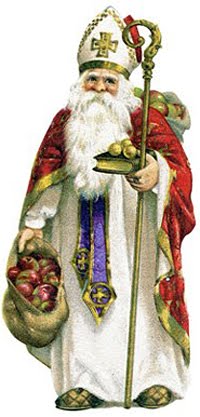
No good Catholic home is without an answer to the question of whether there is such a thing as Santa Claus. There is, but we are accustomed to the corruption of his real name, one that developed over the centuries. By the time devotion to Saint Nicholas reached Europe, he was known by different names. In the British Isles, he was "Father Christmas." In the Netherlands, he was "Sinterklaas." By the 19th century, periodicals such as Harper's Bazaar, and promoters of a fountain beverage known as Coca-Cola, had not only transformed the name, but the bright red costume with the white-fur trim, both of which we recognize today.

Whatever people call him, or however they depict him, the Bishop of Myra in the fourth century is a real person, and he presently dwells in Heaven with the Communion of Saints. Our Mother the Church celebrates his feast on the sixth of December, in both the East and the West.

VIDEO: A variation on a theme.

Nicholas was no lightweight. He was in attendance at the Council of Nicaea in the year 325, when the Arian heresy was being debated. At one point, he became so enraged with the Bishop Arius (whose errors were supported by the majority of bishops up to that time, remember?), that he supposedly punched Arius in the nose.

That's right, kids, Jolly Olde Saint Nick cold-cocked a heretic! (Some accounts say that he merely slapped him, but that's so pantywaist, who'd believe it?)

Anyway, many of the bishops there, including the Emperor Constantine, were scandalized by the assault, and given their sympathies, had Nicholas thrown in the dungeon. That night, the Emperor had a dream where Nicholas appeared to him, adorned in his finest liturgical vesture, and holding the Book of the Gospels. Awakened with a fright, the Emperor summoned his guards, who joined him as he raced to the dungeon, to find Nicholas unchained, with ... you guessed it.

The story varies in certain details. Some accounts tell of Our Lord and Our Lady appearing to Nicholas in the dungeon. I heard the above account from an "Old Calendar" Russian Orthodox priest. It is also said that Nicholas, now restored to his rightful place in the council, slept through the rest of the proceedings.

I can't say I blame him.

At the little Byzantine Rite parish where my son learned the Faith, as it had been taught to his mother, the Feast of Saint Nicholas is a particular cause for celebration. He is the patron of Byzantine Catholics, and his image graces the iconostasis on the far left side as viewed from the assembly. There is a special hymn dedicated to him ...

O kto kto, Nikolaja l'ubit,
O kto kto, Nikolaju sluzit.
    Tomu svjatyj Nikolaj,
    Na vsjakij cas pomahaj.
    Nikolaj, Nikolaj!

O who loves Nicholas the Saintly,
O who loves Nicholas the Saintly.
    Him will Nicholas receive,
    and give help in time of need.
    Nicholas, Nicholas!

... and the children in the School of Religion program do a pageant in his honor every Sunday closest to the sixth of December. It culminates in the arrival of an elderly man with a long white beard, dressed in the robes of a Greek Catholic bishop, with whom the children meet in much the same manner as they would his commercialized (and most inauthentic) counterpart.

Paul used to get special icon cookies to take home, much like the ones that appear in the photos, emblazoned with the words "O Holy Nicholas" in Slavonic. These unique gingerbread cookies are from a recipe which appears at the stnicholascenter.org website.

I dearly miss that little parish. It has changed over nearly four decades. About ten years ago, they completed a new and larger house of worship, one that emulates the style common to Eastern Europe. But with every successful building project they have -- the parish hall, the rectory -- the place seems a little less homey, a little larger than life. Still, the spirit of Saint Nicholas reminds them every year, of the things that are passed on, and that remain the same.

And for those parishes of the Roman Rite, whose priests would hold off any celebration of Christmas until the day itself, and the days thereafter when everyone is out of town, they too might have at least one reason to reconsider, as Advent is not only a season of penitence, but of expectation. (This venue will provide other reasons soon, so stay tuned.)

And on that note, let's go bake some cookies already!
 

Sunday, December 06, 2020

Father Nicholas: The REAL Santa Claus

When I was young and growing up in Ohio, some of my classmates would leave their shoes outside the bedroom door on the night of the fifth of December, so that Saint Nicholas would leave them treats for the next morning.

We never did that at our house, but I did ask Mom how it was that Saint Nicholas got to be called Santa Claus. By this time I had already determined a connection between the two. But while my mother was salutatorian of her high school class -- there were about a dozen students in her class at most, but I digress -- she was not one to wear her erudition on her sleeve. So, rather than go into an entymological treatise on the subject, she simply told me: “Say ‘Santa Claus’ three times real fast.”

That carried me over for at least a few years.

No good Catholic home is without an answer to the question of whether there is such a thing as Santa Claus. There is, but we are accustomed to the corruption of his real name, one that developed over the centuries. By the time devotion to Saint Nicholas reached Europe, he was known by different names. In the British Isles, he was "Father Christmas." In the Netherlands, he was "Sinterklaas." By the 19th century, periodicals such as Harper's Bazaar, and promoters of a fountain beverage known as Coca-Cola, had not only transformed the name, but the bright red costume with the white-fur trim, both of which we recognize today.

Whatever people call him, or however they depict him, the Bishop of Myra in the fourth century is a real person, and he presently dwells in Heaven with the Communion of Saints. Our Mother the Church celebrates his feast on the sixth of December, in both the East and the West.

VIDEO: A variation on a theme.

Nicholas was no lightweight. He was in attendance at the Council of Nicaea in the year 325, when the Arian heresy was being debated. At one point, he became so enraged with the Bishop Arius (whose errors were supported by the majority of bishops up to that time, remember?), that he supposedly punched Arius in the nose.

That's right, kids, Jolly Olde Saint Nick cold-cocked a heretic! (Some accounts say that he merely slapped him, but that's so pantywaist, who'd believe it?)

Anyway, many of the bishops there, including the Emperor Constantine, were scandalized by the assault, and given their sympathies, had Nicholas thrown in the dungeon. That night, the Emperor had a dream where Nicholas appeared to him, adorned in his finest liturgical vesture, and holding the Book of the Gospels. Awakened with a fright, the Emperor summoned his guards, who joined him as he raced to the dungeon, to find Nicholas unchained, with ... you guessed it.

The story varies in certain details. Some accounts tell of Our Lord and Our Lady appearing to Nicholas in the dungeon. I heard the above account from an "Old Calendar" Russian Orthodox priest. It is also said that Nicholas, now restored to his rightful place in the council, slept through the rest of the proceedings.

I can't say I blame him.

At the little Byzantine Rite parish where my son learned the Faith, as it had been taught to his mother, the Feast of Saint Nicholas is a particular cause for celebration. He is the patron of Byzantine Catholics, and his image graces the iconostasis on the far left side as viewed from the assembly. There is a special hymn dedicated to him ...

O kto kto, Nikolaja l'ubit,
O kto kto, Nikolaju sluzit.
    Tomu svjatyj Nikolaj,
    Na vsjakij cas pomahaj.
    Nikolaj, Nikolaj!

O who loves Nicholas the Saintly,
O who loves Nicholas the Saintly.
    Him will Nicholas receive,
    and give help in time of need.
    Nicholas, Nicholas!

... and the children in the School of Religion program do a pageant in his honor every Sunday closest to the sixth of December (or in the case of this year, today). It culminates in the arrival of an elderly man with a long white beard, dressed in the robes of a Greek Catholic bishop, with whom the children meet in much the same manner as they would his commercialized (and most inauthentic) counterpart.

Paul used to get special icon cookies to take home, much like the ones that appear in the photos, emblazoned with the words "O Holy Nicholas" in Slavonic. These unique gingerbread cookies are from a recipe which appears at the stnicholascenter.org website.

I dearly miss that little parish. It has changed over nearly four decades. Several years ago, they completed a new and larger house of worship, one that emulates the style common to Eastern Europe. But with every successful building project they have -- the parish hall, the rectory -- the place seems a little less homey, a little larger than life. Still, the spirit of Saint Nicholas reminds them every year, of the things that are passed on, and that remain the same.

And for those parishes of the Roman Rite, whose priests would hold off any celebration of Christmas until the day itself, and the days thereafter when everyone is out of town, they too might have at least one reason to reconsider, as Advent is not only a season of penitence, but of expectation. (This venue will provide other reasons soon, so stay tuned.)

And on that note, let's go bake some cookies already!
 

Friday, December 06, 2019

Father Nicholas: The REAL Santa Claus

When I was young and growing up in Ohio, some of my classmates would leave their shoes outside the bedroom door on the night of the fifth of December, so that Saint Nicholas would leave them treats for the next morning.

We never did that at our house, but I did ask Mom how it was that Saint Nicholas got to be called Santa Claus. By this time I had already determined a connection between the two. But while my mother was salutatorian of her high school class -- there were about a dozen students in her class at most, but I digress -- she was not one to wear her erudition on her sleeve. So, rather than go into an entymological treatise on the subject, she simply told me: “Say ‘Santa Claus’ three times real fast.”

That carried me over for at least a few years.

No good Catholic home is without an answer to the question of whether there is such a thing as Santa Claus. There is, but we are accustomed to the corruption of his real name, one that developed over the centuries. By the time devotion to Saint Nicholas reached Europe, he was known by different names. In the British Isles, he was "Father Christmas." In the Netherlands, he was "Sinterklaas." By the 19th century, periodicals such as Harper's Bazaar, and promoters of a fountain beverage known as Coca-Cola, had not only transformed the name, but the bright red costume with the white-fur trim, both of which we recognize today.

Whatever people call him, or however they depict him, the Bishop of Myra in the fourth century is a real person, and he presently dwells in Heaven with the Communion of Saints. Our Mother the Church celebrates his feast on the sixth of December, in both the East and the West.

VIDEO: A variation on a theme.

Nicholas was no lightweight. He was in attendance at the Council of Nicaea in the year 325, when the Arian heresy was being debated. At one point, he became so enraged with the Bishop Arius (whose errors were supported by the majority of bishops up to that time, remember?), that he supposedly punched Arius in the nose.

That's right, kids, Jolly Olde Saint Nick cold-cocked a heretic! (Some accounts say that he merely slapped him, but that's so pansy, who'd believe it?)

Anyway, many of the bishops there, including the Emperor Constantine, were scandalized by the assault, and given their sympathies, had Nicholas thrown in the dungeon. That night, the Emperor had a dream where Nicholas appeared to him, adorned in his finest liturgical vesture, and holding the Book of the Gospels. Awakened with a fright, the Emperor summoned his guards, who joined him as he raced to the dungeon, to find Nicholas unchained, with ... you guessed it.

The story varies in certain details. Some accounts tell of Our Lord and Our Lady appearing to Nicholas in the dungeon. I heard the above account from an "Old Calendar" Russian Orthodox priest. It is also said that Nicholas, now restored to his rightful place in the council, slept through the rest of the proceedings.

I can't say I blame him.

At the little Byzantine Rite parish where my son learned the Faith, as it had been taught to his mother, the Feast of Saint Nicholas is a particular cause for celebration. He is the patron of Byzantine Catholics, and his image graces the iconostasis on the far left side as viewed from the assembly. There is a special hymn dedicated to him ...

O kto kto, Nikolaja l'ubit,
O kto kto, Nikolaju sluzit.
    Tomu svjatyj Nikolaj,
    Na vsjakij cas pomahaj.
    Nikolaj, Nikolaj!

O who loves Nicholas the Saintly,
O who loves Nicholas the Saintly.
    Him will Nicholas receive,
    and give help in time of need.
    Nicholas, Nicholas!

... and the children in the School of Religion program do a pageant in his honor every Sunday closest to the sixth of December. It culminates in the arrival of an elderly man with a long white beard, dressed in the robes of an Eastern bishop, with whom the children meet in much the same manner as they would his commercialized (and most inauthentic) counterpart.

Paul used to get special icon cookies to take home, much like the ones that appear in the photos, emblazoned with the words "O Holy Nicholas" in Slavonic. These unique gingerbread cookies are from a recipe which appears at the stnicholascenter.org website.

I dearly miss that little parish. It has changed over more than three decades. Several years ago, they completed a new and larger house of worship, one that emulates the style common to Eastern Europe. But with every successful building project they have -- the parish hall, the rectory -- the place seems a little less homey, a little larger than life. Still, the spirit of Saint Nicholas reminds them every year, of the things that are passed on, and that remain the same.

Now, enough of this self-indulgent soul-searching. Let's go bake some cookies already!
 

Thursday, December 06, 2018

Father Nicholas: The REAL Santa Claus

When I was very young, some of my classmates would leave their shoes outside the bedroom door on the night of the fifth of December, so that Saint Nicholas would leave them treats.

We never did that at our house, but I did ask Mom how it was that Saint Nicholas got to be called Santa Claus. By this time I had already determined a connection between the two. But while my mother was salutatorian of her high school class -- there were about fifteen students at most, but hey, that's not the point -- she was not one to wear her erudition on her sleeve. So, rather than go into an entymological treatise on the subject, she simply told me: “Say ‘Santa Claus’ three times real fast.” That carried me over for at least a few years.

No good Catholic home is without an answer to the question of whether there is such a thing as Santa Claus. There is, but we are accustomed to the corruption of his real name, one that developed over the centuries. By the time devotion to Saint Nicholas reached Europe, he was known by different names. In the British Isles, he was known as "Father Christmas." In the Netherlands, he was known as "Sinterklaas." By the 19th century, periodicals such as Harper's Bazaar and promoters of a fountain beverage known as Coca-Cola had not only transformed the name, but the bright red costume with the white-fur trim, both of which we know today.

Whatever people call him, or however they depict him, the Bishop of Myra in the fourth century is a real person, and he presently dwells in Heaven with the Communion of Saints. Our Mother the Church celebrates his feast on the sixth of December, in both the East and the West.


VIDEO: A variation on a theme.

Nicholas was no lightweight. He was in attendance at the Council of Nicaea when the Arian heresy was being debated. At one point, he became so enraged with the Bishop Arius (whose errors were supported by the majority of bishops up to that time, remember), that he supposedly punched Arius in the nose.

That's right, kids, Jolly Olde Saint Nick cold-cocked a heretic! (Some accounts say that he merely slapped him, but that's so pansy, who'd believe it?)

Anyway, many of the bishops there, including the Emperor Constantine, were scandalized by the assault, and given their sympathies, had Nicholas thrown in the dungeon. That night, the Emperor had a dream where Nicholas appeared to him, adorned in his finest liturgical vesture, and holding the Book of the Gospels. Awakened with a fright, the Emperor summoned his guards, who joined him as he raced to the dungeon, to find Nicholas unchained, with ... you guessed it.

The story varies in certain details. Some accounts tell of Our Lord and Our Lady appearing to Nicholas in the dungeon. I heard the above account from an "Old Calendar" Russian Orthodox priest. It is also said that Nicholas, now restored to his rightful place in the council, slept through the rest of the proceedings.

I can't say I blame him.

At the little Byzantine Rite parish where my son learned the Faith, as it had been taught to his mother, the Feast of Saint Nicholas is a particular cause for celebration. He is the patron of Byzantine Catholics, and his image graces the iconostasis on the far left side as viewed from the assembly. There is a special hymn dedicated to him ...

O kto kto, Nikolaja l'ubit,
O kto kto, Nikolaju sluzit.
    Tomu svjatyj Nikolaj,
    Na vsjakij cas pomahaj.
    Nikolaj, Nikolaj!

O who loves Nicholas the Saintly,
O who loves Nicholas the Saintly.
    Him will Nicholas receive,
    and give help in time of need.
    Nicholas, Nicholas!

... and the children in the School of Religion program do a pageant in his honor every Sunday closest to the sixth of December. It culminates in the arrival of an elderly man with a long white beard, dressed in the robes of an Eastern bishop, with whom the children meet in much the same manner as they would his commercialized (and most inauthentic) counterpart.

Paul used to get special icon cookies to take home, much like the ones that appear in the photos, emblazoned with the words "O Holy Nicholas" in Slavonic. These unique gingerbread cookies are from a recipe which appears at the stnicholascenter.org website.

I dearly miss that little parish. It has changed over more than three decades. Several years ago, they completed a new and larger place of worship next to the original, one that emulates the style common to Eastern Europe. But with every successful building project they have -- the parish hall, the rectory -- the place seems a little less homey, a little larger than life. Still, the spirit of Saint Nicholas reminds them every year, of the things that are passed on, and that remain the same.

Now, enough of this self-indulgent soul-searching. Let's go bake some cookies already!
 

Saturday, December 01, 2018

Ghosts of Christmases Past

IMAGE: Glade jul by Viggo Johansen (1891).

Christmas trees are as American as cherry pie, and as German as sauerbraten.

+    +    +

We always had a tree in our house growing up in Ohio, except for 1968, when the ornaments were suspended by red ribbons from the top edge of the front window, and our presents were found in a big cardboard box that morning.

We can only speculate as to why.

In those days, the end of the year was a busy time for Dad at Procter and Gamble, with all the yeoman's work he was doing for the big year-end meeting. And in the few years before his MS was diagnosed, the stress of working for a living was taking quite a toll on him. When these things happen in our lives, something has to give. And maybe this time it did, just this once. But we'll never know for sure.

PHOTO: Paul Alexander at the annual Saint Nicholas Day Pageant, Epiphany of our Lord Byzantine Catholic Church, December 1989.

I lived in the house where I grew up until moving to the DC area thirty-eight years ago this month. With very little furniture (or much of anything) in an efficiency apartment, I might have gone that first year without a tree.

PHOTO: Paul Alexander pays his respects to "Father Nicholas," Epiphany of our Lord Byzantine Catholic Church, December 1989.

I married a Byzantine Rite Catholic in 1982, and our remembrance of the Birth of Our Savior, as Pope John Paul II would have said, breathed with both lungs. We began the celebration on the sixth of December, the Feast of Saint Nicholas, an important one for Eastern Catholics. In keeping with eastern European custom, our tree was not put up until Christmas Eve, when the decorating began as the sun was setting, and the meatless "Holy Supper" was about to begin. We would end the celebration exactly one month later, on the sixth of January, the Epiphany, or "Little Christmas."

When our once-ostensibly-happy home fell apart in 1990, I moved to Georgetown. It was the end of the world as I knew it, but my basement studio had a two-foot-tall artificial tree, suitably decorated, as if to suggest that hope would breed eternal.

PHOTO: 3114 N Street, Northwest, Georgetown, DC, where the author lived in the early 1990s.

In 1994, I left Georgetown for the Virginia suburbs. Moving to the suburbs at all was my first mistake. My second mistake was moving into a group house with three other guys, while approaching the age of forty, and having a son visit every other weekend. They were all okay, except maybe for an unscrupulous landlord whom we later sued to get our security deposits back. I'm still waiting for it. (Patrick Nelson, I know where you live.) But while I was there, I offered to decorate the tree. One of the housemates, besides being an underdeveloped alpha male who ridiculed my listening to Gregorian chant recordings, was crestfallen to learn that I decorated the oversized houseplant rather than obtaining a more conventional evergreen.

It looked pretty sharp, actually.

PHOTO: Home altar of Chez Alexandre without the Christmas tree, Arlington, Virginia.

In the eleven years that I had the good sense to move back into town, within walking distance of everything, and without roommates while in my forties, my basement studio -- that's right, I spent a total of sixteen years living in people's basements -- always had a Christmas tree, if only the usual two-foot-artificial variety. When I finally bought my own townhouse (again) in 2005, the practice would continue, although some years I was sent a real one.

PHOTO: Christmas tree replacing the home altar of Chez Alexandre, from 2005 to 2016, Arlington, Virginia.

Over time, Chez Alexandre was graced with more lights, and was introduced to a cross between a Chinese lantern and Mexican piñata, direct from the Philippines, known as a "parol." And the sixth-to-sixth schedule was expanded to begin with the First Sunday of Advent, beginning with the tree itself, followed by the full monty of decorating just nine days before the feast, and still ending with what was now called "Tres Reyes." For the longest time, the mini-tree itself would replace the home altar in the living room.

In the mid-1980s, I was invited to a Christmas reception at the Vatican Embassy. They had a number of magnificently decorated trees, one of them graced only with miniature Nativity scenes. For many years, I have building a collection of little creche decorations of my own. Then last year, I got a taller tree; still artificial, but at least five feet tall, already pre-lit, and proudly occupying the landing of the stairs. It is only now that I can display the full array of Nativity ornaments, inspired by or originating from all over the world, from South America to Southeast Asia, and places all around and in between. I make a few exceptions to the rule for sentimental reasons. The guitar is one indicator.

VIDEO: The present Christmas tree of Chez Alexandre, Arlington, Virginia, since 2017. The ancient German carol "O Tannenbaum" performed by the United States Army Band Chorus.

+    +    +

As the tree follows us through the years, it tells the story of ourselves, and of our lives. Its evergreen branches are a sign of hope when all is cold and dark, with the promise of the Light that is to come.

But still, it all comes down on the sixth of January.
 

Wednesday, December 06, 2017

Father Nicholas: The REAL Santa Claus

When I was very young, some of my classmates would leave their shoes outside the bedroom door on the night of the fifth of December, so that Saint Nicholas would leave them treats.

We never did that at our house, but I did ask Mom how it was that Saint Nicholas got to be called Santa Claus. By this time I had already determined a connection between the two. But while my mother was salutatorian of her high school class -- there were about fifteen students at most, but hey, that's not the point -- she was not one to wear her erudition on her sleeve. So, rather than go into an entymological treatise on the subject, she simply told me: “Say ‘Santa Claus’ three times real fast.” That carried me over for at least a few years.

No good Catholic home is without an answer to the question of whether there is such a thing as Santa Claus. There is, but we are accustomed to the corruption of his real name, one that developed over the centuries. By the time devotion to Saint Nicholas reached Europe, he was known by different names. In the British Isles, he was known as "Father Christmas." In the Netherlands, he was known as "Sinterklaas." By the 19th century, periodicals such as Harper's Bazaar and promoters of a fountain beverage known as Coca-Cola had not only transformed the name, but the bright red costume with the white-fur trim, both of which we know today.

Whatever people call him, or however they depict him, the Bishop of Myra in the fourth century is a real person, and he presently dwells in Heaven with the Communion of Saints. Our Mother the Church celebrates his feast on the sixth of December, in both the East and the West.


VIDEO: A variation on a theme.

Nicholas was no lightweight. He was in attendance at the Council of Nicaea when the Arian heresy was being debated. At one point, he became so enraged with the Bishop Arius (whose errors were supported by the majority of bishops up to that time, remember), that he supposedly punched Arius in the nose.

That's right, kids, Jolly Olde Saint Nick cold-cocked a heretic! (Some accounts say that he merely slapped him, but that's so pansy, who'd believe it?)

Anyway, many of the bishops there, including the Emperor Constantine, were scandalized by the assault, and given their sympathies, had Nicholas thrown in the dungeon. That night, the Emperor had a dream where Nicholas appeared to him, adorned in his finest liturgical vesture, and holding the Book of the Gospels. Awakened with a fright, the Emperor summoned his guards, who joined him as he raced to the dungeon, to find Nicholas unchained, with ... you guessed it.

The story varies in certain details. Some accounts tell of Our Lord and Our Lady appearing to Nicholas in the dungeon. I heard the above account from an "Old Calendar" Russian Orthodox priest. It is also said that Nicholas, now restored to his rightful place in the council, slept through the rest of the proceedings.

I can't say I blame him.

At the little Byzantine Rite parish where my son learned the Faith, as it had been taught to his mother, the Feast of Saint Nicholas is a particular cause for celebration. He is the patron of Byzantine Catholics, and his image graces the iconostasis on the far left side as viewed from the assembly. There is a special hymn dedicated to him ...

O kto kto, Nikolaja l'ubit,
O kto kto, Nikolaju sluzit.
    Tomu svjatyj Nikolaj,
    Na vsjakij cas pomahaj.
    Nikolaj, Nikolaj!

O who loves Nicholas the Saintly,
O who loves Nicholas the Saintly.
    Him will Nicholas receive,
    and give help in time of need.
    Nicholas, Nicholas!

... and the children in the School of Religion program do a pageant in his honor every Sunday closest to the sixth of December. It culminates in the arrival of an elderly man with a long white beard, dressed in the robes of an Eastern bishop, with whom the children meet in much the same manner as they would his commercialized (and most inauthentic) counterpart.

Paul used to get special icon cookies to take home, much like the ones that appear in the photos, emblazoned with the words "O Holy Nicholas" in Slavonic. These unique gingerbread cookies are from a recipe which appears at the stnicholascenter.org website.

I dearly miss that little parish. It has changed over more than three decades. Several years ago, they completed a new and larger place of worship next to the original, one that emulates the style common to Eastern Europe. But with every successful building project they have -- the parish hall, the rectory -- the place seems a little less homey, a little larger than life. Still, the spirit of Saint Nicholas reminds them every year, of the things that are passed on, and that remain the same.

Now, enough of this self-indulgent soul-searching. Let's go bake some cookies already!
 

Tuesday, December 06, 2016

Father Nicholas: The REAL Santa Claus

When I was very young, some of my classmates would leave their shoes outside the bedroom door on the night of the fifth of December, so that Saint Nicholas would leave them treats.

We never did that at our house, but I did ask Mom how it was that Saint Nicholas got to be called Santa Claus. By this time I had already determined a connection between the two. But while my mother was salutatorian of her high school class -- there were about fifteen students at most, but hey, that's not the point -- she was not one to wear her erudition on her sleeve. So, rather than go into an entymological treatise on the subject, she simply told me: “Say ‘Santa Claus’ three times real fast.” That carried me over for at least a few years.

No good Catholic home is without an answer to the question of whether there is such a thing as Santa Claus. There is, but we are accustomed to the corruption of his real name, one that developed over the centuries. By the time devotion to Saint Nicholas reached Europe, he was known by different names. In the British Isles, he was known as "Father Christmas." In the Netherlands, he was known as "Sinterklaas." By the 19th century, periodicals such as Harper's Bazaar and promoters of a fountain beverage known as Coca-Cola had not only transformed the name, but the bright red costume with the white-fur trim, both of which we know today.

Whatever people call him, or however they depict him, the Bishop of Myra in the fourth century is a real person, and he presently dwells in Heaven with the Communion of Saints. Our Mother the Church celebrates his feast on the sixth of December, in both the East and the West.

VIDEO: A variation on a theme by Russell Jonas Grigaitis, OFS.

Nicholas was no lightweight. He was in attendance at the Council of Nicaea when the Arian heresy was being debated. At one point, he became so enraged with the Bishop Arius (whose errors were supported by the majority of bishops up to that time, remember), that he supposedly punched Arius in the nose.

That's right, kids, Jolly Olde Saint Nick cold-cocked a heretic! (Some accounts say that he merely slapped him, but that's so pansy, who'd believe it?)

Anyway, many of the bishops there, including the Emperor Constantine, were scandalized by the assault, and given their sympathies, had Nicholas thrown in the dungeon. That night, the Emperor had a dream where Nicholas appeared to him, adorned in his finest liturgical vesture, and holding the Book of the Gospels. Awakened with a fright, the Emperor summoned his guards, who joined him as he raced to the dungeon, to find Nicholas unchained, with ... you guessed it.

The story varies in certain details. Some accounts tell of Our Lord and Our Lady appearing to Nicholas in the dungeon. I heard the above account from an "Old Calendar" Russian Orthodox priest. It is also said that Nicholas, now restored to his rightful place in the council, slept through the rest of the proceedings.

I can't say I blame him.

At the little Byzantine Rite parish where my son learned the Faith, as it had been taught to his mother, the Feast of Saint Nicholas is a particular cause for celebration. He is the patron of Byzantine Catholics, and his image graces the iconostasis on the far left side as viewed from the assembly. There is a special hymn dedicated to him ...

O kto kto, Nikolaja l'ubit,
O kto kto, Nikolaju sluzit.
    Tomu svjatyj Nikolaj,
    Na vsjakij cas pomahaj.
    Nikolaj, Nikolaj!

O who loves Nicholas the Saintly,
O who loves Nicholas the Saintly.
    Him will Nicholas receive,
    and give help in time of need.
    Nicholas, Nicholas!

... and the children in the School of Religion program do a pageant in his honor every Sunday closest to the sixth of December. It culminates in the arrival of an elderly man with a long white beard, dressed in the robes of an Eastern bishop, with whom the children meet in much the same manner as they would his commercialized (and most inauthentic) counterpart.

Paul used to get special icon cookies to take home, much like the ones that appear in the photos, emblazoned with the words "O Holy Nicholas" in Slavonic. These unique gingerbread cookies are from a recipe which appears at the stnicholascenter.org website.

I dearly miss that little parish. It has changed over more than three decades. Several years ago, they completed a new and larger place of worship next to the original, one that emulates the style common to Eastern Europe. But with every successful building project they have -- the parish hall, the rectory -- the place seems a little less homey, a little larger than life. Still, the spirit of Saint Nicholas reminds them every year, of the things that are passed on, and that remain the same.

Now, enough of this self-indulgent soul-searching. Let's go bake some cookies already!
 

Saturday, December 05, 2015

Father Nicholas: The REAL Santa Claus

When I was very young, some of my classmates would leave their shoes outside the bedroom door on the night of the fifth of December, so that Saint Nicholas would leave them treats.

We never did that at our house, but I did ask Mom how it was that Saint Nicholas got to be called Santa Claus. By this time I had already determined a connection between the two. But while my mother was salutatorian of her high school class -- there were ten students at most, but that's not the point -- she was not one to wear her erudition on her sleeve. So, rather than go into an entymological treatise on the subject, she simply told me: “Say ‘Santa Claus’ three times real fast.”

That carried me over for at least a few years.

No good Catholic home is without an answer to the question of whether there is such a thing as Santa Claus. There is, but we are accustomed to the corruption of his real name, one that developed over the centuries. By the time devotion to Saint Nicholas reached Europe, he was known by different names. In the British Isles, he was known as "Father Christmas." In the Netherlands, he was known as "Sinterklaas." By the 19th century, periodicals such as Harper's Bazaar and promoters of a fountain beverage known as Coca-Cola had not only transformed the name, but the bright red costume with the white-fur trim, both of which we know today.

Whatever people call him, or however they depict him, the Bishop of Myra in the fourth century is a real person, and he presently dwells in Heaven with the Communion of Saints. Our Mother the Church celebrates his feast on the sixth of December, in both the East and the West.

VIDEO: A variation on a theme by Russell Jonas Grigaitis, OFS.

Nicholas was no lightweight. He was in attendance at the Council of Nicaea when the Arian heresy was being debated. At one point, he became so enraged with the Bishop Arius (whose errors were supported by the majority of bishops up to that time, remember), that he supposedly punched Arius in the nose.

That's right, kids, Jolly Olde Saint Nick cold-cocked a heretic! (Some accounts say that he merely slapped him, but that's so pansy, who'd believe it?)

Anyway, many of the bishops there, including the Emperor Constantine, were scandalized by the assault, and given their sympathies, had Nicholas thrown in the dungeon. That night, the Emperor had a dream where Nicholas appeared to him, adorned in his finest liturgical vesture, and holding the Book of the Gospels. Awakened with a fright, the Emperor summoned his guards, who joined him as he raced to the dungeon, to find Nicholas unchained, with ... you guessed it.

The story varies in certain details. Some accounts tell of Our Lord and Our Lady appearing to Nicholas in the dungeon. I heard the above account from an "Old Calendar" Russian Orthodox priest. It is also said that Nicholas, now restored to his rightful place in the council, slept through the rest of the proceedings.

I can't say I blame him.

At the little Byzantine Rite parish where my son learned the Faith, as it had been taught to his mother, the Feast of Saint Nicholas is a particular cause for celebration. He is the patron of Byzantine Catholics, and his image graces the iconostasis on the far left side as viewed from the assembly. There is a special hymn dedicated to him ...

O kto kto, Nikolaja l'ubit,
O kto kto, Nikolaju sluzit.
    Tomu svjatyj Nikolaj,
    Na vsjakij cas pomahaj.
    Nikolaj, Nikolaj!

O who loves Nicholas the Saintly,
O who loves Nicholas the Saintly.
    Him will Nicholas receive,
    and give help in time of need.
    Nicholas, Nicholas!

... and the children in the School of Religion program do a pageant in his honor every Sunday closest to the sixth of December. It culminates in the arrival of an elderly man with a long white beard, dressed in the robes of an Eastern bishop, with whom the children meet in much the same manner as they would his commercialized (and most inauthentic) counterpart.

Paul used to get special icon cookies to take home, much like the ones that appear in the photos, emblazoned with the words "O Holy Nicholas" in Slavonic. These unique gingerbread cookies are from a recipe which appears at the stnicholascenter.org website.

I dearly miss that little parish. It has changed over the years. My duties at St John the Beloved have prevented me from attending there, and they have completed a new and larger place of worship next to the original, one that emulates the style common to Eastern Europe. But with every successful building project they have -- the parish hall, the rectory -- the place seems a little less homey, a little larger than life. Still, the spirit of Saint Nicholas reminds them every year, of the things that are passed on, and that remain the same.

Now, enough of this self-indulgent soul-searching. Let's go bake some cookies already!
 

Saturday, December 06, 2014

Father Nicholas: The REAL Santa Claus

When I was very young, some of my classmates would leave their shoes outside the bedroom door on the night of the fifth of December, so that Saint Nicholas would leave them treats.

We never did that at our house, but I did ask Mom how it was that Saint Nicholas got to be called Santa Claus. By this time I had already determined a connection between the two. But while my mother was salutatorian of her high school class -- there were ten students at most, but that's not the point -- she was not one to wear her erudition on her sleeve. So, rather than go into an entymological treatise on the subject, she simply told me: “Say ‘Santa Claus’ three times real fast.” That carried me over for at least a few years.

No good Catholic home is without an answer to the question of whether there is such a thing as Santa Claus. There is, but that is a corruption of his real name, one that developed over the centuries. By the time devotion to Saint Nicholas reached Europe, he was known by different names. In the British Isles, he was known as "Father Christmas." In the Netherlands, he was known as "Sinterklaas," which is how we got the name that people use today. Whatever people call him, the Bishop of Myra in the fourth century is a real person, and he presently dwells in Heaven with the Communion of Saints.

VIDEO: A variation on a theme by Russell Jonas Grigaitis, OFS

He was no lightweight. He was in attendance at the Council of Nicaea when the Arian heresy was being debated. At one point, he became so enraged with the Bishop Arius (whose errors were supported by the majority of bishops up to that time, remember), that he supposedly punched Arius in the nose.

That's right, kids, Jolly Olde Saint Nick cold-cocked a heretic! (Some accounts say that he merely slapped him, but that's so pansy, who'd believe it?)

Anyway, many of the bishops there, including the Emperor Constantine, were scandalized by the assault, and given their sympathies, had Nicholas thrown in the dungeon. That night, the Emperor had a dream where Nicholas appeared to him, adorned in his finest liturgical vesture, and holding the Book of the Gospels. Awakened with a fright, the Emperor summoned his guards, who joined him as he raced to the dungeon, to find Nicholas unchained, with ... you guessed it.

The story varies in certain details. Some accounts tell of Our Lord and Our Lady appearing to Nicholas in the dungeon. I heard the above account from an "Old Calendar" Russian Orthodox priest. It is also said that Nicholas, now restored to his rightful place in the council, slept through the rest of the proceedings. I can't say I blame him.

At the little Byzantine Rite parish where my son learned the Faith, as it had been taught to his mother, the Feast of Saint Nicholas is a really big deal. He is the patron of Byzantine Catholics, and his image graces the iconostasis on the far left side as viewed from the assembly. There is a special hymn dedicated to "Father Nicholas" ...

O kto kto, Nikolaja l'ubit,
O kto kto, Nikolaju sluzit.
    Tomu svjatyj Nikolaj,
    Na vsjakij cas pomahaj.
    Nikolaj, Nikolaj!

O who loves Nicholas the Saintly,
O who loves Nicholas the Saintly.
    Him will Nicholas receive,
    and give help in time of need.
    Nicholas, Nicholas!

... and the children in the School of Religion program do a pageant in his honor every Sunday closest to the sixth of December. It culminates in the arrival of an elderly man with a long white beard, dressed in the robes of an Eastern bishop, with whom the children meet in much the same manner as they would his commercialized (and most inauthentic) counterpart.

Paul used to get special icon cookies to take home, much like the ones that appear in the photos, emblazoned with the words "O Holy Nicholas" in Slavonic. These unique gingerbread cookies are from a recipe which appears at the stnicholascenter.org website.

I dearly miss that little parish. It has changed over the years. My duties at St John the Beloved have prevented me from attending there, and they have completed a new and larger place of worship next to the original, one that emulates the style common to Eastern Europe. But with every successful building project they have -- the parish hall, the rectory -- the place seems a little less homey, a little larger than life. Still, the spirit of Saint Nicholas reminds them every year, of the things that are passed on, and that remain the same.

Now, enough of this self-indulgent soul-searching. Let's go bake some cookies already!
 

Friday, December 06, 2013

Father Nicholas: The REAL Santa Claus

When I was very young, some of my classmates would leave their shoes outside the bedroom door on the night of the fifth of December, so that Saint Nicholas would leave them treats.

We never did that at our house, but I did ask Mom how it was that Saint Nicholas got to be called Santa Claus. By this time I had already determined a connection between the two. But while my mother was salutatorian of her high school class -- there were ten students at most, but that's not the point -- she was not one to wear her erudition on her sleeve. So, rather than go into an entymological treatise on the subject, she simply told me: “Say ‘Santa Claus’ three times real fast.” That carried me over for at least a few years.

No good Catholic home is without an answer to the question of whether there is such a thing as Santa Claus. There is, but that is a corruption of his real name, one that developed over the centuries. By the time devotion to Saint Nicholas reached Europe, he was known by different names. In the British Isles, he was known as "Father Christmas." In the Netherlands, he was known as "Sinterklaas," which is how we got the name that people use today. Whatever people call him, the Bishop of Myra in the fourth century is a real person, and he presently dwells in Heaven with the Communion of Saints.

He was no lightweight. He was in attendance at the Council of Nicaea when the Arian heresy was being debated. At one point, he became so enraged with the Bishop Arius (whose errors were supported by the majority of bishops up to that time, remember), that he supposedly punched Arius in the nose. That's right, kids, Jolly Olde Saint Nick cold-cocked a heretic. (Some accounts say that he merely slapped him, but that's so pansy, who'd believe it?) Anyway, many of the bishops there, including the Emperor Constantine, were scandalized by the assault, and given their sympathies, had Nicholas thrown in the dungeon. That night, the Emperor had a dream where Nicholas appeared to him, adorned in his finest liturgical vesture, and holding the Book of the Gospels. Awakened with a fright, the Emperor summoned his guards, who joined him as he raced to the dungeon, to find Nicholas unchained, with ... you guessed it.

The story varies in certain details. Some accounts tell of Our Lord and Our Lady appearing to Nicholas in the dungeon. I heard the above account from an "Old Calendar" Russian Orthodox priest. It is also said that Nicholas, now restored to his rightful place in the council, slept through the rest of the proceedings. I can't say I blame him.

At the little Byzantine Rite parish where my son learned the Faith, as it had been taught to his mother, the Feast of Saint Nicholas is a really big deal. He is the patron of Byzantine Catholics, and his image graces the iconostasis on the far left side as viewed from the assembly. There is a special hymn dedicated to "Father Nicholas" ...

O kto kto, Nikolaja l'ubit,
O kto kto, Nikolaju sluzit.
    Tomu svjatyj Nikolaj,
    Na vsjakij cas pomahaj.
    Nikolaj, Nikolaj!

O who loves Nicholas the Saintly,
O who loves Nicholas the Saintly.
    Him will Nicholas receive,
    and give help in time of need.
    Nicholas, Nicholas!

... and the children in the School of Religion program do a pageant in his honor every Sunday closest to the sixth of December. It culminates in the arrival of an elderly man with a long white beard, dressed in the robes of an Eastern bishop, with whom the children meet in much the same manner as they would his commercialized counterpart.

Paul used to get special icon cookies to take home, much like the ones that appear in the photos, emblazoned with the words "O Holy Nicholas" in Slavonic. These unique gingerbread cookies are from a recipe which appears at the stnicholascenter.org website.

I dearly miss that little parish. It has changed over the years. My duties at St John the Beloved have prevented me from attending there, and they have completed a new and larger place of worship next to the original, one that emulates the style common to Eastern Europe. But with every successful building project they have -- the parish hall, the rectory -- the place seems a little less homey, a little larger than life. Still, the spirit of Saint Nicholas reminds them every year, of the things that are passed on, and that remain the same.

Now, enough of this self-indulgent soul-searching. Let's go bake some cookies already!