“On the eighth day of Christmas, my true love gave to me, eight maids a-milking ...”
Tied to the Federal Minimum Wage, which hasn’t changed since 2009, the Eight Maids-a-Milking remain priced at $58.00 (remaining at 0.0 percent) this year.
+ + +
The world knows it as New Year's Day. The Church knows it by several other names.
First and foremost, it is the “Octave-day” or eighth day of Christmastide (or "Twelvetide," if you will). Such was its name in the earliest liturgical books, thus remembered as the day of Circumcision, when a son of Israel was marked according to the Law. (It hurts just thinking about it.)
In both forms of the Roman Rite, the brief account from Luke is proclaimed:
At that time, after eight days were accomplished, that the Child should be circumcised: His Name was called Jesus, which was called by the angel before He was conceived in the womb. (Luke 2:21)
In the reformed Missal, the day is primarily known as the Solemnity of Mary the Mother of God. While appearing as a break in tradition, it is a reminder of the Marian emphasis of the Feast, as found even in the orations of the usus antiquior. It was the tradition in Rome that the Pope would go to one of the many churches in the city, whichever was the "Station" for that particular feast -- in the case of this one, the Basilica of Saint Mary Major.
But wait, there is one more ...
In the East, today is known not only for the Circumcision, but as The Feast of Saint Basil the Great, Bishop of Caesarea in the fourth century, and one of the great Fathers of the Eastern Church. Today is when the Greeks would traditionally exchange gifts. For many years, when I couldn't meet with my son Paul for Christmas (and as he was raised as a Greek Catholic, like his mother), I would make an occasion of this day.
With all that arcane information, you still have to admit that four names for one day are a lot. And to think the year is just getting started.
When I was young and growing up in Ohio, some of my classmates would leave their shoes outside the bedroom door on the night of the fifth of December, so that Saint Nicholas would leave them treats for the next morning.
We never did that at our house, but I did ask Mom how it was that Saint Nicholas got to be called "Santa Claus." By this time I had already determined a connection between the two. But while my mother was salutatorian of her high school class -- one of a grand total of fifteen students, but I digress -- she was not one to wear her erudition on her sleeve. So, rather than go into an entymological treatise on the subject, she simply told me: “Say ‘Saint Nicholas’ three times real fast.”
That carried me over for at least a few years.
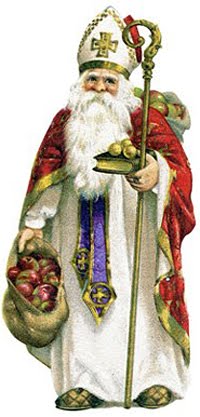
No good Catholic home is without an answer to the question of whether there is such a thing as Santa Claus. There is, but we are accustomed to the corruption of his real name, one that developed over the centuries. By the time devotion to Saint Nicholas reached Europe, he was known by different names. In the British Isles, he was "Father Christmas." In the Netherlands, he was "Sinterklaas." By the 19th century, periodicals such as Harper's Bazaar, and promoters of a fountain beverage known as Coca-Cola, had not only transformed the name, but the bright red costume with the white-fur trim, both of which we recognize today.
Whatever people call him, or however they depict him, the Bishop of Myra in the fourth century is a real person, and he presently dwells in Heaven with the Communion of Saints. Our Mother the Church celebrates his feast on the sixth of December, in both the East and the West.
VIDEO: A variation on a theme.
Nicholas was no lightweight. He was in attendance at the Council of Nicaea in the year 325, when the Arian heresy was being debated. At one point, he became so enraged with the Bishop Arius (whose errors were supported by the majority of bishops up to that time, remember?), that he supposedly punched Arius in the nose.
That's right, kids, Jolly Olde Saint Nick cold-cocked a heretic! (Some accounts say that he merely slapped Aruis, but that's so pantywaist, who'd believe it?)
Anyway, many of the bishops there, including the Emperor Constantine, were outraged by the assault, and given their sympathies, had Nicholas thrown in the dungeon. That night, the Emperor had a dream where Nicholas appeared to him, adorned in his finest liturgical vesture, and holding the Book of the Gospels. Awakened with a fright, the Emperor summoned his guards, who joined him as he raced to the dungeon, to find Nicholas unchained, adorned in ... you guessed it.
The story varies in certain details. Some accounts tell of Our Lord and Our Lady appearing to Nicholas in the dungeon. I heard the one above from an "Old Calendar" Russian Orthodox priest. It is also said that Nicholas, being restored to his rightful place in the council, slept through the rest of the proceedings.
At the little Greek Catholic parish where my son learned the Faith, as it had been taught to his mother, the Feast of Saint Nicholas is a particular cause for celebration. He is the patron of Greek Catholics, and his image graces the iconostasis on the far left side as viewed from the assembly. There is a special hymn dedicated to him ...
O kto kto, Nikolaja l'ubit,
O kto kto, Nikolaju sluzit.
Tomu svjatyj Nikolaj,
Na vsjakij cas pomahaj.
Nikolaj, Nikolaj!
O who loves Nicholas the Saintly,
O who loves Nicholas the Saintly.
Him will Nicholas receive,
and give help in time of need.
Nicholas, Nicholas!
... and the children in the School of Religion program do a pageant in his honor every Sunday closest to the sixth of December. It culminates in the arrival of an elderly man with a long white beard, dressed in the robes of a Greek Catholic bishop, with whom the children meet in much the same manner as they would his commercialized (and most inauthentic) counterpart.
Paul used to get special icon cookies to take home, much like the ones that appear in the photos, emblazoned with the words "O Holy Nicholas" in Slavonic. These unique gingerbread cookies are from a recipe which appears at the stnicholascenter.org website.
I dearly miss that little parish. It has changed over the last four decades. In 2012, they completed a new and larger house of worship, one that emulates the style common to Eastern Europe. But with every successful building project they have -- the parish hall, the rectory -- the place seems a little less homey, a little larger than life. Still, the spirit of Saint Nicholas reminds them every year, of the things that are passed on, and that remain the same.
And for those parishes of the Roman Rite, whose priests would hold off any celebration of Christmas until the day itself, and the days thereafter when everyone is out of town, they too might have at least one reason to reconsider, as Advent is not only a season of penitence, but of expectation. (This venue will provide other reasons soon, so stay tuned.)
“On the eighth day of Christmas, my true love gave to me, eight maids a-milking ...”
The Eight Maids-A-Milking reflect the Federal Minimum Wage, which remains unchanged this year. Therefore, the maids are available for $58.00 this holiday season. (In other words, up by 0.0%.)
+ + +
The world knows it as New Year's Day. The Church knows it by several other names.
First and foremost, it is the “Octave-day” or eighth day of Christmastide (or "Twelvetide," if you will). Such was its name in the earliest liturgical books, thus remembered as the day of Circumcision, when a son of Israel was marked according to the Law. (It hurts just thinking about it.)
In both forms of the Roman Rite, the brief account from Luke is proclaimed:
At that time, after eight days were accomplished, that the Child should be circumcised: His Name was called Jesus, which was called by the angel before He was conceived in the womb. (Luke 2:21)
In the reformed Missal, the day is primarily known as the Solemnity of Mary the Mother of God. While appearing as a break in tradition, it is a reminder of the Marian emphasis of the Feast, as found even in the orations of the usus antiquior. It was the tradition in Rome that the Pope would go to one of the many churches in the city, whichever was the "Station" for that particular feast -- in the case of this one, the Basilica of Saint Mary Major.
But wait, there is one more ...
In the East, today is known not only for the Circumcision, but as the Feast of Saint Basil the Great, bishop of Caesarea in the fourth century, and one of the great Fathers of the Eastern Church. Today is when the Greeks would traditionally exchange gifts. For many years, when I couldn't meet with Paul for Christmas (and as he was raised in the Byzantine Rite of his mother), I would make an occasion of this day.
With all that arcane information, you still have to admit that four names for one day are a lot. And to think the year is just getting started.
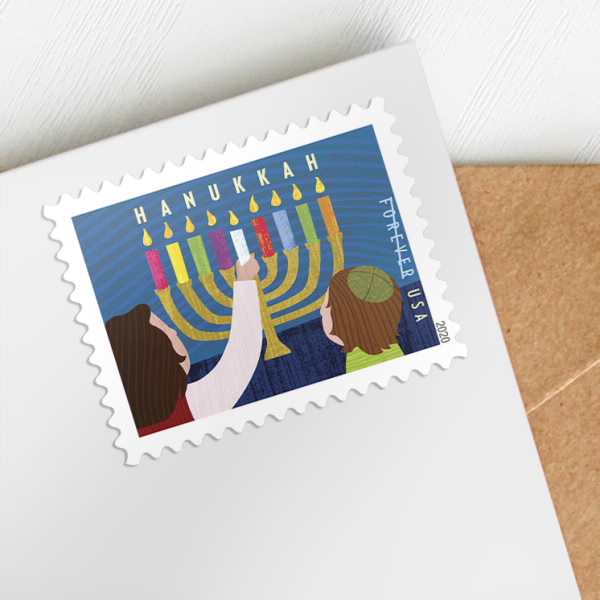
Today at sundown marks the beginning of the Jewish Festival of Lights, known as Chanukkah (also rendered as Hanukkah, and as חנוכה), which commemorates the re-dedication of the Holy Temple in Jerusalem, following the Maccabean Revolt of the 2nd century BC. It is observed for eight nights, as a reminder of the miracle of one night's supply of oil for the lamps lasting for eight, until a fresh supply could be obtained.
+ + +
It was over twenty years ago, that the communications director of my agency at the time was a devout Jewish woman, who invited all the staff to her house in the country for a holiday celebration. A highlight of the affair was her presentation with her grandchildren, as she told them of the story of Chanukkah. As the rest of us Gentiles watched, she would lead the children in the Hebrew chant for the occasion: “Blessed art Thou, Lord our God, King of the Universe, Who sanctified us by His commandments, and has commanded us to kindle the lights of Chanukkah ...” While others stood around watching in varying degrees of perplexity, I found myself singing with the children ... well, maybe sort of following along.
I turned to my son, then in his early teens, and who was raised a Greek Catholic: "Does this sound familiar, like what you hear in the Divine Liturgy?" He nodded somewhat tentatively, as I continued. "This is where we get the Byzantine chant, and the Gregorian chant. It came to us from the Jews." His eyes lit up, as he said "Ahhhh ..."
He totally got it.
+ + +
A comedian named Adam Sandler first introduced this holiday classic on NBC's Saturday Night Live. The song gives a list of famous celebrities from various walks of life who are Jewish: “Put on your yarmulke, here comes Hanukkah / It's so much funukkah, to celebrate Hanukkah / Hanukkah is the Festival of Lights / Instead of one day of presents, we get eight crazy nights!”
There's more where that came from.
This is an original work by Matisyahu. “Miracle” is produced by Dr Luke protégé Kool Kojak (Flo Rida, Katy Perry, Ke$ha), and is drenched in a joyful spirit, with chiming synths, bouncing beats, and an irresistible chorus. And ice skating. (A totally awesome a cappella rendition can be found here.)
There are so many Christmas songs out there. I wanted to give the Jewish kids something to be proud of. We've got Adam Sandler's song, which is hilarious, but I wanted to try to get across some of the depth and spirituality inherent in the holiday in a fun, celebratory song. My boy Kojak was in town so at the last minute we went into the studio in the spirit of miracles and underdogs and this is what we came up with. Happy Hannukah!
On a more serious note, Charlie Harare explains the origins of Chanukkah, and its meaning in daily life from a Jewish point of view, which is only reasonable as this is a Jewish holiday. This begs the question ...
+ + +
What is there for a Catholic in this message, and why does yours truly share it every year at this time?
As a Catholic, one believes that while the Jewish people were chosen by God under the Old Covenant, that from among their number would come as the Messiah, “He came to his own home, and his own people received him not.” (John 1:11) From this, a subset of traditionalist Catholics claim that Judaism is a "false religion." They will cite the distinction between the Hebraic Judaism of the Old Testament, and the Talmudic Judaism introduced after the destruction of the Temple, accompanied by the loss of their priesthood and the practice of offering sacrifice. Some will even maintain that those who claim to be Jewish are not descendants of the original Jews up to the time of Christ.
If that were not enough, one such individual claims that Chanukkah is a hoax, a fabricated story, when in fact the account of the Maccabean Revolt is found in the First and Second Books of Maccabees. The Jews do not include these books in the Tanakh, or Jewish bible, nor are they found among the books of the Protestant Old Testament, but they are considered to be of divine inspiration by both Catholic and Orthodox Christians. One might even say, by extension, that it was the Catholic Church that saved Chanukkah for the Jews.
So not only is there is a case for the authenticity of the story, but more important, for the manner in which it is commemorated.
As Judaism is a sign of the Old Covenant, and Christ brought it to fulfillment in the New Covenant, to be a Catholic is to be, in effect, a fulfilled Jew. We therefore cannot rule out the possibility of something to be learned here. Judaism is not a false religion; it is an unfulfilled religion. It was -- indeed, it IS -- fulfilled in the coming of the Messiah, the Christ. As for the distinction between Hebraic and Talmudic Judaism, this only reinforces that point, as by rejecting the True Messiah, the proverbial vacuum that nature would abhor was filled by something else.
If you as a Catholic don't get that after reading all this, I can't explain it to you.
When I was young and growing up in Ohio, some of my classmates would leave their shoes outside the bedroom door on the night of the fifth of December, so that Saint Nicholas would leave them treats for the next morning.
We never did that at our house, but I did ask Mom how it was that Saint Nicholas got to be called "Santa Claus." By this time I had already determined a connection between the two. But while my mother was salutatorian of her high school class -- there were only about a dozen students in her class, but I digress -- she was not one to wear her erudition on her sleeve. So, rather than go into an entymological treatise on the subject, she simply told me: “Say ‘Saint Nicholas’ three times real fast.”
That carried me over for at least a few years.
No good Catholic home is without an answer to the question of whether there is such a thing as Santa Claus. There is, but we are accustomed to the corruption of his real name, one that developed over the centuries. By the time devotion to Saint Nicholas reached Europe, he was known by different names. In the British Isles, he was "Father Christmas." In the Netherlands, he was "Sinterklaas." By the 19th century, periodicals such as Harper's Bazaar, and promoters of a fountain beverage known as Coca-Cola, had not only transformed the name, but the bright red costume with the white-fur trim, both of which we recognize today.
Whatever people call him, or however they depict him, the Bishop of Myra in the fourth century is a real person, and he presently dwells in Heaven with the Communion of Saints. Our Mother the Church celebrates his feast on the sixth of December, in both the East and the West.
VIDEO: A variation on a theme.
Nicholas was no lightweight. He was in attendance at the Council of Nicaea in the year 325, when the Arian heresy was being debated. At one point, he became so enraged with the Bishop Arius (whose errors were supported by the majority of bishops up to that time, remember?), that he supposedly punched Arius in the nose.
That's right, kids, Jolly Olde Saint Nick cold-cocked a heretic! (Some accounts say that he merely slapped Aruis, but that's so pantywaist, who'd believe it?)
Anyway, many of the bishops there, including the Emperor Constantine, were outraged by the assault, and given their sympathies, had Nicholas thrown in the dungeon. That night, the Emperor had a dream where Nicholas appeared to him, adorned in his finest liturgical vesture, and holding the Book of the Gospels. Awakened with a fright, the Emperor summoned his guards, who joined him as he raced to the dungeon, to find Nicholas unchained, adorned in ... you guessed it.
The story varies in certain details. Some accounts tell of Our Lord and Our Lady appearing to Nicholas in the dungeon. I heard the one above from an "Old Calendar" Russian Orthodox priest. It is also said that Nicholas, being restored to his rightful place in the council, slept through the rest of the proceedings.
At the little Greek Catholic parish where my son learned the Faith, as it had been taught to his mother, the Feast of Saint Nicholas is a particular cause for celebration. He is the patron of Greek Catholics, and his image graces the iconostasis on the far left side as viewed from the assembly. There is a special hymn dedicated to him ...
O kto kto, Nikolaja l'ubit,
O kto kto, Nikolaju sluzit.
Tomu svjatyj Nikolaj,
Na vsjakij cas pomahaj.
Nikolaj, Nikolaj!
O who loves Nicholas the Saintly,
O who loves Nicholas the Saintly.
Him will Nicholas receive,
and give help in time of need.
Nicholas, Nicholas!
... and the children in the School of Religion program do a pageant in his honor every Sunday closest to the sixth of December. It culminates in the arrival of an elderly man with a long white beard, dressed in the robes of a Greek Catholic bishop, with whom the children meet in much the same manner as they would his commercialized (and most inauthentic) counterpart.
Paul used to get special icon cookies to take home, much like the ones that appear in the photos, emblazoned with the words "O Holy Nicholas" in Slavonic. These unique gingerbread cookies are from a recipe which appears at the stnicholascenter.org website.
I dearly miss that little parish. It has changed over the last four decades. More than ten years ago, they completed a new and larger house of worship, one that emulates the style common to Eastern Europe. But with every successful building project they have -- the parish hall, the rectory -- the place seems a little less homey, a little larger than life. Still, the spirit of Saint Nicholas reminds them every year, of the things that are passed on, and that remain the same.
And for those parishes of the Roman Rite, whose priests would hold off any celebration of Christmas until the day itself, and the days thereafter when everyone is out of town, they too might have at least one reason to reconsider, as Advent is not only a season of penitence, but of expectation. (This venue will provide other reasons soon, so stay tuned.)
“On the eighth day of Christmas, my true love gave to me, eight maids a-milking ...”
Where were you on July 24, 2009? The Eight Maids-a-Milking were fresh off of their last pay raise. The Federal Minimum Wage hasn't changed since that date and neither has the cost of this gift. (at $58.00).
+ + +
The world knows it as New Year's Day. The Church knows it by several other names.
First and foremost, it is the “Octave-day” or eighth day of Christmastide (or "Twelvetide," if you will). Such was its name in the earliest liturgical books, thus remembered as the day of Circumcision, when a son of Israel was marked according to the Law. (It hurts just thinking about it.)
In both forms of the Roman Rite, the brief account from Luke is proclaimed:
At that time, after eight days were accomplished, that the Child should be circumcised: His Name was called Jesus, which was called by the angel before He was conceived in the womb. (Luke 2:21)
In the reformed Missal, the day is primarily known as the Solemnity of Mary the Mother of God. While appearing as a break in tradition, it is a reminder of the Marian emphasis of the Feast, as found even in the orations of the usus antiquior. It was the tradition in Rome that the Pope would go to one of the many churches in the city, whichever was the "Station" for that particular feast -- in the case of this one, the Basilica of Saint Mary Major.
But wait, there is one more ...
In the East, today is known not only for the Circumcision, but as the Feast of Saint Basil the Great, bishop of Caesarea in the fourth century, and one of the great Fathers of the Eastern Church. Today is when the Greeks would traditionally exchange gifts. For many years, when I couldn't meet with Paul for Christmas (and as he was raised in the Byzantine Rite of his mother), I would make an occasion of this day.
With all that arcane information, you still have to admit that four names for one day are a lot. And to think the year is just getting started.
Today at sundown marks the beginning of the Jewish Festival of Lights, known as Chanukkah (also rendered as Hanukkah, and as חנוכה), which commemorates the re-dedication of the Holy Temple in Jerusalem, following the Maccabean Revolt of the 2nd century BC. It is observed for eight nights, as a reminder of the miracle of one night's supply of oil for the lamps lasting for eight, until a fresh supply could be obtained.
+ + +
It was over twenty years ago, that the communications director of my agency at the time was a devout Jewish woman, who invited all the staff to her house in the country for a holiday celebration. A highlight of the affair was her presentation with her grandchildren, as she told them of the story of Chanukkah. As the rest of us Gentiles watched, she would lead the children in the Hebrew chant for the occasion: “Blessed art Thou, Lord our God, King of the Universe, Who sanctified us by His commandments, and has commanded us to kindle the lights of Chanukkah ...” While others stood around watching in varying degrees of perplexity, I found myself singing with the children ... well, maybe sort of following along.
I turned to my son, then in his early teens, and who was raised a Greek Catholic: "Does this sound familiar, like what you hear in the Divine Liturgy?" He nodded somewhat tentatively, as I continued. "This is where we get the Byzantine chant, and the Gregorian chant. It came to us from the Jews." His eyes lit up, as he said "Ahhhh ..."
He totally got it.
+ + +
A comedian named Adam Sandler first introduced his own holiday classic on NBC's Saturday Night Live. The song gives a list of famous celebrities from various walks of life who are Jewish: “Put on your yarmulke, here comes Hanukkah / It's so much funukkah, to celebrate Hanukkah / Hanukkah is the Festival of Lights / Instead of one day of presents, we get eight crazy nights!”
There's more where that came from.
This is an original work by Matisyahu. “Miracle” is produced by Dr Luke protégé Kool Kojak (Flo Rida, Katy Perry, Ke$ha), and is drenched in a joyful spirit, with chiming synths, bouncing beats, and an irresistible chorus. And ice skating. (A totally awesome a cappella rendition can be found here.)
There are so many Christmas songs out there. I wanted to give the Jewish kids something to be proud of. We've got Adam Sandler's song, which is hilarious, but I wanted to try to get across some of the depth and spirituality inherent in the holiday in a fun, celebratory song. My boy Kojak was in town so at the last minute we went into the studio in the spirit of miracles and underdogs and this is what we came up with. Happy Hannukah!
Matisyahu can be found on Facebook, and followed on Twitter.
On a more serious note, Charlie Harare explains the origins of Chanukkah, and its meaning in daily life from a Jewish point of view, which is only reasonable as this is a Jewish holiday. This begs the question ...
+ + +
What is there for a Catholic in this message, and why does yours truly share it every year at this time?
As a Catholic, one believes that while the Jewish people were chosen by God under the Old Covenant, that from among their number would come as the Messiah, “He came to his own home, and his own people received him not.” (John 1:11) From this, a subset of traditionalist Catholics claim that Judaism is a "false religion." They will cite the distinction between the Hebraic Judaism of the Old Testament, and the Talmudic Judaism introduced after the destruction of the Temple, accompanied by the loss of their priesthood and the practice of offering sacrifice. Some will even maintain that those who claim to be Jewish are not descendants of the original Jews up to the time of Christ.
If that were not enough, one such individual claims that Chanukkah is a hoax, a fabricated story, when in fact the account of the Maccabean Revolt is found in the First and Second Books of Maccabees. The Jews do not include these books in the Tanakh, or Jewish bible, nor are they found among the books of the Protestant Old Testament, but they are considered to be of divine inspiration by both Catholic and Orthodox Christians. One might even say, by extension, that it was the Catholic Church that saved Chanukkah for the Jews.
So not only is there is a case for the authenticity of the story, but more important, for the manner in which it is commemorated.
As Judaism is a sign of the Old Covenant, and Christ brought it to fulfillment in the New Covenant, to be a Catholic is to be, in effect, a fulfilled Jew. We therefore cannot rule out the possibility of something to be learned here. Judaism is not a false religion; it is an unfulfilled religion. It was -- indeed, it IS -- fulfilled in the coming of the Messiah, the Christ. As for the distinction between Hebraic and Talmudic Judaism, this only reinforces that point, as by rejecting the True Messiah, the proverbial vacuum that nature would abhor was filled by something else.
If you as a Catholic don't get that after watching this video, I can't explain it to you.
When I was young and growing up in Ohio, some of my classmates would leave their shoes outside the bedroom door on the night of the fifth of December, so that Saint Nicholas would leave them treats for the next morning.
We never did that at our house, but I did ask Mom how it was that Saint Nicholas got to be called "Santa Claus." By this time I had already determined a connection between the two. But while my mother was salutatorian of her high school class -- there were only about a dozen students in her class, but I digress -- she was not one to wear her erudition on her sleeve. So, rather than go into an entymological treatise on the subject, she simply told me: “Say ‘Saint Nicholas’ three times real fast.”
That carried me over for at least a few years.
No good Catholic home is without an answer to the question of whether there is such a thing as Santa Claus. There is, but we are accustomed to the corruption of his real name, one that developed over the centuries. By the time devotion to Saint Nicholas reached Europe, he was known by different names. In the British Isles, he was "Father Christmas." In the Netherlands, he was "Sinterklaas." By the 19th century, periodicals such as Harper's Bazaar, and promoters of a fountain beverage known as Coca-Cola, had not only transformed the name, but the bright red costume with the white-fur trim, both of which we recognize today.
Whatever people call him, or however they depict him, the Bishop of Myra in the fourth century is a real person, and he presently dwells in Heaven with the Communion of Saints. Our Mother the Church celebrates his feast on the sixth of December, in both the East and the West.
VIDEO: A variation on a theme.
Nicholas was no lightweight. He was in attendance at the Council of Nicaea in the year 325, when the Arian heresy was being debated. At one point, he became so enraged with the Bishop Arius (whose errors were supported by the majority of bishops up to that time, remember?), that he supposedly punched Arius in the nose.
That's right, kids, Jolly Olde Saint Nick cold-cocked a heretic! (Some accounts say that he merely slapped Aruis, but that's so pantywaist, who'd believe it?)
Anyway, many of the bishops there, including the Emperor Constantine, were outraged by the assault, and given their sympathies, had Nicholas thrown in the dungeon. That night, the Emperor had a dream where Nicholas appeared to him, adorned in his finest liturgical vesture, and holding the Book of the Gospels. Awakened with a fright, the Emperor summoned his guards, who joined him as he raced to the dungeon, to find Nicholas unchained, adorned in ... you guessed it.
The story varies in certain details. Some accounts tell of Our Lord and Our Lady appearing to Nicholas in the dungeon. I heard the one above from an "Old Calendar" Russian Orthodox priest. It is also said that Nicholas, being restored to his rightful place in the council, slept through the rest of the proceedings.
At the little Greek Catholic parish where my son learned the Faith, as it had been taught to his mother, the Feast of Saint Nicholas is a particular cause for celebration. He is the patron of Greek Catholics, and his image graces the iconostasis on the far left side as viewed from the assembly. There is a special hymn dedicated to him ...
O kto kto, Nikolaja l'ubit,
O kto kto, Nikolaju sluzit.
Tomu svjatyj Nikolaj,
Na vsjakij cas pomahaj.
Nikolaj, Nikolaj!
O who loves Nicholas the Saintly,
O who loves Nicholas the Saintly.
Him will Nicholas receive,
and give help in time of need.
Nicholas, Nicholas!
... and the children in the School of Religion program do a pageant in his honor every Sunday closest to the sixth of December. It culminates in the arrival of an elderly man with a long white beard, dressed in the robes of a Greek Catholic bishop, with whom the children meet in much the same manner as they would his commercialized (and most inauthentic) counterpart.
Paul used to get special icon cookies to take home, much like the ones that appear in the photos, emblazoned with the words "O Holy Nicholas" in Slavonic. These unique gingerbread cookies are from a recipe which appears at the stnicholascenter.org website.
I dearly miss that little parish. It has changed over nearly four decades. About ten years ago, they completed a new and larger house of worship, one that emulates the style common to Eastern Europe. But with every successful building project they have -- the parish hall, the rectory -- the place seems a little less homey, a little larger than life. Still, the spirit of Saint Nicholas reminds them every year, of the things that are passed on, and that remain the same.
And for those parishes of the Roman Rite, whose priests would hold off any celebration of Christmas until the day itself, and the days thereafter when everyone is out of town, they too might have at least one reason to reconsider, as Advent is not only a season of penitence, but of expectation. (This venue will provide other reasons soon, so stay tuned.)
“Memento, homo, quia pulvis es, et in pulverem reverteris.”
There was a time, when blogging was more the realm of the common aspirant, and before the Catholic media giants took over, that any number of participants in the Catholic blogosphere would announce, with some measure of fanfare, that they were giving up blogging and other forms of social media for Lent (or, in one case, announcing giving up blogging, and then spending more time on social media, and you know who you were, Skippy!). We were supposed to admire them. I remember many of them. They did us all a big favor. And then they came back.
And so, at a place well outside the Celebrity Convert Circuit, what follows is why I'm not giving up blogging for Lent. In addition, while not a complete treatise on the subject, this piece will serve to clear up some heretofore little-known aspects of the season.
+ + +
The Christian calendar has traditionally had numerous periods of fasting in anticipation of great feasts. In some parts of Europe, the "Saint Martin's Fast" would begin on the 11th of November ("Martinmas"), and continue until Christmas. Officially, however, the Roman (Latin) tradition would not begin the penitential season until the four Sundays before Christmas, the time of which is known as "Advent," or "the Coming." There were also the "Ember Days," three days of penance each occurring on a quarterly basis throughout the year. But it was the season of Lent which is known as "The Great Fast" of the Liturgical Year.
People assume that Lent is the only time for giving up something, when it isn't. People also assume that giving up something involves making a big to-do about it, when it shouldn't. Attending daily Mass is a popular exercise, and in most major cities where there are urban parishes near a business district, there's an extra scheduled weekday Mass -- and extra time for confessions -- during the season. These things don't always call attention to themselves. They shouldn't.
But don't take MY word for it.
At that time, Jesus said to his disciples: “Take care not to perform righteous deeds in order that people may see them; otherwise, you will have no recompense from your heavenly Father. When you give alms, do not blow a trumpet before you, as the hypocrites do in the synagogues and in the streets to win the praise of others. Amen, I say to you, they have received their reward. But when you give alms, do not let your left hand know what your right is doing, so that your almsgiving may be secret. And your Father who sees in secret will repay you.
“When you pray, do not be like the hypocrites, who love to stand and pray in the synagogues and on street corners so that others may see them. Amen, I say to you, they have received their reward. But when you pray, go to your inner room, close the door, and pray to your Father in secret. And your Father who sees in secret will repay you.
“When you fast, do not look gloomy like the hypocrites. They neglect their appearance, so that they may appear to others to be fasting. Amen, I say to you, they have received their reward. But when you fast, anoint your head and wash your face, so that you may not appear to be fasting, except to your Father who is hidden. And your Father who sees what is hidden will repay you.” sees what is hidden will repay you.” (Matthew 6:1-6, 16-18)
And speaking of the season, it doesn't necessarily start right away. The traditional Roman calendar precedes Lent with three Sundays collectively known as "Septuagesima" (literally "seventy days" but actually "within the octave of seventy days"). They were termed "Septuagesima Sunday," "Sexagesima Sunday," and "Quinquagesima Sunday," respectively. As with Lent, the priest wears violet vestments, the Gloria is not sung, and the Tract replaces the Alleluia before the Gospel. But unlike Lent, the musical accompaniment is not restricted, and flowers and other suitable decor can be placed on the reredos behind the altar, as normally done during the year.
This is also the inspiration for the pre-Lenten celebration known as “Carnival” (from the Latin for “farewell to meat”).
Meanwhile, on the eastern side of the tracks, the Byzantine Rite has five special Sundays preceding their "Great Fast": "Zacchaeus Sunday" (if only in the Slavic churches), "The Sunday of the Publican and Pharisee," "The Sunday of the Prodigal Son," "Meatfare Sunday" (or "The Sunday of the Last Judgment," when the faithful begin abstaining from meat), and "Cheesefare Sunday" (when the faithful begin abstaining from dairy products, which for them would include eggs, don't ask me why). The following day is when the the Fast begins in the East, and is generally known as "Clean Monday."
There was also a time when weddings were not permitted during Advent or Lent, unless there was a serious reason. And if one was allowed, the altar and sanctuary could not be decorated as it could otherwise be for the occasion. (Try that today, and see a young lady get in touch with her inner Bridezilla. I've seen it. It's not pretty.)
+ + +
So right now you're saying, “Pray tell us, O Black Hatted One, as you are a veritable fountain of arcane and useless knowledge, how does it explain why you're not giving up blogging for Lent?”
Well, my little minions, there is much, much more to Lent than giving up things, never mind making a big-@$$ whoop-dee-do out of it. There is a significance in the marking of sacred time, something lost on a people whose solemnities all get moved to the nearest Sunday. But you wouldn't know all that if there was no one to tell you along the way, now, would you? Duh, guess not! Besides, I had to work in all that arcane and useless knowledge somehow.
To the extent that this corner of the interwebs identifies itself as "Catholic," its author is engaged in what could be considered a propagation of the Faith. And in case it isn't obvious by now,
But still, you must be wondering if yours truly is actually giving up anything for Lent. Well, yes, and it's something really important.
The world knows it as New Year's Day. The Church knows it by several other names.
First and foremost, it is the “Octave-day” or eighth day of Christmastide (or "Twelvetide," if you will). Such was its name in the earliest liturgical books, thus remembered as the day of Circumcision, when a son of Israel was marked according to the Law. (It hurts just thinking about it.)
In both forms of the Roman Rite, the brief account from Luke is proclaimed:
At that time, after eight days were accomplished, that the Child should be circumcised: His Name was called Jesus, which was called by the angel before He was conceived in the womb. (2:21)
In the reformed Missal, the day is primarily known as the Solemnity of Mary the Mother of God. While appearing as a break in tradition, it is a reminder of the Marian emphasis of the Feast, as found even in the orations of the pre-conciliar Missal. It was the tradition in Rome, that the Pope would go to one of the many churches in the city, whichever was the "Station" for that particular feast -- in the case of this one, the Basilica of Saint Mary Major.
But wait, there is one more ...
In the East, today is known not only for the Circumcision, but as the Feast of Saint Basil the Great, bishop of Caesarea in the fourth century, and one of the great Fathers of the Eastern Church. Today is when the Greeks would traditionally exchange gifts. For many years, when I couldn't meet with Paul for Christmas (and as he was raised in the Byzantine Rite of his mother), I would make an occasion of this day.
With all that arcane information, you still have to admit that four names for one day are a lot. And to think the year is just getting started.
When I was young and growing up in Ohio, some of my classmates would leave their shoes outside the bedroom door on the night of the fifth of December, so that Saint Nicholas would leave them treats for the next morning.
We never did that at our house, but I did ask Mom how it was that Saint Nicholas got to be called Santa Claus. By this time I had already determined a connection between the two. But while my mother was salutatorian of her high school class -- there were about a dozen students in her class at most, but I digress -- she was not one to wear her erudition on her sleeve. So, rather than go into an entymological treatise on the subject, she simply told me: “Say ‘Saint Nicholas’ three times real fast.”
That carried me over for at least a few years.
No good Catholic home is without an answer to the question of whether there is such a thing as Santa Claus. There is, but we are accustomed to the corruption of his real name, one that developed over the centuries. By the time devotion to Saint Nicholas reached Europe, he was known by different names. In the British Isles, he was "Father Christmas." In the Netherlands, he was "Sinterklaas." By the 19th century, periodicals such as Harper's Bazaar, and promoters of a fountain beverage known as Coca-Cola, had not only transformed the name, but the bright red costume with the white-fur trim, both of which we recognize today.
Whatever people call him, or however they depict him, the Bishop of Myra in the fourth century is a real person, and he presently dwells in Heaven with the Communion of Saints. Our Mother the Church celebrates his feast on the sixth of December, in both the East and the West.
VIDEO: A variation on a theme.
Nicholas was no lightweight. He was in attendance at the Council of Nicaea in the year 325, when the Arian heresy was being debated. At one point, he became so enraged with the Bishop Arius (whose errors were supported by the majority of bishops up to that time, remember?), that he supposedly punched Arius in the nose.
That's right, kids, Jolly Olde Saint Nick cold-cocked a heretic! (Some accounts say that he merely slapped him, but that's so pantywaist, who'd believe it?)
Anyway, many of the bishops there, including the Emperor Constantine, were scandalized by the assault, and given their sympathies, had Nicholas thrown in the dungeon. That night, the Emperor had a dream where Nicholas appeared to him, adorned in his finest liturgical vesture, and holding the Book of the Gospels. Awakened with a fright, the Emperor summoned his guards, who joined him as he raced to the dungeon, to find Nicholas unchained, with ... you guessed it.
The story varies in certain details. Some accounts tell of Our Lord and Our Lady appearing to Nicholas in the dungeon. I heard the above account from an "Old Calendar" Russian Orthodox priest. It is also said that Nicholas, now restored to his rightful place in the council, slept through the rest of the proceedings.
I can't say I blame him.
At the little Byzantine Rite parish where my son learned the Faith, as it had been taught to his mother, the Feast of Saint Nicholas is a particular cause for celebration. He is the patron of Byzantine Catholics, and his image graces the iconostasis on the far left side as viewed from the assembly. There is a special hymn dedicated to him ...
O kto kto, Nikolaja l'ubit,
O kto kto, Nikolaju sluzit.
Tomu svjatyj Nikolaj,
Na vsjakij cas pomahaj.
Nikolaj, Nikolaj!
O who loves Nicholas the Saintly,
O who loves Nicholas the Saintly.
Him will Nicholas receive,
and give help in time of need.
Nicholas, Nicholas!
... and the children in the School of Religion program do a pageant in his honor every Sunday closest to the sixth of December. It culminates in the arrival of an elderly man with a long white beard, dressed in the robes of a Greek Catholic bishop, with whom the children meet in much the same manner as they would his commercialized (and most inauthentic) counterpart.
Paul used to get special icon cookies to take home, much like the ones that appear in the photos, emblazoned with the words "O Holy Nicholas" in Slavonic. These unique gingerbread cookies are from a recipe which appears at the stnicholascenter.org website.
I dearly miss that little parish. It has changed over nearly four decades. About ten years ago, they completed a new and larger house of worship, one that emulates the style common to Eastern Europe. But with every successful building project they have -- the parish hall, the rectory -- the place seems a little less homey, a little larger than life. Still, the spirit of Saint Nicholas reminds them every year, of the things that are passed on, and that remain the same.
And for those parishes of the Roman Rite, whose priests would hold off any celebration of Christmas until the day itself, and the days thereafter when everyone is out of town, they too might have at least one reason to reconsider, as Advent is not only a season of penitence, but of expectation. (This venue will provide other reasons soon, so stay tuned.)
Today at sundown marks the beginning of the Jewish Festival of Lights, known as Chanukkah (also rendered as Hanukkah, and as חנוכה), which commemorates the re-dedication of the Holy Temple in Jerusalem, following the Maccabean Revolt of the 2nd century BC. It is observed for eight nights, as a reminder of the miracle of one night's supply of oil for the lamps lasting for eight, until a fresh supply could be obtained.
+ + +
It was over twenty years ago, that the communications director of my agency at the time was a devout Jewish woman, who invited all the staff to her house in the country for a holiday celebration. A highlight of the affair was her presentation with her grandchildren, as she told them of the story of Chanukkah. As the rest of us Gentiles watched, she would lead the children in the Hebrew chant for the occasion: “Blessed art Thou, Lord our God, King of the Universe, Who sanctified us by His commandments, and has commanded us to kindle the lights of Chanukkah ...” While others stood around watching in varying degrees of perplexity, I found myself singing with the children ... well, maybe sort of following along.
I turned to my son, then in his early teens, and who was raised a Greek Catholic: "Does this sound familiar, like what you hear in the Divine Liturgy?" He nodded somewhat tentatively, as I continued. "This is where we get the Byzantine chant, and the Gregorian chant. It came to us from the Jews." His eyes lit up, as he said "Ahhhh ..."
He totally got it.
+ + +
A comedian named Adam Sandler first introduced this holiday classic on NBC's Saturday Night Live. The song gives a list of famous celebrities from various walks of life who are Jewish: “Put on your yarmulke, here comes Hanukkah / It's so much funukkah, to celebrate Hanukkah / Hanukkah is the Festival of Lights / Instead of one day of presents, we get eight crazy nights!”
There's more where that came from.
This is an original work by Matisyahu. “Miracle” is produced by Dr Luke protégé Kool Kojak (Flo Rida, Katy Perry, Ke$ha), and is drenched in a joyful spirit, with chiming synths, bouncing beats, and an irresistible chorus. And ice skating. (A totally awesome a cappella rendition can be found here.)
There are so many Christmas songs out there. I wanted to give the Jewish kids something to be proud of. We've got Adam Sandler's song, which is hilarious, but I wanted to try to get across some of the depth and spirituality inherent in the holiday in a fun, celebratory song. My boy Kojak was in town so at the last minute we went into the studio in the spirit of miracles and underdogs and this is what we came up with. Happy Hannukah!
Matisyahu can be found on Facebook, and followed on Twitter.
On a more serious note, Charlie Harare explains the origins of Chanukkah, and its meaning in daily life from a Jewish point of view, which is only reasonable as this is a Jewish holiday. This begs the question ...
+ + +
What is there for a Catholic in this message, and why does yours truly share it every year at this time?
As a Catholic, one believes that while the Jewish people were chosen by God under the Old Covenant, that from among their number would come as the Messiah, “He came to his own home, and his own people received him not.” (John 1:11) From this, a subset of traditionalist Catholics claim that Judaism is a "false religion." They will cite the distinction between the Hebraic Judaism of the Old Testament, and the Talmudic Judaism introduced after the destruction of the Temple, accompanied by the loss of their priesthood and the practice of offering sacrifice. Some will even maintain that those who claim to be Jewish are not descendants of the original Jews up to the time of Christ.
If that were not enough, one such individual claims that Chanukkah is a hoax, a fabricated story, when in fact the account of the Maccabean Revolt is found in the First and Second Books of Maccabees. The Jews do not include these books in the Tanakh, or Jewish bible, nor are they found among the books of the Protestant Old Testament, but they are considered to be of divine inspiration by both Catholic and Orthodox Christians. One might even say, by extension, that it was the Catholic Church that saved Chanukkah for the Jews.
So not only is there is a case for the authenticity of the story, but more important, for the manner in which it is commemorated.
As Judaism is a sign of the Old Covenant, and Christ brought it to fulfillment in the New Covenant, to be a Catholic is to be, in effect, a fulfilled Jew. We therefore cannot rule out the possibility of something to be learned here. Judaism is not a false religion; it is an unfulfilled religion. It was -- indeed, it IS -- fulfilled in the coming of the Messiah, the Christ. As for the distinction between Hebraic and Talmudic Judaism, this only reinforces that point, as by rejecting the True Messiah, the proverbial vacuum that nature would abhor was filled by something else.
If you as a Catholic don't get that after watching this video, I can't explain it to you.
“Memento, homo, quia pulvis es, et in pulverem reverteris.”
There was a time, when blogging was more the realm of the common aspirant, and before the Catholic media giants took over, that any number of participants in the Catholic blogosphere would announce, with some measure of fanfare, that they were giving up blogging and other forms of social media for Lent (or, in one case, announcing giving up blogging, and then spending more time on social media, and you know who you were, Skippy!). We were supposed to admire them. I remember many of them. They did us all a big favor. And then they came back.
And so, at a place well outside the Celebrity Convert Circuit, what follows is why I'm not giving up blogging for Lent. In addition, while not a complete treatise on the subject, this piece will serve to clear up some heretofore little-known aspects of the season.
The Christian calendar has traditionally had numerous periods of fasting in anticipation of great feasts. In some parts of Europe, the "Saint Martin's Fast" would begin on the 11th of November ("Martinmas"), and continue until Christmas. Officially, however, the Roman (Latin) tradition would not begin the penitential season until the four Sundays before Christmas, the time of which is known as "Advent," or "the Coming." There were also the "Ember Days," three days of penance each occurring on a quarterly basis throughout the year. But it was the season of Lent which is known as "The Great Fast" of the Year of Grace.
People assume that Lent is the only time for giving up something, when it isn't. People also assume that giving up something involves making a big to-do about it, when it shouldn't. Attending daily Mass is a popular exercise, and in most major cities where there are urban parishes near a business district, there's an extra scheduled weekday Mass -- and extra time for confessions -- during the season. These things don't always call attention to themselves. They shouldn't.
But don't take MY word for it.
At that time, Jesus said to his disciples: “Take care not to perform righteous deeds in order that people may see them; otherwise, you will have no recompense from your heavenly Father. When you give alms, do not blow a trumpet before you, as the hypocrites do in the synagogues and in the streets to win the praise of others. Amen, I say to you, they have received their reward. But when you give alms, do not let your left hand know what your right is doing, so that your almsgiving may be secret. And your Father who sees in secret will repay you.
“When you pray, do not be like the hypocrites, who love to stand and pray in the synagogues and on street corners so that others may see them. Amen, I say to you, they have received their reward. But when you pray, go to your inner room, close the door, and pray to your Father in secret. And your Father who sees in secret will repay you.
“When you fast, do not look gloomy like the hypocrites. They neglect their appearance, so that they may appear to others to be fasting. Amen, I say to you, they have received their reward. But when you fast, anoint your head and wash your face, so that you may not appear to be fasting, except to your Father who is hidden. And your Father who sees what is hidden will repay you.” sees what is hidden will repay you.” (Matthew 6:1-6, 16-18)
And speaking of the season, it doesn't necessarily start right away. The traditional Roman calendar precedes Lent with three Sundays collectively known as "Septuagesima" (literally "seventy days" but actually "within the octave of seventy days"). They were termed "Septuagesima Sunday," "Sexagesima Sunday," and "Quinquagesima Sunday," respectively. As with Lent, the priest wears violet vestments, the Gloria is not sung, and the Tract replaces the Alleluia before the Gospel. But unlike Lent, the musical accompaniment is not restricted, and flowers and other suitable decor can be placed on the reredos behind the altar, as normally done during the year.
This is also the inspiration for the pre-Lenten celebration known as “Carnival” (from the Latin for “farewell to meat”).
Meanwhile, on the eastern side of the tracks, the Byzantine Rite has five special Sundays preceding their "Great Fast": "Zacchaeus Sunday" (if only in the Slavic churches), "The Sunday of the Publican and Pharisee," "The Sunday of the Prodigal Son," "Meatfare Sunday" (or "The Sunday of the Last Judgment," when the faithful begin abstaining from meat), and "Cheesefare Sunday" (when the faithful begin abstaining from dairy products, which for them would include eggs, don't ask me why). The following day is when the the Fast begins in the East, and is generally known as "Clean Monday."
There was also a time when weddings were not permitted during Advent or Lent, unless there was a serious reason. And if one was allowed, the altar and sanctuary could not be decorated as it could otherwise be for the occasion. (Try that today, and see a young lady get in touch with her inner Bridezilla. I've seen it. It's not pretty.)
So right now you're saying, “Pray tell us, O Black Hatted One, as you are a veritable fountain of arcane and useless knowledge, how does it explain why you're not giving up blogging for Lent?”
Well, my little minions, there is much, much more to Lent than giving up things, never mind making a big-@$$ whoop-dee-do out of it. There is a significance in the marking of sacred time, something lost on a people whose solemnities all get moved to the nearest Sunday. But you wouldn't know all that if there was no one to tell you along the way, now, would you? Duh, guess not! Besides, I had to work in all that arcane and useless knowledge somehow.
To the extent that man with black hat identifies itself as "Catholic," its author is engaged in what could be considered a propagation of the Faith. And in case it isn't obvious by now,
But still, you must be wondering if yours truly is actually giving up anything for Lent. Well, yes, and it's something really important.
The world knows it as New Year's Day. The Church knows it by several other names.
First and foremost, it is the “Octave-day” or eighth day of Christmastide. Such was its name in the earliest liturgical books, thus remembered as the day of Circumcision, when a son of Israel was marked according to the Law. (It hurts just thinking about it.)
In both forms of the Roman Rite, the brief account from Luke is proclaimed:
At that time, after eight days were accomplished, that the Child should be circumcised: His Name was called Jesus, which was called by the angel before He was conceived in the womb. (2:21)
In the reformed Missal, the day is primarily known as the Solemnity of Mary the Mother of God. While appearing as a break in tradition, it is a reminder of the Marian emphasis of the Feast, as found even in the orations of the pre-conciliar Missal. It was the tradition in Rome, that the Pope would go to one of the many churches in the city, whichever was the "Station" for that particular feast -- in the case of this one, the Basilica of Saint Mary Major.
But wait, there is one more ...
In the East, today is known not only for the Circumcision, but as the Feast of Saint Basil the Great, bishop of Caesarea in the fourth century, and one of the great Fathers of the Eastern Church. Today is when the Greeks would traditionally exchange gifts. For many years, when I couldn't meet with Paul for Christmas (and as he was raised in the Byzantine Rite of his mother), I would make an occasion of this day.
With all that arcane information, you still have to admit that four names for one day are a lot. And to think the year is just getting started.
Today at sundown marks the beginning of the Jewish Festival of Lights, known as Chanukkah (also rendered as Hanukkah, and as חנוכה), which commemorates the re-dedication of the Holy Temple in Jerusalem, following the Maccabean Revolt of the 2nd century BC. It is observed for eight nights, as a reminder of the miracle of one night's supply of oil for the lamps lasting for eight, until a fresh supply could be obtained.
+ + +
It was twenty years ago, that the communications director of my agency at the time was a devout Jewish woman, who invited all the staff to her house in the country for a holiday celebration. A highlight of the affair was her presentation with her grandchildren, as she told them of the story of Chanukkah. As the rest of us Gentiles watched, she would lead the children in the Hebrew chant for the occasion: “Blessed art Thou, Lord our God, King of the Universe, Who sanctified us by His commandments, and has commanded us to kindle the lights of Chanukkah ...” While others stood around watching in varying degrees of perplexity, I found myself singing with the children ... well, maybe sort of following along.
I turned to my son, then in his early teens, and who was raised a Greek Catholic: "Does this sound familiar, like what you hear in the Divine Liturgy?" He nodded, as I continued. "This is where we get the Byzantine chant, and the Gregorian chant. It came to us from the Jews." His eyes lit up, as he said "Ahhhh ..."
He totally got it.
+ + +
A comedian named Adam Sandler first introduced this holiday classic on NBC's Saturday Night Live. The song gives a list of famous celebrities from various walks of life who are Jewish: “Put on your yarmulke, here comes Hanukkah / It's so much funukkah, to celebrate Hanukkah / Hanukkah is the Festival of Lights / Instead of one day of presents, we get eight crazy nights!”
There's more where that came from.
This is an original work by Matisyahu. “Miracle” is produced by Dr Luke protégé Kool Kojak (Flo Rida, Katy Perry, Ke$ha), and is drenched in a joyful spirit, with chiming synths, bouncing beats, and an irresistible chorus. And ice skating. (A totally awesome a cappella rendition can be found here.)
There are so many Christmas songs out there. I wanted to give the Jewish kids something to be proud of. We've got Adam Sandler's song, which is hilarious, but I wanted to try to get across some of the depth and spirituality inherent in the holiday in a fun, celebratory song. My boy Kojak was in town so at the last minute we went into the studio in the spirit of miracles and underdogs and this is what we came up with. Happy Hannukah!
Matisyahu can be found on Facebook, and followed on Twitter.
On a more serious note, Charlie Harare explains the origins of Chanukkah, and its meaning in daily life from a Jewish point of view, which is only reasonable as this is a Jewish holiday. This begs the question ...
+ + +
What is there for a Catholic in this message, and why does yours truly share it every year at this time?
As a Catholic, one believes that while the Jewish people were chosen by God under the Old Covenant, that from among their number would come as the Messiah, “He came to his own home, and his own people received him not.” (John 1:11) From this, a subset of traditionalist Catholics claim that Judaism is a "false religion." They will cite the distinction between the Hebraic Judaism of the Old Testament, and the Talmudic Judaism introduced after the destruction of the Temple, accompanied by the loss of their priesthood and the practice of offering sacrifice. Some will even maintain that those who claim to be Jewish are not descendants of the original Jews up to the time of Christ.
If that were not enough, one such individual claims that Chanukkah is a hoax, a fabricated story, when in fact the account of the Maccabean Revolt is found in the First and Second Books of Maccabees. The Jews do not include these books in the Tanakh, or Jewish bible, nor are they found among the books of the Protestant Old Testament, but they are considered to be of divine inspiration by both Catholic and Orthodox Christians. One might even say, by extension, that it was the Catholic Church that saved Chanukkah for the Jews.
So not only is there is a case for the authenticity of the story, but more important, for the manner in which it is commemorated.
As Judaism is a sign of the Old Covenant, and Christ brought it to fulfillment in the New Covenant, to be a Catholic is to be, in effect, a fulfilled Jew. We therefore cannot rule out the possibility of something to be learned here. Judaism is not a false religion; it is an unfulfilled religion. It was -- indeed, it IS -- fulfilled in the coming of the Messiah, the Christ. As for the distinction between Hebraic and Talmudic Judaism, this only reinforces that point, as by rejecting the True Messiah, the proverbial vacuum that nature would abhor was filled by something else.
If you as a Catholic don't get that after watching this video, I can't explain it to you.
 “On the eighth day of Christmas, my true love gave to me, eight maids a-milking ...”
 But wait, there is one more ...