Showing posts with label food. Show all posts

Monday, March 17, 2025

My Annual Über-Celtic Moment

Sorry, kids, it's on a Monday this year.

Today the Church celebrates the feast of Saint Patrick (387-493), the patron saint of Ireland. It is on the Emerald Isle that today is both a national and religious holiday. At one time, the bars would close and the churches would be full out of obligation. Only in recent years has the feast seen a more rebellious spirit, complete with parades and green beer (not to mention green hair). Naturally (if ironically), they have the Americans to thank for this.

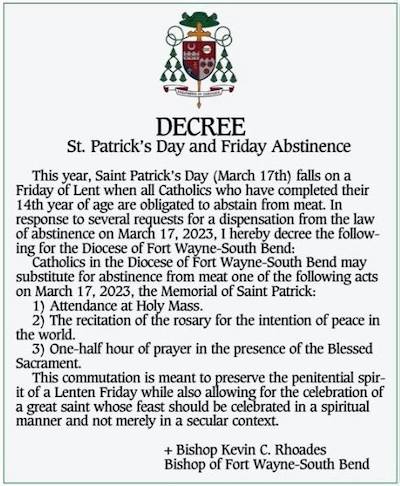
And, since the feast usually takes place during Lent, there are times such as shown above, when some of us are permitted on a day of abstinence to indulge a wee bit more than others.

+    +    +

Growing up in a postwar Catholic environment, those of us who attended the parish schools in the United States, were taught that there were two kinds of people; those who were Irish, and those who wish they were. My own family appeared to fall into neither category. There were the Irish nuns who favored the Irish kids, including the unforgettable Sister Mary Mel (yes, her real name), who wasn't above calling some miscreant a "jackass" (including my kid brother, as evesdropping on a phone call with Mom gave away).

But hey, at least she was colorful.

The rest of all things that were allegedly Irish were just so much blarney. I came to dismiss the whole notion of St Paddy's Day -- indeed, the whole notion of being Irish -- as a license for certain people to be more arrogant and obnoxious than they already were.

"Hail glorious Saint Patrick dear saint of our isle
On us thy poor children look down with a smile —"
But I'm not singing hymns and I'm not saying prayers
No, I'm gritting my teeth as I walk down the stairs

And into the street with these louts fiercely drinking
And screeching and lurching, and here's what I'm thinking —
They're using a stereotype, a narrow example,
A fraction, not even a marketing sample

To imitate Ireland, from which they don't come!
So unless that's just stupid, unless it's plain dumb,
All these kids from New Jersey and the five boroughs
And hundreds of cities, all drowning their sorrows,

With bottles and glasses and heads getting broken
(Believe me, just ask the mayor of Hoboken)
All that mindlessness, shouting and getting plain stocious —
That isn't Irish, that's simply atrocious.

I've another word too for it, this one's more stinging
I call it "racism." See, just 'cause you're singing
Some drunken old ballad on Saint Patrick's Day
Does that make you Irish? Oh, no — no way.

Nor does a tee-shirt that asks you to kiss them —
If they never come back I surely won't miss them
Or their beer cans and badges and wild maudlin bawling
And hammered and out of it, bodies all sprawling.

They're not of Joyce or of Yeats, Wilde, or Shaw.
How many Nobel Laureates does Dublin have? Four!
Think of this as you wince through Saint Patrick's guano —
Not every Italian is Tony Soprano.

Eventually I went to college, where I discovered Irish music. I mean the real thing, not the over-romanticized "Christmas-in-Killarney-on-St-Patrick's-in-June" that passed itself off as genuine the whole time, and I couldn't get enough of it. I used to watch the Saint Patrick's Day parade in Cincinnati, which included the carrying of the statue of the Saint, which the local chapter of the Ancient Order of Hibernians would "steal" in the middle of night, from what was once the German parish in Mount Adams. (Long story.) There was also the local Irish dance school, with boys and girls who never imagined that, decades later, they could do it for fame and fortune in shows like "Riverdance."

Who knew?

By the end of the 1970s I spent Sunday evenings working at a coffeehouse, and I helped broker a deal that brought Clannad to Cincinnati on their first American tour. I even gave harpist/vocalist Máire Brennan (pronounced MOY-uh) a ride back to where she was staying. Otherwise shy and aloof, I got her to laugh at my jokes. That seemed to matter at the time.

I saw Máire again in 1987, in a music video on VH1, for a song entitled "Something to Believe In." She was also the haunting voice in the Volkswagen commercials. Naturally she's world-famous now, and probably wouldn't return my calls, although she did write me a long and possibly heartfelt note when she autographed my copy of their album. I say "possibly" because it was in Gaelic, so I'll never know for sure, especially since it was among my collection that was stolen from my apartment in Georgetown back in 1994.

(Bob, if you're reading this, tell your rich white trash buddies that I'd really like to have it back. And before you get your boxers in a bunch, the neighbors all thought YOU did it!)


Máire also came out with a book in 2001 entitled "The Other Side of the Rainbow." She continues to tour and so on, but I knew her when.

(Sigh ...) Anyway, back to the '70s.

While the whole world (including my now-beloved Celia on the other side of it) was going bananas over disco, the feast became an annual ritual, of spending most of the accompanying weekend hanging out at Hap's Irish Pub in the Hyde Park section of Cincinnati, or at Arnold's Bar and Grill downtown. Even when I moved to Washington in 1980, I learned Irish dancing (if not quite what appears in the above video), Irish folk tales, and the like. But the upscale bars in the Nation's capital weren't as quaint as the neighborhood pubs in my old hometown. I was under no illusions that this heritage was one that I could claim for my own.

In 1982, that claim became even more elusive. I married a girl whose grandparents came over from Slovakia, and who grew up hearing Slovak around the house. This pretty much killed any enthusiasm for all things Irish around our house.

You see, I learned a piece of American Catholic history that the mostly Irish-American church historians didn't exactly wear on their sleeves.

By the time eastern Europeans came to America in the late 19th and early 20th century, the Irish were already the big fish in the little blue-collar pond, and didn't mind letting the "Hunkies" in the coal towns and factory neighborhoods know it. Going up the food chain, it got worse. Catholics of Eastern Rites -- with customs and liturgy similar to the Orthodox, but in communion with Rome -- had married priests. The mostly-Irish bishops assumed they were either schismatics, or worse. Their wives were barred from treatment in Catholic hospitals, and their children were barred from Catholic schools. Confused as these bishops were, they concluded that the faithful would be even more confused by the presence of married Catholic priests. Thus, by the 1920s, The (Irish-)American bishops pressured Rome to bar the (legitimately) married priests from coming to America, let alone ministering.

It has been shown that most of the growth of Eastern Orthodoxy in North America can be attributed to the damned ignorance of the (Irish-)American bishops of the time. (Hey, Mickey, nice work!)

This latency towards all things Irish got a reprieve when the marriage tanked in 1992. Then one night -- it was about 1998, as I remember -- I was interviewed for a writing job by a priest who edited a major Catholic periodical. A native of Dublin, he reminded me of what really mattered:

“Patrick was not Irish, and on his Feast Day, we do not celebrate being Irish; we celebrate being Catholic.”

I knew that the Alexanders came from a small town near Verdun, in the Lorraine province of northeastern France. But in recent years we learned that, before the 18th century, the Alexandre line was expatriated from Scotland, a result of the Rebellion when England overtook them. I was also to learn that the man known by the Roman name of Maganus Sucatus (Maewyn Succat in Gaelic) was of a Roman family, born in Kilpatrick, near Dumbarton, in that part of Great Britain that is now Scotland.

Sooooo ... if not being Irish were not enough, Patricius (in modern English, Patrick) -- as he was known in later years, being of the Roman "patrician" class, and a "patriarch" to his spiritual charges -- might just as easily be claimed by the Scots as one of their own.

For years, one highlight of the day would be the Annual Irish Poetry Reading. That was when I'd call my folks in Ohio on this day every year, and with their speakerphone on, recite the following piece by Benjamin Hapgood Burt in a very bad Irish brogue:

One evening in October, when I was one-third sober,
    An' taking home a "load" with manly pride;
My poor feet began to stutter, so I lay down in the gutter,
    And a pig came up an' lay down by my side;
Then we sang "It's all fair weather when good fellows get together,"
    Till a lady passing by was heard to say:
"You can tell a man who 'boozes' by the company he chooses"
    And the pig got up and slowly walked away.


Since then, both have entered into eternity, most likely with better things to do.

Today, those who are Irish, who wish they were, or who don't give a rat's arse either way, will dine on Irish lamb stew. When I can ever find it amidst my stuff, I use this occasion to wear a button with the words of William Butler Yeats: “I will arise and go now, and go to Innisfree.” Usually, I listen to Celtic music the entire day, and at an opportune time and place, I dine on corned beef and cabbage. This is admittedly an American innovation for the Irish, as poor immigrants from the "auld sod" found corned beef (a substitute used by their Jewish neighbors in place of bacon) to be much cheaper than lamb.

Then about eight or nine years ago, I got lucky, because right down the street from me, they opened an Irish pub. It seems that three Thai restaurants within a half mile of each other was one too many, and the one closest to me was replaced with the watering hole of my dreams. The Celtic House is situated on the corner of Columbia Pike and South Barton Street, right on the corner, a mere five-or-ten-minute walk away from my home on South Barton. Sometime today I'm making a point of being there, as if my fond memories of discovering real Irish culture have come full circle. True, it's not as small and crowded as Hap's Irish Pub in Hyde Park, not nearly as weather-beaten as Arnold's downtown, and they won't be selling raffle tickets for NORAID under the table, but I can ignore that long enough to enjoy a lamb stew.

I'll also probably watch Mel Gibson in Braveheart later tonight, while enjoying a Guinness float (which is like a root beer float, except you have Guinness, right?). Who cares if William Wallace was Scottish? No one cares if Patrick isn't Irish, do they? After all, "The Apostle of Ireland" is properly claimed by Catholics everywhere, whether a bunch of Micks care to admit it or not.

“Agus fagaimid siud mar ata se.”

Friday, December 06, 2024

Father Nicholas: The REAL Santa Claus

When I was young and growing up in Ohio, some of my classmates would leave their shoes outside the bedroom door on the night of the fifth of December, so that Saint Nicholas would leave them treats for the next morning.

We never did that at our house, but I did ask Mom how it was that Saint Nicholas got to be called "Santa Claus." By this time I had already determined a connection between the two. But while my mother was salutatorian of her high school class -- one of a grand total of fifteen students, but I digress -- she was not one to wear her erudition on her sleeve. So, rather than go into an entymological treatise on the subject, she simply told me: “Say ‘Saint Nicholas’ three times real fast.”

That carried me over for at least a few years.

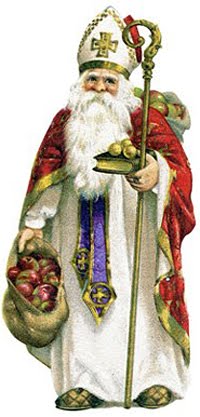
No good Catholic home is without an answer to the question of whether there is such a thing as Santa Claus. There is, but we are accustomed to the corruption of his real name, one that developed over the centuries. By the time devotion to Saint Nicholas reached Europe, he was known by different names. In the British Isles, he was "Father Christmas." In the Netherlands, he was "Sinterklaas." By the 19th century, periodicals such as Harper's Bazaar, and promoters of a fountain beverage known as Coca-Cola, had not only transformed the name, but the bright red costume with the white-fur trim, both of which we recognize today.

Whatever people call him, or however they depict him, the Bishop of Myra in the fourth century is a real person, and he presently dwells in Heaven with the Communion of Saints. Our Mother the Church celebrates his feast on the sixth of December, in both the East and the West.

VIDEO: A variation on a theme.

Nicholas was no lightweight. He was in attendance at the Council of Nicaea in the year 325, when the Arian heresy was being debated. At one point, he became so enraged with the Bishop Arius (whose errors were supported by the majority of bishops up to that time, remember?), that he supposedly punched Arius in the nose.

That's right, kids, Jolly Olde Saint Nick cold-cocked a heretic! (Some accounts say that he merely slapped Aruis, but that's so pantywaist, who'd believe it?)

Anyway, many of the bishops there, including the Emperor Constantine, were outraged by the assault, and given their sympathies, had Nicholas thrown in the dungeon. That night, the Emperor had a dream where Nicholas appeared to him, adorned in his finest liturgical vesture, and holding the Book of the Gospels. Awakened with a fright, the Emperor summoned his guards, who joined him as he raced to the dungeon, to find Nicholas unchained, adorned in ... you guessed it.

The story varies in certain details. Some accounts tell of Our Lord and Our Lady appearing to Nicholas in the dungeon. I heard the one above from an "Old Calendar" Russian Orthodox priest. It is also said that Nicholas, being restored to his rightful place in the council, slept through the rest of the proceedings.

I can't say I blame him.

Michael Foley provides more details about the life and legacy of Nicholas.

+    +    +

At the little Greek Catholic parish where my son learned the Faith, as it had been taught to his mother, the Feast of Saint Nicholas is a particular cause for celebration. He is the patron of Greek Catholics, and his image graces the iconostasis on the far left side as viewed from the assembly. There is a special hymn dedicated to him ...

O kto kto, Nikolaja l'ubit,
O kto kto, Nikolaju sluzit.
    Tomu svjatyj Nikolaj,
    Na vsjakij cas pomahaj.
    Nikolaj, Nikolaj!

O who loves Nicholas the Saintly,
O who loves Nicholas the Saintly.
    Him will Nicholas receive,
    and give help in time of need.
    Nicholas, Nicholas!

... and the children in the School of Religion program do a pageant in his honor every Sunday closest to the sixth of December. It culminates in the arrival of an elderly man with a long white beard, dressed in the robes of a Greek Catholic bishop, with whom the children meet in much the same manner as they would his commercialized (and most inauthentic) counterpart.

Paul used to get special icon cookies to take home, much like the ones that appear in the photos, emblazoned with the words "O Holy Nicholas" in Slavonic. These unique gingerbread cookies are from a recipe which appears at the stnicholascenter.org website.

I dearly miss that little parish. It has changed over the last four decades. In 2012, they completed a new and larger house of worship, one that emulates the style common to Eastern Europe. But with every successful building project they have -- the parish hall, the rectory -- the place seems a little less homey, a little larger than life. Still, the spirit of Saint Nicholas reminds them every year, of the things that are passed on, and that remain the same.

And for those parishes of the Roman Rite, whose priests would hold off any celebration of Christmas until the day itself, and the days thereafter when everyone is out of town, they too might have at least one reason to reconsider, as Advent is not only a season of penitence, but of expectation. (This venue will provide other reasons soon, so stay tuned.)

And on that note, let's go bake some cookies already!
 

Sunday, March 17, 2024

My Annual Über-Celtic Moment

Today the Church celebrates the feast of Saint Patrick (387-493), the patron saint of Ireland. It is on the Emerald Isle that today is both a national and religious holiday. At one time, the bars would close and the churches would be full out of obligation. Only in recent years has the feast seen a more rebellious spirit, complete with parades and green beer (not to mention green hair). Naturally (if ironically), they have the Americans to thank for this.

And, since the feast usually takes place during Lent, there are times such as last year, when some of us are permitted on a day of abstinence to indulge a wee bit more than others.

+    +    +

Growing up in a postwar Catholic environment, those of us who attended the parish schools in the United States, were taught that there were two kinds of people; those who were Irish, and those who wish they were. My own family appeared to fall into neither category. There were the Irish nuns who favored the Irish kids, including the unforgettable Sister Mary Mel (yes, her real name), who wasn't above calling some miscreant a "jackass" (including my kid brother, as evesdropping on a phone call with Mom gave away). But at least she was colorful. The rest of all things that were allegedly Irish were just so much blarney. I came to dismiss the whole notion of St Paddy's Day -- indeed, the whole notion of being Irish -- as a license for certain people to be more arrogant and obnoxious than they already were.

"Hail glorious Saint Patrick dear saint of our isle
On us thy poor children look down with a smile —"
But I'm not singing hymns and I'm not saying prayers
No, I'm gritting my teeth as I walk down the stairs
And into the street with these louts fiercely drinking
And screeching and lurching, and here's what I'm thinking —
They're using a stereotype, a narrow example,
A fraction, not even a marketing sample
To imitate Ireland, from which they don't come!
So unless that's just stupid, unless it's plain dumb,
All these kids from New Jersey and the five boroughs
And hundreds of cities, all drowning their sorrows,
With bottles and glasses and heads getting broken
(Believe me, just ask the mayor of Hoboken)
All that mindlessness, shouting and getting plain stocious —
That isn't Irish, that's simply atrocious.
I've another word too for it, this one's more stinging
I call it "racism." See, just 'cause you're singing
Some drunken old ballad on Saint Patrick's Day
Does that make you Irish? Oh, no — no way.
Nor does a tee-shirt that asks you to kiss them —
If they never come back I surely won't miss them
Or their beer cans and badges and wild maudlin bawling
And hammered and out of it, bodies all sprawling.

They're not of Joyce or of Yeats, Wilde, or Shaw.
How many Nobel Laureates does Dublin have? Four!
Think of this as you wince through Saint Patrick's guano —
Not every Italian is Tony Soprano.

Eventually I went to college, where I discovered Irish music. I mean the real thing, not the over-romanticized "Christmas-in-Killarney-on-St-Patrick's-in-June" that passed itself off as genuine the whole time, and I couldn't get enough of it. I used to watch the Saint Patrick's Day parade in Cincinnati, which included the carrying of the statue of the Saint, which the local chapter of the Ancient Order of Hibernians would "steal" in the middle of night, from what was once the German parish in Mount Adams. (Long story.) There was also the local Irish dance school, with boys and girls who never imagined that, decades later, they could do it for fame and fortune in shows like "Riverdance."

Who knew?

By the end of the 1970s I spent Sunday evenings working at a coffeehouse, and I helped broker a deal that brought Clannad to Cincinnati on their first American tour. I even gave harpist/vocalist Máire Brennan (pronounced MOY-uh) a ride back to where she was staying. Otherwise shy and aloof, I got her to laugh at my jokes. That seemed to matter at the time.

I saw Máire again in 1987, in a music video on VH1, for a song entitled "Something to Believe In." She was also the haunting voice in the Volkswagen commercials. Naturally she's world-famous now, and probably wouldn't return my calls, although she did write me a long and possibly heartfelt note when she autographed my copy of their album. I say "possibly" because it was in Gaelic, so I'll never know for sure, especially since it was among my collection that was stolen from my apartment in Georgetown back in 1994. (Bob, if you're reading this, tell your rich white trash buddies that I'd really like to have it back. And before you get your boxers in a bunch, the neighbors all thought YOU did it!) Máire also came out with a book in 2001 entitled "The Other Side of the Rainbow." She continues to tour and so on, but I knew her when.

(Sigh ...) Anyway, back to the '70s. While the whole world (including my now-beloved Celia on the other side of it) was going bananas over disco, the feast became an annual ritual, of spending most of the accompanying weekend hanging out at Hap's Irish Pub in the Hyde Park section of Cincinnati, or at Arnold's Bar and Grill downtown. Even when I moved to Washington in 1980, I learned Irish dancing (if not quite what appears in the above video), Irish folk tales, and the like. But the upscale bars in the Nation's capital weren't as quaint as the neighborhood pubs in my old hometown. I was under no illusions that this heritage was one that I could claim for my own.

In 1982, that claim became even more elusive. I married a girl whose grandparents came over from Slovakia, and who grew up hearing Slovak around the house. This pretty much killed any enthusiasm for all things Irish around our house.


You see, I learned a piece of American Catholic history that the mostly Irish-American church historians didn't exactly wear on their sleeves.

By the time eastern Europeans came to America in the late 19th and early 20th century, the Irish were already the big fish in the little blue-collar pond, and didn't mind letting the "Hunkies" in the coal towns and factory neighborhoods know it. Going up the food chain, it got worse. Catholics of Eastern Rites -- with customs and liturgy similar to the Orthodox, but in communion with Rome -- had married priests. The mostly-Irish bishops assumed they were either schismatics, or worse. Their wives couldn't be treated in Catholic hospitals, and their children were barred from Catholic schools. Confused as these bishops were, they concluded that the faithful would be even more confused by the presence of married Catholic priests. Thus, by the 1920s, The (Irish-)American bishops pressured Rome to bar the (legitimately) married priests from coming to America, let alone ministering.

It has been shown that most of the growth of Eastern Orthodoxy in North America can be attributed to the damned ignorance of the (Irish-)American bishops of the time. (Hey, guys, nice work!)

This latency towards all things Irish got a reprieve when the marriage tanked in 1992. Then one night -- it was about 1998, as I remember -- I was interviewed for a writing job by a priest who edited a major Catholic periodical. A native of Dublin, he reminded me of what really mattered:

“Patrick was not Irish, and on his Feast Day, we do not celebrate being Irish; we celebrate being Catholic.”

I knew that the Alexanders came from a small town near Verdun, in the Lorraine province of northeastern France. But in recent years we learned that, before the 18th century, the Alexandre line was expatriated from Scotland, a result of the Rebellion when England overtook them. I was also to learn that the man known by the Roman name of Maganus Sucatus (Maewyn Succat in Gaelic) was of a Roman family, born in Kilpatrick, near Dumbarton, in that part of Great Britain that is now Scotland. Sooooo ... if not being Irish were not enough, Patricius (in modern English, Patrick) -- as he was known in later years, being of the Roman "patrician" class, and a "patriarch" to his spiritual charges -- might just as easily be claimed by the Scots as one of their own.
For years, one highlight of the day would be the Annual Irish Poetry Reading. That was when I'd call my folks in Ohio on this day every year, and with their speakerphone on, recite the following piece by Benjamin Hapgood Burt in a very bad Irish brogue:

One evening in October, when I was one-third sober,
    An' taking home a "load" with manly pride;
My poor feet began to stutter, so I lay down in the gutter,
    And a pig came up an' lay down by my side;
Then we sang "It's all fair weather when good fellows get together,"
    Till a lady passing by was heard to say:
"You can tell a man who 'boozes' by the company he chooses"
    And the pig got up and slowly walked away.


Since then, both have entered into eternity, most likely with better things to do.

Today, those who are Irish, who wish they were, or who don't give a rat's arse either way, will dine on Irish lamb stew. When I can ever find it amidst my stuff, I use this occasion to wear a button with the words of William Butler Yeats: “I will arise and go now, and go to Innisfree.” Usually, I listen to Celtic music the entire day, and at an opportune time and place, I dine on corned beef and cabbage. This is admittedly an American innovation for the Irish, as poor immigrants from the "auld sod" found corned beef (a substitute used by their Jewish neighbors in place of bacon) to be much cheaper than lamb.

Then about seven years ago, I got lucky, because right down the street from me, they opened an Irish pub. It seems that three Thai restaurants within a half mile of each other was one too many, and the one closest to me was replaced with the watering hole of my dreams. The Celtic House is situated on the corner of Columbia Pike and South Barton Street, right at the end of the latter street, which would be my street, a mere ten-minute walk away. Sometime today I'm making a point of being there, as if my fond memories of discovering real Irish culture have come full circle. True, it's not as small and crowded as Hap's in Hyde Park, not nearly as weather-beaten as Arnold's downtown, and they won't be selling raffle tickets for NORAID under the table, but I can ignore that long enough to enjoy a lamb stew.

I'll also probably watch Mel Gibson in Braveheart later tonight, while enjoying a Guinness float (which is like a root beer float, with the obvious exception). Who cares if William Wallace was Scottish? No one cares if Patrick isn't Irish, do they? After all, "The Apostle of Ireland" is properly claimed by Catholics everywhere, whether a bunch of Micks care to admit it or not.

“Agus fagaimid siud mar ata se.”

Wednesday, December 06, 2023

Father Nicholas: The REAL Santa Claus

When I was young and growing up in Ohio, some of my classmates would leave their shoes outside the bedroom door on the night of the fifth of December, so that Saint Nicholas would leave them treats for the next morning.

We never did that at our house, but I did ask Mom how it was that Saint Nicholas got to be called "Santa Claus." By this time I had already determined a connection between the two. But while my mother was salutatorian of her high school class -- there were only about a dozen students in her class, but I digress -- she was not one to wear her erudition on her sleeve. So, rather than go into an entymological treatise on the subject, she simply told me: “Say ‘Saint Nicholas’ three times real fast.”

That carried me over for at least a few years.

No good Catholic home is without an answer to the question of whether there is such a thing as Santa Claus. There is, but we are accustomed to the corruption of his real name, one that developed over the centuries. By the time devotion to Saint Nicholas reached Europe, he was known by different names. In the British Isles, he was "Father Christmas." In the Netherlands, he was "Sinterklaas." By the 19th century, periodicals such as Harper's Bazaar, and promoters of a fountain beverage known as Coca-Cola, had not only transformed the name, but the bright red costume with the white-fur trim, both of which we recognize today.

Whatever people call him, or however they depict him, the Bishop of Myra in the fourth century is a real person, and he presently dwells in Heaven with the Communion of Saints. Our Mother the Church celebrates his feast on the sixth of December, in both the East and the West.

VIDEO: A variation on a theme.

Nicholas was no lightweight. He was in attendance at the Council of Nicaea in the year 325, when the Arian heresy was being debated. At one point, he became so enraged with the Bishop Arius (whose errors were supported by the majority of bishops up to that time, remember?), that he supposedly punched Arius in the nose.

That's right, kids, Jolly Olde Saint Nick cold-cocked a heretic! (Some accounts say that he merely slapped Aruis, but that's so pantywaist, who'd believe it?)

Anyway, many of the bishops there, including the Emperor Constantine, were outraged by the assault, and given their sympathies, had Nicholas thrown in the dungeon. That night, the Emperor had a dream where Nicholas appeared to him, adorned in his finest liturgical vesture, and holding the Book of the Gospels. Awakened with a fright, the Emperor summoned his guards, who joined him as he raced to the dungeon, to find Nicholas unchained, adorned in ... you guessed it.

The story varies in certain details. Some accounts tell of Our Lord and Our Lady appearing to Nicholas in the dungeon. I heard the one above from an "Old Calendar" Russian Orthodox priest. It is also said that Nicholas, being restored to his rightful place in the council, slept through the rest of the proceedings.

I can't say I blame him.

Michael Foley provides more details about the life and legacy of Nicholas.

+    +    +

At the little Greek Catholic parish where my son learned the Faith, as it had been taught to his mother, the Feast of Saint Nicholas is a particular cause for celebration. He is the patron of Greek Catholics, and his image graces the iconostasis on the far left side as viewed from the assembly. There is a special hymn dedicated to him ...

O kto kto, Nikolaja l'ubit,
O kto kto, Nikolaju sluzit.
    Tomu svjatyj Nikolaj,
    Na vsjakij cas pomahaj.
    Nikolaj, Nikolaj!

O who loves Nicholas the Saintly,
O who loves Nicholas the Saintly.
    Him will Nicholas receive,
    and give help in time of need.
    Nicholas, Nicholas!

... and the children in the School of Religion program do a pageant in his honor every Sunday closest to the sixth of December. It culminates in the arrival of an elderly man with a long white beard, dressed in the robes of a Greek Catholic bishop, with whom the children meet in much the same manner as they would his commercialized (and most inauthentic) counterpart.

Paul used to get special icon cookies to take home, much like the ones that appear in the photos, emblazoned with the words "O Holy Nicholas" in Slavonic. These unique gingerbread cookies are from a recipe which appears at the stnicholascenter.org website.

I dearly miss that little parish. It has changed over the last four decades. More than ten years ago, they completed a new and larger house of worship, one that emulates the style common to Eastern Europe. But with every successful building project they have -- the parish hall, the rectory -- the place seems a little less homey, a little larger than life. Still, the spirit of Saint Nicholas reminds them every year, of the things that are passed on, and that remain the same.

And for those parishes of the Roman Rite, whose priests would hold off any celebration of Christmas until the day itself, and the days thereafter when everyone is out of town, they too might have at least one reason to reconsider, as Advent is not only a season of penitence, but of expectation. (This venue will provide other reasons soon, so stay tuned.)

And on that note, let's go bake some cookies already!
 

Thursday, June 29, 2023

Sometimes you feel like a nut ...

Today, the Christian world celebrates the Feast of Saints Peter and Paul.

The Church of Rome reserves this day for ecumenical celebrations with the Eastern Orthodox, as a sign of hope for unity between East and West. In the reformed Roman calendar, it is recognized as a solemnity, and is a holyday of obligation in many countries (if not the United States). The traditional Roman calendar notes it as a double octave of the first class. In both cases, its celebration displaces that of the Sunday of the year. In other words, it's definitely up there on the food chain.

And speaking of food ...

The world of Catholic new media has plenty of meditations on this day. This writer prefers different approach:

At the train station in Naugatuck, Connecticut, candy and ice-cream shop owner Peter Paul Halajian used to meet the commuter trains carrying baskets full of fresh hand-made chocolates. The most popular of his candies was a blend of coconut, fruits, nuts, and chocolate that he called Konabar ...

Eventually Peter Paul merged with Cadbury, which later merged with Hershey. Not only is there a recipe for the Mounds and Almond Joy confections on the internet, but you can also bake a cake out of them, with recipes to be found here and here.

Personally, I can't think of a better way to celebrate this feast than to bake a cake out of something that says "Peter Paul," don't you think?

Or don't you?
 

Friday, March 17, 2023

My Annual Über-Celtic Moment

Today the Church celebrates the feast of Saint Patrick (387-493), the patron saint of Ireland. It is on the Emerald Isle that today is both a national and religious holiday. At one time, the bars would close and the churches would be full out of obligation. Only in recent years has the feast seen a more rebellious spirit, complete with parades and green beer (not to mention green hair). Naturally (if ironically), they have the Americans to thank for this.

And, since the feast usually takes place during Lent, the announcement above shows that some of us can indulge a wee bit more than others.

+    +    +

Growing up in a postwar Catholic environment, those of us who attended the parish schools in the United States, were taught that there were two kinds of people; those who were Irish, and those who wish they were. My own family appeared to fall into neither category. There were the Irish nuns who favored the Irish kids, including the unforgettable Sister Mary Mel (yes, her real name), who wasn't above calling some miscreant a "jackass." But at least she was colorful. The rest of all things that were allegedly Irish were just so much blarney. I came to dismiss the whole notion of St Paddy's Day -- indeed, the whole notion of being Irish -- as a license for certain people to be more arrogant and obnoxious than they already were.

"Hail glorious Saint Patrick dear saint of our isle
On us thy poor children look down with a smile —"
But I'm not singing hymns and I'm not saying prayers
No, I'm gritting my teeth as I walk down the stairs
And into the street with these louts fiercely drinking
And screeching and lurching, and here's what I'm thinking —
They're using a stereotype, a narrow example,
A fraction, not even a marketing sample
To imitate Ireland, from which they don't come!
So unless that's just stupid, unless it's plain dumb,
All these kids from New Jersey and the five boroughs
And hundreds of cities, all drowning their sorrows,
With bottles and glasses and heads getting broken
(Believe me, just ask the mayor of Hoboken)
All that mindlessness, shouting and getting plain stocious —
That isn't Irish, that's simply atrocious.
I've another word too for it, this one's more stinging
I call it "racism." See, just 'cause you're singing
Some drunken old ballad on Saint Patrick's Day
Does that make you Irish? Oh, no — no way.
Nor does a tee-shirt that asks you to kiss them —
If they never come back I surely won't miss them
Or their beer cans and badges and wild maudlin bawling
And hammered and out of it, bodies all sprawling.

They're not of Joyce or of Yeats, Wilde, or Shaw.
How many Nobel Laureates does Dublin have? Four!
Think of this as you wince through Saint Patrick's guano —
Not every Italian is Tony Soprano.

Eventually I went to college, where I discovered Irish music. I mean the real thing, not the over-romanticized "Christmas-in-Killarney-on-St-Patrick's-in-June" that passed itself off as genuine the whole time. I simply couldn't get enough of it. I used to watch the Saint Patrick's Day parade in Cincinnati, which included the carrying of the statue of the Saint, which the local chapter of the Ancient Order of Hibernians would "steal" in the middle of night, from what was once the German parish in Mount Adams. (Long story.) There was also the local Irish dance school, with boys and girls who never imagined that, three decades later, they could do it for fame and fortune in shows like "Riverdance."

Who knew?

By the end of the 1970s I spent Sunday evenings working at a coffeehouse, and I helped broker a deal that brought Clannad to Cincinnati on their first American tour. I even gave harpist/vocalist Máire Brennan (pronounced MOY-uh) a ride back to where she was staying. Otherwise shy and aloof, I got her to laugh at my jokes. That seemed to matter at the time.

I saw Máire again in 1987, in a music video on VH1, for a song entitled "Something to Believe In." She was also the haunting voice in the Volkswagen commercials. Naturally she's world-famous now, and probably wouldn't return my calls, although she did write me a long and possibly heartfelt note when she autographed my copy of their album. I say "possibly" because it was in Gaelic, so I'll never know for sure, especially since it was among my collection that was stolen from my apartment in Georgetown back in 1994. (Bob, if you're reading this, tell your rich white trash buddies that I'd really like to have it back. And before you get your boxers in a bunch, the neighbors all thought YOU did it!) Máire also came out with a book in 2001 entitled "The Other Side of the Rainbow." She continues to tour and so on, but I knew her when.

(Sigh ...) Anyway, back to the '70s. While the whole world (including my now-beloved Celia on the other side of it) was going bananas over disco, the feast became an annual ritual, of spending most of the accompanying weekend hanging out at Hap's Irish Pub in the Hyde Park section of Cincinnati, or at Arnold's Bar and Grill downtown. Even when I moved to Washington in 1980, I learned Irish dancing (if not quite what appears in the above video), Irish folk tales, and the like. But the upscale bars in the Nation's capital weren't as quaint as the neighborhood pubs in my old hometown. I was under no illusions that this heritage was one that I could claim for my own.

In 1982, that claim became even more elusive. I married a girl whose grandparents came over from Slovakia, and who grew up hearing Slovak around the house. This pretty much killed any enthusiasm for all things Irish around our house.

You see, I learned a piece of American Catholic history that the mostly Irish-American church historians didn't exactly wear on their sleeves. By the time eastern Europeans came to America in the late 19th and early 20th century, the Irish were already the big fish in the little blue-collar pond, and didn't mind letting the "Hunkies" in the coal towns and factory neighborhoods know it. Going up the food chain, it got worse. Catholics of Eastern Rites -- with customs and liturgy similar to the Orthodox, but in communion with Rome -- had married priests. The mostly-Irish bishops assumed they were either schismatics, or worse. Their wives couldn't be treated in Catholic hospitals, and their children were barred from Catholic schools. Confused as these bishops were, they concluded that the faithful would be even more confused by the presence of married Catholic priests. Thus, by the 1920s, The (Irish-)American bishops pressured Rome to bar the (legitimately) married priests from coming to America, let alone ministering.

It has been shown that most of the growth of Eastern Orthodoxy in North America can be attributed to the damned ignorance of the (Irish-)American bishops of the time. (Hey, guys, nice work!)

This latency towards all things Irish got a reprieve when the marriage tanked in 1990. Then one night -- it was about 1998, as I remember -- I was interviewed for a writing job by a priest who edited a major Catholic periodical. A native of Dublin, he reminded me of what really mattered:

“Patrick was not Irish, and on his Feast Day, we do not celebrate being Irish; we celebrate being Catholic.”

I knew that the Alexanders came from a small town near Verdun, in the Lorraine province of northeastern France. But in recent years we learned that, before the 18th century, the Alexandre line was expatriated from Scotland, a result of the Rebellion when England overtook them. I was also to learn that the man known by the Roman name of Maganus Sucatus (Maewyn Succat in Gaelic) was of a Roman family, born in Kilpatrick, near Dumbarton, in that part of Great Britain that is now Scotland. Sooooo ... if not being Irish were not enough, Patricius (in modern English, Patrick) -- as he was known in later years, being of the Roman "patrician" class, and a "patriarch" to his spiritual charges -- might just as easily be claimed by the Scots as one of their own.
For years, one highlight of the day would be the Annual Irish Poetry Reading. That was when I'd call my folks in Ohio on this day every year, and with their speakerphone on, recite the following piece by Benjamin Hapgood Burt in a very bad Irish brogue:

One evening in October, when I was one-third sober,
    An' taking home a "load" with manly pride;
My poor feet began to stutter, so I lay down in the gutter,
    And a pig came up an' lay down by my side;
Then we sang "It's all fair weather when good fellows get together,"
    Till a lady passing by was heard to say:
"You can tell a man who 'boozes' by the company he chooses"
    And the pig got up and slowly walked away.


Since then, both have entered into eternity, most likely with better things to do.

Today, those who are Irish, who wish they were, or who don't give a rat's arse either way, will dine on Irish lamb stew. When I can ever find it amidst my stuff, I use this occasion to wear a button with the words of William Butler Yeats: “I will arise and go now, and go to Innisfree.” Usually, I listen to Celtic music the entire day, and at an opportune time and place, I dine on corned beef and cabbage. This is admittedly an American innovation for the Irish, as poor immigrants from the "auld sod" found corned beef (a substitute used by their Jewish neighbors in place of bacon) to be much cheaper than lamb.

Beginning this year, I got lucky, because right down the street from me, they opened an Irish pub. It seems that three Thai restaurant within a half mile of each other was one too many, and the one closest to me was replaced with the watering hole of my dreams. The Celtic House is situated on the corner of Columbia Pike and South Barton Street, right at the end of the latter street, which would be my street, a mere ten-minute walk away. Sometime today I'm making a point of being there, as if my fond memories of discovering real Irish culture have come full circle. True, it's not as small and crowded as Hap's, not nearly as weather-beaten as Arnold's, and they won't be selling raffle tickets for NORAID under the table, but I can ignore that long enough to enjoy a lamb stew.

I'll also probably watch Mel Gibson in Braveheart later tonight, while enjoying a Guiness float (which is like a root beer float, only ... well, you know). Who cares if William Wallace was Scottish? No one cares if Patrick isn't Irish, do they? After all, "The Apostle of Ireland" is properly claimed by Catholics everywhere, whether a bunch of micks care to admit it or not.

“Agus fagaimid siud mar ata se.”

Tuesday, December 06, 2022

Father Nicholas: The REAL Santa Claus

When I was young and growing up in Ohio, some of my classmates would leave their shoes outside the bedroom door on the night of the fifth of December, so that Saint Nicholas would leave them treats for the next morning.

We never did that at our house, but I did ask Mom how it was that Saint Nicholas got to be called "Santa Claus." By this time I had already determined a connection between the two. But while my mother was salutatorian of her high school class -- there were only about a dozen students in her class, but I digress -- she was not one to wear her erudition on her sleeve. So, rather than go into an entymological treatise on the subject, she simply told me: “Say ‘Saint Nicholas’ three times real fast.”

That carried me over for at least a few years.

No good Catholic home is without an answer to the question of whether there is such a thing as Santa Claus. There is, but we are accustomed to the corruption of his real name, one that developed over the centuries. By the time devotion to Saint Nicholas reached Europe, he was known by different names. In the British Isles, he was "Father Christmas." In the Netherlands, he was "Sinterklaas." By the 19th century, periodicals such as Harper's Bazaar, and promoters of a fountain beverage known as Coca-Cola, had not only transformed the name, but the bright red costume with the white-fur trim, both of which we recognize today.

Whatever people call him, or however they depict him, the Bishop of Myra in the fourth century is a real person, and he presently dwells in Heaven with the Communion of Saints. Our Mother the Church celebrates his feast on the sixth of December, in both the East and the West.

VIDEO: A variation on a theme.

Nicholas was no lightweight. He was in attendance at the Council of Nicaea in the year 325, when the Arian heresy was being debated. At one point, he became so enraged with the Bishop Arius (whose errors were supported by the majority of bishops up to that time, remember?), that he supposedly punched Arius in the nose.

That's right, kids, Jolly Olde Saint Nick cold-cocked a heretic! (Some accounts say that he merely slapped Aruis, but that's so pantywaist, who'd believe it?)

Anyway, many of the bishops there, including the Emperor Constantine, were outraged by the assault, and given their sympathies, had Nicholas thrown in the dungeon. That night, the Emperor had a dream where Nicholas appeared to him, adorned in his finest liturgical vesture, and holding the Book of the Gospels. Awakened with a fright, the Emperor summoned his guards, who joined him as he raced to the dungeon, to find Nicholas unchained, adorned in ... you guessed it.

The story varies in certain details. Some accounts tell of Our Lord and Our Lady appearing to Nicholas in the dungeon. I heard the one above from an "Old Calendar" Russian Orthodox priest. It is also said that Nicholas, being restored to his rightful place in the council, slept through the rest of the proceedings.

I can't say I blame him.

Michael Foley provides more details about the life and legacy of Nicholas.

+    +    +

At the little Greek Catholic parish where my son learned the Faith, as it had been taught to his mother, the Feast of Saint Nicholas is a particular cause for celebration. He is the patron of Greek Catholics, and his image graces the iconostasis on the far left side as viewed from the assembly. There is a special hymn dedicated to him ...

O kto kto, Nikolaja l'ubit,
O kto kto, Nikolaju sluzit.
    Tomu svjatyj Nikolaj,
    Na vsjakij cas pomahaj.
    Nikolaj, Nikolaj!

O who loves Nicholas the Saintly,
O who loves Nicholas the Saintly.
    Him will Nicholas receive,
    and give help in time of need.
    Nicholas, Nicholas!

... and the children in the School of Religion program do a pageant in his honor every Sunday closest to the sixth of December. It culminates in the arrival of an elderly man with a long white beard, dressed in the robes of a Greek Catholic bishop, with whom the children meet in much the same manner as they would his commercialized (and most inauthentic) counterpart.

Paul used to get special icon cookies to take home, much like the ones that appear in the photos, emblazoned with the words "O Holy Nicholas" in Slavonic. These unique gingerbread cookies are from a recipe which appears at the stnicholascenter.org website.

I dearly miss that little parish. It has changed over nearly four decades. About ten years ago, they completed a new and larger house of worship, one that emulates the style common to Eastern Europe. But with every successful building project they have -- the parish hall, the rectory -- the place seems a little less homey, a little larger than life. Still, the spirit of Saint Nicholas reminds them every year, of the things that are passed on, and that remain the same.

And for those parishes of the Roman Rite, whose priests would hold off any celebration of Christmas until the day itself, and the days thereafter when everyone is out of town, they too might have at least one reason to reconsider, as Advent is not only a season of penitence, but of expectation. (This venue will provide other reasons soon, so stay tuned.)

And on that note, let's go bake some cookies already!
 

Monday, December 06, 2021

Father Nicholas: The REAL Santa Claus

When I was young and growing up in Ohio, some of my classmates would leave their shoes outside the bedroom door on the night of the fifth of December, so that Saint Nicholas would leave them treats for the next morning.

We never did that at our house, but I did ask Mom how it was that Saint Nicholas got to be called Santa Claus. By this time I had already determined a connection between the two. But while my mother was salutatorian of her high school class -- there were about a dozen students in her class at most, but I digress -- she was not one to wear her erudition on her sleeve. So, rather than go into an entymological treatise on the subject, she simply told me: “Say ‘Saint Nicholas’ three times real fast.”

That carried me over for at least a few years.

No good Catholic home is without an answer to the question of whether there is such a thing as Santa Claus. There is, but we are accustomed to the corruption of his real name, one that developed over the centuries. By the time devotion to Saint Nicholas reached Europe, he was known by different names. In the British Isles, he was "Father Christmas." In the Netherlands, he was "Sinterklaas." By the 19th century, periodicals such as Harper's Bazaar, and promoters of a fountain beverage known as Coca-Cola, had not only transformed the name, but the bright red costume with the white-fur trim, both of which we recognize today.

Whatever people call him, or however they depict him, the Bishop of Myra in the fourth century is a real person, and he presently dwells in Heaven with the Communion of Saints. Our Mother the Church celebrates his feast on the sixth of December, in both the East and the West.

VIDEO: A variation on a theme.

Nicholas was no lightweight. He was in attendance at the Council of Nicaea in the year 325, when the Arian heresy was being debated. At one point, he became so enraged with the Bishop Arius (whose errors were supported by the majority of bishops up to that time, remember?), that he supposedly punched Arius in the nose.

That's right, kids, Jolly Olde Saint Nick cold-cocked a heretic! (Some accounts say that he merely slapped him, but that's so pantywaist, who'd believe it?)

Anyway, many of the bishops there, including the Emperor Constantine, were scandalized by the assault, and given their sympathies, had Nicholas thrown in the dungeon. That night, the Emperor had a dream where Nicholas appeared to him, adorned in his finest liturgical vesture, and holding the Book of the Gospels. Awakened with a fright, the Emperor summoned his guards, who joined him as he raced to the dungeon, to find Nicholas unchained, with ... you guessed it.

The story varies in certain details. Some accounts tell of Our Lord and Our Lady appearing to Nicholas in the dungeon. I heard the above account from an "Old Calendar" Russian Orthodox priest. It is also said that Nicholas, now restored to his rightful place in the council, slept through the rest of the proceedings.

I can't say I blame him.

At the little Byzantine Rite parish where my son learned the Faith, as it had been taught to his mother, the Feast of Saint Nicholas is a particular cause for celebration. He is the patron of Byzantine Catholics, and his image graces the iconostasis on the far left side as viewed from the assembly. There is a special hymn dedicated to him ...

O kto kto, Nikolaja l'ubit,
O kto kto, Nikolaju sluzit.
    Tomu svjatyj Nikolaj,
    Na vsjakij cas pomahaj.
    Nikolaj, Nikolaj!

O who loves Nicholas the Saintly,
O who loves Nicholas the Saintly.
    Him will Nicholas receive,
    and give help in time of need.
    Nicholas, Nicholas!

... and the children in the School of Religion program do a pageant in his honor every Sunday closest to the sixth of December. It culminates in the arrival of an elderly man with a long white beard, dressed in the robes of a Greek Catholic bishop, with whom the children meet in much the same manner as they would his commercialized (and most inauthentic) counterpart.

Paul used to get special icon cookies to take home, much like the ones that appear in the photos, emblazoned with the words "O Holy Nicholas" in Slavonic. These unique gingerbread cookies are from a recipe which appears at the stnicholascenter.org website.

I dearly miss that little parish. It has changed over nearly four decades. About ten years ago, they completed a new and larger house of worship, one that emulates the style common to Eastern Europe. But with every successful building project they have -- the parish hall, the rectory -- the place seems a little less homey, a little larger than life. Still, the spirit of Saint Nicholas reminds them every year, of the things that are passed on, and that remain the same.

And for those parishes of the Roman Rite, whose priests would hold off any celebration of Christmas until the day itself, and the days thereafter when everyone is out of town, they too might have at least one reason to reconsider, as Advent is not only a season of penitence, but of expectation. (This venue will provide other reasons soon, so stay tuned.)

And on that note, let's go bake some cookies already!
 

Wednesday, March 17, 2021

My Annual Über-Celtic Moment

Today the Church celebrates the feast of Saint Patrick (387-493), the patron saint of Ireland. It is on the Emerald Isle that today is both a national and religious holiday. At one time, the bars would close and the churches would be full out of obligation. Only in recent years has the feast seen a more rebellious spirit, complete with parades and green beer (not to mention green hair). Naturally (if ironically), they have the Americans to thank for this.

Growing up in a postwar Catholic environment, those of us who attended the parish schools in the United States, were taught that there were two kinds of people; those who were Irish, and those who wish they were. My own family appeared to fall into neither category. There were the Irish nuns who favored the Irish kids, including the unforgettable Sister Mary Mel (yes, her real name), who wasn't above calling some miscreant a "jackass." But at least she was colorful. The rest of all things that were allegedly Irish were just so much blarney. I came to dismiss the whole notion of St Paddy's Day -- indeed, the whole notion of being Irish -- as a license for certain people to be more arrogant and obnoxious than they already were.

"Hail glorious Saint Patrick dear saint of our isle
On us thy poor children look down with a smile —"
But I'm not singing hymns and I'm not saying prayers
No, I'm gritting my teeth as I walk down the stairs
And into the street with these louts fiercely drinking
And screeching and lurching, and here's what I'm thinking —
They're using a stereotype, a narrow example,
A fraction, not even a marketing sample
To imitate Ireland, from which they don't come!
So unless that's just stupid, unless it's plain dumb,
All these kids from New Jersey and the five boroughs
And hundreds of cities, all drowning their sorrows,
With bottles and glasses and heads getting broken
(Believe me, just ask the mayor of Hoboken)
All that mindlessness, shouting and getting plain stocious —
That isn't Irish, that's simply atrocious.
I've another word too for it, this one's more stinging
I call it "racism." See, just 'cause you're singing
Some drunken old ballad on Saint Patrick's Day
Does that make you Irish? Oh, no — no way.
Nor does a tee-shirt that asks you to kiss them —
If they never come back I surely won't miss them
Or their beer cans and badges and wild maudlin bawling
And hammered and out of it, bodies all sprawling.

They're not of Joyce or of Yeats, Wilde, or Shaw.
How many Nobel Laureates does Dublin have? Four!
Think of this as you wince through Saint Patrick's guano —
Not every Italian is Tony Soprano.

Eventually I went to college, where I discovered Irish music. I mean the real thing, not the over-romanticized "Christmas-in-Killarney-on-St-Patrick's-in-June" that passed itself off as genuine the whole time. I simply couldn't get enough of it. I used to watch the Saint Patrick's Day parade in Cincinnati, which included the carrying of the statue of the Saint, which the local chapter of the Ancient Order of Hibernians would "steal" in the middle of night, from what was once the German parish in Mount Adams. (Long story.) There was also the local Irish dance school, with boys and girls who never imagined that, three decades later, they could do it for fame and fortune in shows like "Riverdance."

Who knew?

By the end of the 1970s I spent Sunday evenings working at a coffeehouse, and I helped broker a deal that brought Clannad to Cincinnati on their first American tour. I even gave harpist/vocalist Máire Brennan (pronounced MOY-uh) a ride back to where she was staying. Otherwise shy and aloof, I got her to laugh at my jokes. That seemed to matter at the time.

I saw Máire again in 1987, in a music video on VH1, for a song entitled "Something to Believe In." She was also the haunting voice in the Volkswagen commercials. Naturally she's world-famous now, and probably wouldn't return my calls, although she did write me a long and possibly heartfelt note when she autographed my copy of their album. I say "possibly" because it was in Gaelic, so I'll never know for sure, especially since it was among my collection that was stolen from my apartment in Georgetown back in 1994. (Bob, if you're reading this, tell your rich white trash buddies that I'd really like to have it back. And before you get your boxers in a bunch, the neighbors all thought YOU did it!) Máire also came out with a book in 2001 entitled "The Other Side of the Rainbow." She continues to tour and so on, but I knew her when.

(Sigh ...) Anyway, back to the '70s. While the whole world (including my now-beloved Celia on the other side of it) was going bananas over disco, the feast became an annual ritual, of spending most of the accompanying weekend hanging out at Hap's Irish Pub in the Hyde Park section of Cincinnati, or at Arnold's Bar and Grill downtown. Even when I moved to Washington in 1980, I learned Irish dancing (if not quite what appears in the above video), Irish folk tales, and the like. But the upscale bars in the Nation's capital weren't as quaint as the neighborhood pubs in my old hometown. I was under no illusions that this heritage was one that I could claim for my own.

In 1982, that claim became even more elusive. I married a girl whose grandparents came over from Slovakia, and who grew up hearing Slovak around the house. This pretty much killed any enthusiasm for all things Irish around our house.

You see, I learned a piece of American Catholic history that the mostly Irish-American church historians didn't exactly wear on their sleeves. By the time eastern Europeans came to America in the late 19th and early 20th century, the Irish were already the big fish in the little blue-collar pond, and didn't mind letting the "Hunkies" in the coal towns and factory neighborhoods know it. Going up the food chain, it got worse. Catholics of Eastern Rites -- with customs and liturgy similar to the Orthodox, but in communion with Rome -- had married priests. The mostly-Irish bishops assumed they were either schismatics, or worse. Their wives couldn't be treated in Catholic hospitals, and their children were barred from Catholic schools. Confused as these bishops were, they concluded that the faithful would be even more confused by the presence of married Catholic priests. Thus, by the 1920s, The (Irish-)American bishops pressured Rome to bar the (legitimately) married priests from coming to America, let alone ministering.

It has been shown that most of the growth of Eastern Orthodoxy in North America can be attributed to the damned ignorance of the (Irish-)American bishops of the time. (Hey, guys, nice work!)

This latency towards all things Irish got a reprieve when the marriage tanked in 1990. Then one night -- it was about 1998, as I remember -- I was interviewed for a writing job by a priest who edited a major Catholic periodical. A native of Dublin, he reminded me of what really mattered:

“Patrick was not Irish, and on his Feast Day, we do not celebrate being Irish; we celebrate being Catholic.”

I knew that the Alexanders came from a small town near Verdun, in the Lorraine province of northeastern France. But in recent years we learned that, before the 18th century, the Alexandre line was expatriated from Scotland, a result of the Rebellion when England overtook them. I was also to learn that the man known by the Roman name of Maganus Sucatus (Maewyn Succat in Gaelic) was of a Roman family, born in Kilpatrick, near Dumbarton, in that part of Great Britain that is now Scotland. Sooooo ... if not being Irish were not enough, Patricius (in modern English, Patrick) -- as he was known in later years, being of the Roman "patrician" class, and a "patriarch" to his spiritual charges -- might just as easily be claimed by the Scots as one of their own.
For years, one highlight of the day would be the Annual Irish Poetry Reading. That was when I'd call my folks in Ohio on this day every year, and with their speakerphone on, recite the following piece by Benjamin Hapgood Burt in a very bad Irish brogue:

One evening in October, when I was one-third sober,
    An' taking home a "load" with manly pride;
My poor feet began to stutter, so I lay down in the gutter,
    And a pig came up an' lay down by my side;
Then we sang "It's all fair weather when good fellows get together,"
    Till a lady passing by was heard to say:
"You can tell a man who 'boozes' by the company he chooses"
    And the pig got up and slowly walked away.


Since then, both have entered into eternity, most likely with better things to do.

Today, those who are Irish, who wish they were, or who don't give a rat's arse either way, will dine on Irish lamb stew. When I can ever find it amidst my stuff, I use this occasion to wear a button with the words of William Butler Yeats: “I will arise and go now, and go to Innisfree.” Usually, I listen to Celtic music the entire day, and at an opportune time and place, I dine on corned beef and cabbage. This is admittedly an American innovation for the Irish, as poor immigrants from the "auld sod" found corned beef (a substitute used by their Jewish neighbors in place of bacon) to be much cheaper than lamb.

Beginning this year, I got lucky, because right down the street from me, they opened an Irish pub. It seems that three Thai restaurant within a half mile of each other was one too many, and the one closest to me was replaced with the watering hole of my dreams. The Celtic House is situated on the corner of Columbia Pike and South Barton Street, right at the end of the latter street, which would be my street, a mere ten-minute walk away. Sometime today I'm making a point of being there, as if my fond memories of discovering real Irish culture have come full circle. True, it's not as small and crowded as Hap's, not nearly as weather-beaten as Arnold's, and they won't be selling raffle tickets for NORAID under the table, but I can ignore that long enough to enjoy a lamb stew.

I'll also probably watch Mel Gibson in Braveheart later tonight, while enjoying a Guiness float (which is like a root beer float, only ... well, you know). Who cares if William Wallace was Scottish? No one cares if Patrick isn't Irish, do they? After all, "The Apostle of Ireland" is properly claimed by Catholics everywhere, whether a bun ch of micks care to admit it or not.

“Agus fagaimid siud mar ata se.”
Sunday, December 06, 2020

Father Nicholas: The REAL Santa Claus

When I was young and growing up in Ohio, some of my classmates would leave their shoes outside the bedroom door on the night of the fifth of December, so that Saint Nicholas would leave them treats for the next morning.

We never did that at our house, but I did ask Mom how it was that Saint Nicholas got to be called Santa Claus. By this time I had already determined a connection between the two. But while my mother was salutatorian of her high school class -- there were about a dozen students in her class at most, but I digress -- she was not one to wear her erudition on her sleeve. So, rather than go into an entymological treatise on the subject, she simply told me: “Say ‘Santa Claus’ three times real fast.”

That carried me over for at least a few years.

No good Catholic home is without an answer to the question of whether there is such a thing as Santa Claus. There is, but we are accustomed to the corruption of his real name, one that developed over the centuries. By the time devotion to Saint Nicholas reached Europe, he was known by different names. In the British Isles, he was "Father Christmas." In the Netherlands, he was "Sinterklaas." By the 19th century, periodicals such as Harper's Bazaar, and promoters of a fountain beverage known as Coca-Cola, had not only transformed the name, but the bright red costume with the white-fur trim, both of which we recognize today.

Whatever people call him, or however they depict him, the Bishop of Myra in the fourth century is a real person, and he presently dwells in Heaven with the Communion of Saints. Our Mother the Church celebrates his feast on the sixth of December, in both the East and the West.

VIDEO: A variation on a theme.

Nicholas was no lightweight. He was in attendance at the Council of Nicaea in the year 325, when the Arian heresy was being debated. At one point, he became so enraged with the Bishop Arius (whose errors were supported by the majority of bishops up to that time, remember?), that he supposedly punched Arius in the nose.

That's right, kids, Jolly Olde Saint Nick cold-cocked a heretic! (Some accounts say that he merely slapped him, but that's so pantywaist, who'd believe it?)

Anyway, many of the bishops there, including the Emperor Constantine, were scandalized by the assault, and given their sympathies, had Nicholas thrown in the dungeon. That night, the Emperor had a dream where Nicholas appeared to him, adorned in his finest liturgical vesture, and holding the Book of the Gospels. Awakened with a fright, the Emperor summoned his guards, who joined him as he raced to the dungeon, to find Nicholas unchained, with ... you guessed it.

The story varies in certain details. Some accounts tell of Our Lord and Our Lady appearing to Nicholas in the dungeon. I heard the above account from an "Old Calendar" Russian Orthodox priest. It is also said that Nicholas, now restored to his rightful place in the council, slept through the rest of the proceedings.

I can't say I blame him.

At the little Byzantine Rite parish where my son learned the Faith, as it had been taught to his mother, the Feast of Saint Nicholas is a particular cause for celebration. He is the patron of Byzantine Catholics, and his image graces the iconostasis on the far left side as viewed from the assembly. There is a special hymn dedicated to him ...

O kto kto, Nikolaja l'ubit,
O kto kto, Nikolaju sluzit.
    Tomu svjatyj Nikolaj,
    Na vsjakij cas pomahaj.
    Nikolaj, Nikolaj!

O who loves Nicholas the Saintly,
O who loves Nicholas the Saintly.
    Him will Nicholas receive,
    and give help in time of need.
    Nicholas, Nicholas!

... and the children in the School of Religion program do a pageant in his honor every Sunday closest to the sixth of December (or in the case of this year, today). It culminates in the arrival of an elderly man with a long white beard, dressed in the robes of a Greek Catholic bishop, with whom the children meet in much the same manner as they would his commercialized (and most inauthentic) counterpart.

Paul used to get special icon cookies to take home, much like the ones that appear in the photos, emblazoned with the words "O Holy Nicholas" in Slavonic. These unique gingerbread cookies are from a recipe which appears at the stnicholascenter.org website.

I dearly miss that little parish. It has changed over nearly four decades. Several years ago, they completed a new and larger house of worship, one that emulates the style common to Eastern Europe. But with every successful building project they have -- the parish hall, the rectory -- the place seems a little less homey, a little larger than life. Still, the spirit of Saint Nicholas reminds them every year, of the things that are passed on, and that remain the same.

And for those parishes of the Roman Rite, whose priests would hold off any celebration of Christmas until the day itself, and the days thereafter when everyone is out of town, they too might have at least one reason to reconsider, as Advent is not only a season of penitence, but of expectation. (This venue will provide other reasons soon, so stay tuned.)

And on that note, let's go bake some cookies already!