Showing posts with label saints. Show all posts

Tuesday, March 17, 2026

My Annual Über-Celtic Moment

Today we remember Saint Patrick (387-493), the patron saint of Ireland. It is on the Emerald Isle that today is both a national and religious holiday. At one time, the bars would close and the churches would be full out of obligation. Only in recent years has the feast seen a more rebellious spirit, complete with parades and green beer (not to mention green hair). Naturally (if ironically), they have the Americans to thank for this.

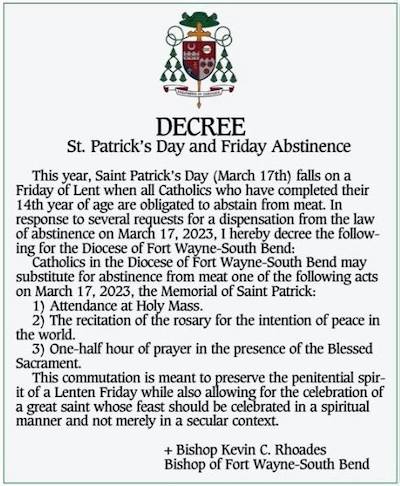
And, since the feast usually takes place during Lent, there are times such as a couple of years ago, when some of us are permitted on a day of abstinence to indulge a wee bit more than others. But this year it's on a Tuesday, so it's all good craic.

+    +    +

Growing up in a postwar Catholic environment, those of us who attended the parish schools in the United States, were taught that there were two kinds of people; those who were Irish, and those who wish they were. My own family appeared to fall into neither category. There were the Irish nuns who favored the Irish kids, including the unforgettable Sister Mary Mel (yes, her real name), who wasn't above calling some miscreant a "jackass" (including my kid brother, as evesdropping on a phone call with Mom gave away). But at least she was colorful. The rest of all things that were allegedly Irish were just so much blarney. I came to dismiss the whole notion of St Paddy's Day -- indeed, the whole notion of being Irish -- as a license for certain people to be more arrogant and obnoxious than they already were.

"Hail glorious Saint Patrick dear saint of our isle
On us thy poor children look down with a smile —"
But I'm not singing hymns and I'm not saying prayers
No, I'm gritting my teeth as I walk down the stairs

And into the street with these louts fiercely drinking
And screeching and lurching, and here's what I'm thinking —
They're using a stereotype, a narrow example,
A fraction, not even a marketing sample

To imitate Ireland, from which they don't come!
So unless that's just stupid, unless it's plain dumb,
All these kids from New Jersey and the five boroughs
And hundreds of cities, all drowning their sorrows,

With bottles and glasses and heads getting broken
(Believe me, just ask the mayor of Hoboken)
All that mindlessness, shouting and getting plain stocious —
That isn't Irish, that's simply atrocious.

I've another word too for it, this one's more stinging
I call it "racism." See, just 'cause you're singing
Some drunken old ballad on Saint Patrick's Day
Does that make you Irish? Oh, no — no way.

Nor does a tee-shirt that asks you to kiss them —
If they never come back I surely won't miss them
Or their beer cans and badges and wild maudlin bawling
And hammered and out of it, bodies all sprawling.

They're not of Joyce or of Yeats, Wilde, or Shaw.
How many Nobel Laureates does Dublin have? Four!
Think of this as you wince through Saint Patrick's guano.
Not every Italian is Tony Soprano.

+    +    +

Eventually I went to college, where I discovered Irish music. I mean the real thing, not the over-romanticized "Christmas-in-Killarney-on-St-Patrick's-in-June" that passed itself off as genuine the whole time, and I couldn't get enough of it. I used to watch the Saint Patrick's Day parade in Cincinnati, which included the carrying of the statue of the Saint, which the local chapter of the Ancient Order of Hibernians would "steal" in the middle of night, from what was once the German parish in Mount Adams. (Long story.) There was also the local Irish dance school, with boys and girls who never imagined that, decades later, they could do it for fame and fortune in shows like "Riverdance."

Who knew?

By the end of the 1970s I spent Sunday evenings working at a coffeehouse, and I helped broker a deal that brought Clannad to Cincinnati on their first American tour. I even gave harpist/vocalist Máire Brennan (pronounced MOY-uh) a ride back to where she was staying. Otherwise shy and aloof, I got her to laugh at my jokes. That seemed to matter at the time.

I saw Máire again in 1987, in a music video on VH1, for a song entitled "Something to Believe In." She was also the haunting voice in the Volkswagen commercials. Naturally she's world-famous now, and probably wouldn't return my calls, although she did write me a long and possibly heartfelt note when she autographed my copy of their album. I say "possibly" because it was in Gaelic, so I'll never know for sure, especially since it was among my collection that was stolen from my apartment in Georgetown back in 1994. (Bob, if you're reading this, tell your rich white trash buddies that I'd really like to have it back. And before you get your boxers in a bunch, the neighbors all thought YOU did it!) Máire also came out with a book in 2001 entitled "The Other Side of the Rainbow." She continues to tour and so on, but I knew her when.

(Sigh ...) Anyway, back to the '70s. While the whole world (including my now-beloved Celia on the other side of it) was going bananas over disco, the feast became an annual ritual, of spending most of the accompanying weekend hanging out at Hap's Irish Pub in the Hyde Park section of Cincinnati, or at Arnold's Bar and Grill downtown. Even when I moved to Washington in 1980, I learned Irish dancing (if not quite what appears in the above video), Irish folk tales, and the like. But the upscale bars in the Nation's capital weren't as quaint as the neighborhood pubs in my old hometown. I was under no illusions that this heritage was one that I could claim for my own.

In 1982, that claim became even more elusive. I married a girl whose grandparents came over from Slovakia, and who grew up hearing Slovak around the house. This pretty much killed any enthusiasm for all things Irish around our house.

You see, I learned a piece of American Catholic history that the mostly Irish-American church historians back then didn't exactly wear on their sleeves.

By the time eastern Europeans came to America in the late 19th and early 20th century, the Irish were already the big fish in the little blue-collar pond, and didn't mind letting the "Hunkies" in the coal towns and factory neighborhoods know it. Going up the food chain, it got worse. Catholics of Eastern Rites -- with customs and liturgy similar to the Orthodox, but in communion with Rome -- had married priests. The mostly-Irish bishops assumed they were either schismatics, or worse. Their wives couldn't be treated in Catholic hospitals, and their children were barred from Catholic schools. Confused as these bishops were, they concluded that the faithful would be even more confused by the presence of married Catholic priests. Thus, by the 1920s, The (mostly Irish-)American bishops pressured Rome to bar the (legitimately) married priests from coming to America, let alone ministering.

It has been shown that most of the growth of Eastern Orthodoxy in North America can be attributed to the damned ignorance of the mitred Micks at the time. (Hey, guys, nice work!)

This latency towards all things Irish got a reprieve when the marriage tanked in 1992. Then one night -- it was about 1998, as I remember -- I was interviewed for a writing job by a priest who edited a major Catholic periodical. A native of Dublin, he reminded me of what really mattered:

“Patrick was not Irish, and on his Feast Day, we do not celebrate being Irish; we celebrate being Catholic.”

I knew that the Alexanders came from a small town near Verdun, in the Lorraine province of northeastern France. But in recent years we learned that, before the 18th century, the "Alexandre" line was expatriated from Scotland, the result of the rebellion when the Scottish nationalists who were followers of the French "Bonnie Prince Charles" were defeated. I was also to learn that the man known by the Roman name of Maganus Sucatus (Maewyn Succat in Gaelic) was of a Roman family, born in Kilpatrick, near Dumbarton, in that part of Great Britain that is now Scotland. Sooooo ... if not being Irish were not enough, Patricius (in modern English, Patrick) -- as he was known in later years, being of the Roman "patrician" class, and a "patriarch" to his spiritual charges -- might just as easily be claimed by the Scots as one of their own.

+    +    +

For years, one highlight of the day was the Annual Irish Poetry Reading. That was when I'd call my folks in Ohio on this day every year, and with their speakerphone on, recite the following piece by Benjamin Hapgood Burt in my very bad Irish brogue:

One evening in October, when I was one-third sober,
    An' taking home a "load" with manly pride;
My poor feet began to stutter, so I lay down in the gutter,
    And a pig came up an' lay down by my side;
Then we sang "It's all fair weather when good fellows get together,"
    Till a lady passing by was heard to say:
"You can tell a man who 'boozes' by the company he chooses"
    And the pig got up and slowly walked away.


Since then, both have entered into eternity with better things to do.

+    +    +

Today, those who are Irish, who wish they were, or who don't give a rat's arse either way, will dine on Irish lamb stew. When I can ever find it amidst my stuff, I use this occasion to wear a button with the words of William Butler Yeats: “I will arise and go now, and go to Innisfree.” (Yes, that's the poem above.) Usually, I listen to Celtic music the entire day, and at an opportune time and place, I dine on corned beef and cabbage, an admittedly an American innovation for the Irish, as poor immigrants from the "auld sod" found corned beef (a substitute used by their Jewish neighbors in place of bacon) to be much cheaper than lamb.

Then about ten years ago, I got lucky, because right down the street from me, they opened an Irish pub. It seems that three Thai restaurants within a half mile of each other was one too many, and the one closest to me was replaced with the watering hole of my dreams. The Celtic House is situated on the corner of Columbia Pike and South Barton Street, right at the end of the latter street, which would be my street, a mere ten-minute walk away.

Earlier today, my beloved and I dined there amidst the usual record crowd, as if my fond memories of discovering real Irish culture have come full circle. True, it's not as small and crowded as Hap's in Hyde Park, not nearly as weather-beaten as Arnold's downtown, and they won't be selling raffle tickets for NORAID under the table, but I can ignore that long enough to enjoy a lamb stew, or a rueben sandwich with sauerkraut, if I'm in the mood.

I'll also probably watch Mel Gibson in Braveheart later tonight, while enjoying a Guinness float (which is like a root beer float, with the obvious exception). Who cares if William Wallace was Scottish? No one cares if Patrick isn't Irish, do they? After all, "The Apostle of Ireland" is properly claimed by Catholics everywhere, whether a bunch of Micks care to admit it or not.

“Agus fagaimid siud mar ata se.”

Monday, March 17, 2025

My Annual Über-Celtic Moment

Sorry, kids, it's on a Monday this year.

Today the Church celebrates the feast of Saint Patrick (387-493), the patron saint of Ireland. It is on the Emerald Isle that today is both a national and religious holiday. At one time, the bars would close and the churches would be full out of obligation. Only in recent years has the feast seen a more rebellious spirit, complete with parades and green beer (not to mention green hair). Naturally (if ironically), they have the Americans to thank for this.

And, since the feast usually takes place during Lent, there are times such as shown above, when some of us are permitted on a day of abstinence to indulge a wee bit more than others.

+    +    +

Growing up in a postwar Catholic environment, those of us who attended the parish schools in the United States, were taught that there were two kinds of people; those who were Irish, and those who wish they were. My own family appeared to fall into neither category. There were the Irish nuns who favored the Irish kids, including the unforgettable Sister Mary Mel (yes, her real name), who wasn't above calling some miscreant a "jackass" (including my kid brother, as evesdropping on a phone call with Mom gave away).

But hey, at least she was colorful.

The rest of all things that were allegedly Irish were just so much blarney. I came to dismiss the whole notion of St Paddy's Day -- indeed, the whole notion of being Irish -- as a license for certain people to be more arrogant and obnoxious than they already were.

"Hail glorious Saint Patrick dear saint of our isle
On us thy poor children look down with a smile —"
But I'm not singing hymns and I'm not saying prayers
No, I'm gritting my teeth as I walk down the stairs

And into the street with these louts fiercely drinking
And screeching and lurching, and here's what I'm thinking —
They're using a stereotype, a narrow example,
A fraction, not even a marketing sample

To imitate Ireland, from which they don't come!
So unless that's just stupid, unless it's plain dumb,
All these kids from New Jersey and the five boroughs
And hundreds of cities, all drowning their sorrows,

With bottles and glasses and heads getting broken
(Believe me, just ask the mayor of Hoboken)
All that mindlessness, shouting and getting plain stocious —
That isn't Irish, that's simply atrocious.

I've another word too for it, this one's more stinging
I call it "racism." See, just 'cause you're singing
Some drunken old ballad on Saint Patrick's Day
Does that make you Irish? Oh, no — no way.

Nor does a tee-shirt that asks you to kiss them —
If they never come back I surely won't miss them
Or their beer cans and badges and wild maudlin bawling
And hammered and out of it, bodies all sprawling.

They're not of Joyce or of Yeats, Wilde, or Shaw.
How many Nobel Laureates does Dublin have? Four!
Think of this as you wince through Saint Patrick's guano —
Not every Italian is Tony Soprano.

Eventually I went to college, where I discovered Irish music. I mean the real thing, not the over-romanticized "Christmas-in-Killarney-on-St-Patrick's-in-June" that passed itself off as genuine the whole time, and I couldn't get enough of it. I used to watch the Saint Patrick's Day parade in Cincinnati, which included the carrying of the statue of the Saint, which the local chapter of the Ancient Order of Hibernians would "steal" in the middle of night, from what was once the German parish in Mount Adams. (Long story.) There was also the local Irish dance school, with boys and girls who never imagined that, decades later, they could do it for fame and fortune in shows like "Riverdance."

Who knew?

By the end of the 1970s I spent Sunday evenings working at a coffeehouse, and I helped broker a deal that brought Clannad to Cincinnati on their first American tour. I even gave harpist/vocalist Máire Brennan (pronounced MOY-uh) a ride back to where she was staying. Otherwise shy and aloof, I got her to laugh at my jokes. That seemed to matter at the time.

I saw Máire again in 1987, in a music video on VH1, for a song entitled "Something to Believe In." She was also the haunting voice in the Volkswagen commercials. Naturally she's world-famous now, and probably wouldn't return my calls, although she did write me a long and possibly heartfelt note when she autographed my copy of their album. I say "possibly" because it was in Gaelic, so I'll never know for sure, especially since it was among my collection that was stolen from my apartment in Georgetown back in 1994.

(Bob, if you're reading this, tell your rich white trash buddies that I'd really like to have it back. And before you get your boxers in a bunch, the neighbors all thought YOU did it!)


Máire also came out with a book in 2001 entitled "The Other Side of the Rainbow." She continues to tour and so on, but I knew her when.

(Sigh ...) Anyway, back to the '70s.

While the whole world (including my now-beloved Celia on the other side of it) was going bananas over disco, the feast became an annual ritual, of spending most of the accompanying weekend hanging out at Hap's Irish Pub in the Hyde Park section of Cincinnati, or at Arnold's Bar and Grill downtown. Even when I moved to Washington in 1980, I learned Irish dancing (if not quite what appears in the above video), Irish folk tales, and the like. But the upscale bars in the Nation's capital weren't as quaint as the neighborhood pubs in my old hometown. I was under no illusions that this heritage was one that I could claim for my own.

In 1982, that claim became even more elusive. I married a girl whose grandparents came over from Slovakia, and who grew up hearing Slovak around the house. This pretty much killed any enthusiasm for all things Irish around our house.

You see, I learned a piece of American Catholic history that the mostly Irish-American church historians didn't exactly wear on their sleeves.

By the time eastern Europeans came to America in the late 19th and early 20th century, the Irish were already the big fish in the little blue-collar pond, and didn't mind letting the "Hunkies" in the coal towns and factory neighborhoods know it. Going up the food chain, it got worse. Catholics of Eastern Rites -- with customs and liturgy similar to the Orthodox, but in communion with Rome -- had married priests. The mostly-Irish bishops assumed they were either schismatics, or worse. Their wives were barred from treatment in Catholic hospitals, and their children were barred from Catholic schools. Confused as these bishops were, they concluded that the faithful would be even more confused by the presence of married Catholic priests. Thus, by the 1920s, The (Irish-)American bishops pressured Rome to bar the (legitimately) married priests from coming to America, let alone ministering.

It has been shown that most of the growth of Eastern Orthodoxy in North America can be attributed to the damned ignorance of the (Irish-)American bishops of the time. (Hey, Mickey, nice work!)

This latency towards all things Irish got a reprieve when the marriage tanked in 1992. Then one night -- it was about 1998, as I remember -- I was interviewed for a writing job by a priest who edited a major Catholic periodical. A native of Dublin, he reminded me of what really mattered:

“Patrick was not Irish, and on his Feast Day, we do not celebrate being Irish; we celebrate being Catholic.”

I knew that the Alexanders came from a small town near Verdun, in the Lorraine province of northeastern France. But in recent years we learned that, before the 18th century, the Alexandre line was expatriated from Scotland, a result of the Rebellion when England overtook them. I was also to learn that the man known by the Roman name of Maganus Sucatus (Maewyn Succat in Gaelic) was of a Roman family, born in Kilpatrick, near Dumbarton, in that part of Great Britain that is now Scotland.

Sooooo ... if not being Irish were not enough, Patricius (in modern English, Patrick) -- as he was known in later years, being of the Roman "patrician" class, and a "patriarch" to his spiritual charges -- might just as easily be claimed by the Scots as one of their own.

For years, one highlight of the day would be the Annual Irish Poetry Reading. That was when I'd call my folks in Ohio on this day every year, and with their speakerphone on, recite the following piece by Benjamin Hapgood Burt in a very bad Irish brogue:

One evening in October, when I was one-third sober,
    An' taking home a "load" with manly pride;
My poor feet began to stutter, so I lay down in the gutter,
    And a pig came up an' lay down by my side;
Then we sang "It's all fair weather when good fellows get together,"
    Till a lady passing by was heard to say:
"You can tell a man who 'boozes' by the company he chooses"
    And the pig got up and slowly walked away.


Since then, both have entered into eternity, most likely with better things to do.

Today, those who are Irish, who wish they were, or who don't give a rat's arse either way, will dine on Irish lamb stew. When I can ever find it amidst my stuff, I use this occasion to wear a button with the words of William Butler Yeats: “I will arise and go now, and go to Innisfree.” Usually, I listen to Celtic music the entire day, and at an opportune time and place, I dine on corned beef and cabbage. This is admittedly an American innovation for the Irish, as poor immigrants from the "auld sod" found corned beef (a substitute used by their Jewish neighbors in place of bacon) to be much cheaper than lamb.

Then about eight or nine years ago, I got lucky, because right down the street from me, they opened an Irish pub. It seems that three Thai restaurants within a half mile of each other was one too many, and the one closest to me was replaced with the watering hole of my dreams. The Celtic House is situated on the corner of Columbia Pike and South Barton Street, right on the corner, a mere five-or-ten-minute walk away from my home on South Barton. Sometime today I'm making a point of being there, as if my fond memories of discovering real Irish culture have come full circle. True, it's not as small and crowded as Hap's Irish Pub in Hyde Park, not nearly as weather-beaten as Arnold's downtown, and they won't be selling raffle tickets for NORAID under the table, but I can ignore that long enough to enjoy a lamb stew.

I'll also probably watch Mel Gibson in Braveheart later tonight, while enjoying a Guinness float (which is like a root beer float, except you have Guinness, right?). Who cares if William Wallace was Scottish? No one cares if Patrick isn't Irish, do they? After all, "The Apostle of Ireland" is properly claimed by Catholics everywhere, whether a bunch of Micks care to admit it or not.

“Agus fagaimid siud mar ata se.”

Monday, January 13, 2025

"Lord, halfway through these forty days ..."

Let us suppose that one considers the Christmas celebration as lasting forty days.

We would note that, in the traditional Roman calendar, today happens to be the Feast of the Baptism of Our Lord. Those who follow this venue faithfully (and you both know who you are) remember how we described the Christmas season, or Christmastide, as running "from 25 December (the day of the 'Christ Mass' itself) to the end of the Octave of the Epiphany on 13 January (the Feast of the Baptism of Our Lord)." That would make today the twentieth day of Christmastide -- that's right, halfway through forty days.

The next day, John saw Jesus coming to him, and he saith: Behold the Lamb of God, behold Him Who taketh away the sin of the world. This is He, of whom I said: After me there cometh a man, who is preferred before me: because He was before me. And I knew Him not, but that He may be made manifest in Israel, therefore am I come baptizing with water.

And John gave testimony, saying: I saw the Spirit coming down, as a dove from heaven, and He remained upon him. And I knew Him not; but He Who sent me to baptize with water, said to me: He upon Whom thou shalt see the Spirit descending, and remaining upon Him, He it is that baptizeth with the Holy Ghost. And I saw, and I gave testimony, that this is the Son of God. (John 1:29-34)

Given the significance of this "twentieth day," it seemed only appropriate that there be a hymn devoted to John baptizing in the Jordan, one designed to highlight the occasion specifically in the context of Christmastide. Alas, none could be found.

So, using the familiar tune "St Flavian," I wrote one. (Somebody cue the organ in the video already.)

Lord, halfway through these forty days,
Unto the Jordan came.
There, John the Baptist saw His light,
And called Him out by name.

"This is the One, the Lamb of God,
Who takes our sins away."
And then did water pour on Him
To hear the Father say.

"Behold, hear my beloved Son,
In whom I am well pleased."
And Andrew when he heard of this,
Upon the moment seized.

"Oh Master, say where dost thou dwell,
That I may follow thee."
Our blessed Lord then did reply
To Andrew: "Come and see."

Praise to the Father and the Son
And to the Spirit be,
As all three Persons are as One,
Unto the Trinity.

Copyright 2024 by David Lawrence Alexander. All rights reserved.
Fisheaters provides further commentary on the significance of this event in salvation history. And so, our response to the "Christmas Season Lasts Forty Days" tirade continues.

Sunday, January 05, 2025

Christmastide: Day 12 (St Telesphorus/St John Neumann)

“On the twelfth day of Christmas, my true love gave to me, twelve drummers drumming ...”

Not to be outdone by the rival pipers, the drummers also commanded a 15.8 percent raise this year, to $4,016.85, indicating wage inflation marches on.

+    +    +

Contrary to popular opinion (including that of people who should know better), the sixth day of January is not the twelfth day of Christmas. The day before, the fifth of January, is the twelfth day of Christmas. The following day, the sixth of January, is the first day of Epiphanytide.

(Don't believe me? Get the calendar. Do the math. You're welcome.)

To Everything There Is (More Than) A Season

Another misconception, one growing in recent years among traditional Catholics, is that Christmas literally lasts for forty days, leading up to the Feast of the Presentation, or Candlemas Day.

No, Christmas does not last for forty days. Well, not exactly.

Let's back up a minute and go over the distinctions. I'll use big letters so no one misses anything. (Whatever I can do to help.)

The TEMPORAL CYCLE of the traditional Church year has two sections; CHRISTMAS and EASTER.

The CHRISTMAS SECTION has three seasons. The first season is the ADVENT SEASON.

The second season is the CHRISTMAS SEASON, which runs from 25 December (the day of the "Christ Mass" itself) to the end of the Octave of the Epiphany on 13 January (the Feast of the Baptism of Our Lord).

The third season is the EPIPHANY SEASON, which runs from 14 January (the day after the Feast of the Baptism) to the Saturday (or Eve) of Septuagesima (the pre-Lenten season).

The number of days for the seaon of Septuagesima varies, based upon when the Paschal Sunday falls, based on the Sunday after the first full moon after the Vernal Equinox. Nevertheless, it is with Septuagesima Sunday that the EASTER SECTION of the temporal cycle begins. (We'll deal with that whole thing later. Probably.)

Cycle. Section. Season. Got all that? Good, there's more.

So, what of the Feast of the Purification of the Blessed Virgin Mary (also known in the West as the Feast of the Presentation of Our Lord Jesus Christ), or Candlemas Day, forty days after Christmas? In his commentaries found in the Saint Andrew Daily Missal, Dom Gaspar refers to it thus:
There is, however, a "satellite feast" of the Christmas Season, the Purification, occurring invariably 40 days after Christmas (Feb 2), sometimes in the Time after Epiphany [that is, the "Epiphany Season"]. For that reason, it has been placed in the Sanctoral Cycle, although its object brings it into close connexion [sic] with the Christmas section of the Sanctoral Cycle.
Well, that wasn't much help, was it?

Or was it?

Same Thing, Only Different

The above being said, how the time for Christmas observance is calculated still tends to vary. In 1969, the reformed Roman calander composed by men with nothing better to do expanded the season by a variable number of days, from Christmas Day itself, up to and including the Sunday after Epiphany or the sixth of January. However, the 1960 Code of Rubrics that were placed in force before all hell broke loose defines Christmastide as running from First Vespers (evening prayer) of Christmas to None (midafternoon prayer) of the fifth of January inclusive. However, it became a custom during the Middle Ages for the forty-day observance of Christmas. Even to this day, the Christian cultures of western Europe and Latin America still maintain the forty-day observance.

The result would appear to be a distinction between that which is codified as law, and that which falls under the category of customary law, or to put it another way, the folkways of a people of Faith. It is as such, then, that we continue to celebrate the coming of God-With-Us, but not in the same way as in the first twelve days. That is why we have Carnivale in Brazil, Mardi Gras (the weekend and culminating on the Tuesday before the start of Lent) in New Orleans and beyond, and in the Philippines, the Feast of Santo Niño on the third Sunday of January. (More on that last one later as well.)

And once again ... you're welcome.

+    +    +

Meanwhile ...

Today, the reformed Roman calendar also honors Saint John Nepomucene Neumann, a native of Bohemia and Redemptorist priest who was appointed Bishop of Philadelphia in the mid-19th century, and who was a key figure in spreading the Faith to an ever-expanding United States of America.

In the traditional Roman calendar, Mother Church remembers Pope Saint Telesphorus, elected Bishop of Rome in 126, and martyred ten years later. The tradition of celebrating Mass on Christmas at Midnight, the celebration of Easter on Sundays, the keeping of a seven-week Lent before Easter, and the singing of the Gloria, all are attributed by tradition to his pontificate, even as the historical accuracy of these claims remains in doubt.

Tonight, a season ends, and here at Chez Alexandre, we start the day by taking the ornaments down from the tree, and elsewhere in the house. Tomorrow, a new season begins. Stay tuned ...

See all twelve days in progress at the "xmas12days2024-2025" label.

Saturday, January 04, 2025

Christmastide: Day 11 (St Elizabeth Ann Seton)

“On the eleventh day of Christmas, my true love gave to me, eleven pipers piping ...”

It’s been an expensive year in the entertainment industry and the pipers are demanding their share. Their price ballooned 15.8% in 2024, to $3,714.96, due to labor costs. It might be a brilliant move to start practicing.

+    +    +

The end of Twelvetide draws near, but is still with us. And yet, as some of us returned to work the day before yesterday, the party is effectively over. Trees will be taken down to sit on the curb, and commercials for "holiday sales" will soon fade away, if they haven't already. Meanwhile ...

Today is the feast of Saint Elizabeth Ann Seton, the foundress of the Sisters of Charity of Saint Joseph, the mother of the Nation's parochial school system, and patroness of Catholic schools. Raised to the altar by Pope Paul VI in 1975, she was the first native-born American to be so honored.

From the original motherhouse in Emmitsburg, Maryland, a branch house was established out west, its occupants known today as the Sisters of Charity of Cincinnati, based at Mount Saint Joseph-on-the-Ohio, on the city's once-predominantly-Catholic west side. This order did much, not only to build the parochial school system in this part of the Midwest through their teaching apostolate, but its health care system as well, through the establishment of Good Samaritan Hospital in 1852.

The role of women Religious in the health care apostolate has changed in recent decades, to say the least. As we await the return of religious life to its former glory in nomine Domini, let us pause to consider how it used to be, and how it might be again.

See all twelve days in progress at the "xmas12days2024-2025" label.

Friday, January 03, 2025

Christmastide: Day 10 (St Geneviève)

“On the tenth day of Christmas, my true love gave to me, ten lords a-leaping ...”

“Leaping” is right. As if they needed the additional buffer, the ten lords leapt an additional 7.2 percent, to a total price of $15,579.65, to cement their hold as the most expensive gift in the index, surpassing the Swans last year. So, if Lords are under the tree, that’s true love indeed!

+    +    +

Today, the churches of both the East and the West remember the French shepherd girl Saint Geneviève, who lived in the mid- and late-fifth century. Her sanctity was noted at a very early age by Saint Germanus, bishop of Auxerre, who consecrated her to God at the age of seven. Genevieve is the patroness of the city of Paris, which has been saved through her intercession more than once, the first time from her contemporary, Attila the Hun.

Geneviève loved to pray in church alone at night. On one such occasion, a gust of wind came into the church and blew out her candle, leaving her in darkness. She attributed this act of nature to the Evil One himself, that he was trying to frighten her. Thus she is often depicted holding a candle. Other images show an irritated devil standing nearby.

See all twelve days in progress at the "xmas12days2024-2025" label.

Wednesday, January 01, 2025

Christmastide: Day 8 (Circumcision/St Basil)

“On the eighth day of Christmas, my true love gave to me, eight maids a-milking ...”

Tied to the Federal Minimum Wage, which hasn’t changed since 2009, the Eight Maids-a-Milking remain priced at $58.00 (remaining at 0.0 percent) this year.

+    +    +

The world knows it as New Year's Day. The Church knows it by several other names.

First and foremost, it is the “Octave-day” or eighth day of Christmastide (or "Twelvetide," if you will). Such was its name in the earliest liturgical books, thus remembered as the day of Circumcision, when a son of Israel was marked according to the Law. (It hurts just thinking about it.)

In both forms of the Roman Rite, the brief account from Luke is proclaimed:

At that time, after eight days were accomplished, that the Child should be circumcised: His Name was called Jesus, which was called by the angel before He was conceived in the womb. (Luke 2:21)

In the reformed Missal, the day is primarily known as the Solemnity of Mary the Mother of God. While appearing as a break in tradition, it is a reminder of the Marian emphasis of the Feast, as found even in the orations of the usus antiquior. It was the tradition in Rome that the Pope would go to one of the many churches in the city, whichever was the "Station" for that particular feast -- in the case of this one, the Basilica of Saint Mary Major.

But wait, there is one more ...

In the East, today is known not only for the Circumcision, but as The Feast of Saint Basil the Great, Bishop of Caesarea in the fourth century, and one of the great Fathers of the Eastern Church. Today is when the Greeks would traditionally exchange gifts. For many years, when I couldn't meet with my son Paul for Christmas (and as he was raised as a Greek Catholic, like his mother), I would make an occasion of this day.

With all that arcane information, you still have to admit that four names for one day are a lot. And to think the year is just getting started.

See all twelve days in progress at the "xmas12days2024-2025" label.

Tuesday, December 31, 2024

Christmastide: Day 7 (St Sylvester)

“On the seventh day of Christmas, my true love gave to me, seven swans a-swimming ...”

To buy the swans, True Love needs to be a-swimming in cash. They stayed flat this year, but they’re still the second most expensive gift in the index at $13,125 (aka 0.0 percent).

+    +    +

Allowing for corruptions evolving the text as described earlier, the "seven swans a-swimming" completes the first seven days being represented by birds, in honor of the seven sacraments. The song is just more than half over, and we can already see that someone obviously put a great deal of thought into it.

What do birds and sacraments have in common? We may never know, but we already know this much ...

This day is also the Feast of Saint Sylvester, who was Pope from 31 January, 314, until his death on this day in 335. He was the first bishop of Rome to refer to himself as "Pope," or more specifically, "Papa (Father)." His reign would have occurred during that of Emperor Constantine, as well as the First Council of Nicea in 325, which composed the Nicene Creed proclaimed at Mass on Sunday. (Sylvester did not attend this council, but sent a delegation.) He is also one of the ten longest-reigning popes in history.

In present-day Germany, this day of New Year's Eve is known as "Silvester." Beverly Stevens of Regina Magazine tells us: "Okay, this is TRADITIONAL in Germany to play this clip on 'Sylvester' -- that is, New Year's Eve." The English comedian Freddie Frinton (1909-1968) is a butler in his famous "Dinner for One" scene, from the 1948 British short comedy "Trouble in the Air." Other countries know the day better by the saints name as well (such as "la Saint-Sylvestre" in France).

As for the year of our Lord, two thousand and twenty-four, the clock is running out. May it please the Almighty that the year to come may be a blessed one for all.

Brace yourselves.

See all twelve days in progress at the "xmas12days2024-2025" label.

Sunday, December 29, 2024

Christmastide: Day 5 (St Thomas of Canterbury/Sunday Within Octave)

“On the fifth day of Christmas, my true love gave to me, five gold rings ...”

Quick, run to the jeweler. It’s the second straight year of flat pricing in the gold market (0.0 percent at $1,245.00) after more than five years of price hikes for this precious metal.

+    +    +

The fifth day's gift of gold rings (or "golden rings" in some versions) refers not to gold jewelry, but to a characteristic of the ring-necked pheasant. This becomes significant later, as in the day after tomorrow.

Just wait, we'll get there.

But you don't have to wait for today's feast, which in the western Church is that of Saint Thomas à Becket, also known as Thomas of Canterbury, named for where he was Archbishop at the time of his death. Born around 1162, he became the confidant and High Chancellor of King Henry II of England. Then the King got the idea for Thomas, already an archdeacon, to be consecrated Archbishop of Canterbury and Primate of All England. This did not have the effect for which the King had hoped. Eventually, Thomas was embroiled in conflict with Henry over the rights and privileges of the Church and was assassinated by the King's followers in Canterbury Cathedral, on this day in 1170. He was canonized less than four years later by Pope Alexander III.

This story became the subject of a stage play, and eventually the great 1964 film, Becket, starring Richard Burton as Thomas Becket and Peter O'Toole as King Henry. It won an Academy Award for Best Screenplay, and received eleven other nominations, including Best Actor (Burton and O'Toole).

Following an extensive restoration process, the original 1964 film was made available in limited theatrical re-release in 2007. It is currently available on DVD and at Amazon Prime Video.

And the celebration of "Twelvetide" continues.

+    +    +

It is a little-known fact, that today the Western church also celebrates the feast of an Old Testament figure, none other than King David. In the West, we rarely address Old Testament people as "Saint So-and-so," although it is quite common in the East. ("Saint Elias," for example, is a popular name for Eastern Catholic and Orthodox parish churches, a name otherwise rendered as "Elijah.")

See all twelve days in progress at the "xmas12days2024-2025" label.

Saturday, December 28, 2024

Christmastide: Day 4 (Childermas/Los Niños Inocentes)

“On the fourth day of Christmas, my true love gave to me, four calling birds ...”

No, you didn’t time travel back to the 2014 Christmas Price Index. The Four Calling Birds just haven’t changed prices since then (still 0.0 percent, at $599.96). While remaining the same for ten years can be boring, in this case it makes for reliable planning in True Love’s budget.

+    +    +

Actually, they would have been referred to as "colly birds," meaning a form of blackbird. This is one of a number of lines that had become corrupted over the centuries. But enough about the song. Today is the Feast of the Holy Innocents, the infant males in Bethlehem under the age of two years, that King Herod had put to death, in the hopes of doing away with the newborn King, which he saw as a threat to his power (Matthew 2:16-18).

In this 1611 painting by Guido Reni, we see the depiction of that which fulfilled the prophecy: “A voice is heard in Ramah, mourning and great weeping, Rachel weeping for her children and refusing to be comforted, because her children are no more.” (Jeremiah 31:15)

Some historians have debated whether the incident actually occurred, as the ancient historian Josephus fails to mention it, but the consensus of biblical scholars will attest to its authenticity. Tradition has placed the death toll at fourteen thousand, most likely an allusion to the many atrocities committed by Herod, including the killing of his own son. However, given that the "little town of Bethlehem" had a population of only about one thousand at the time, the estimated number of victims has been more realistically placed at around twenty.

In Spanish-speaking countries (including, uh, Spain), as well as former colonies such as the Philippines, this is traditionally a day given to playing practical jokes, much like April Fools' Day elsewhere. The pranks are known as "inocentadas" and either the pranksters or their victims are referred to as "inocentes."

I suppose it depends on which ones you ask.

+    +    +

It is also a day of remembrance for yours truly, as an entry scheduled for later today will attest. Stay tuned ...

See all twelve days in progress at the "xmas12days2024-2025" label.

Friday, December 27, 2024

Christmastide: Day 3 (St John the Apostle)

“On the third day of Christmas, my true love gave to me, three French hens ...”

It’s another modest increase for the French Hens in 2024. They rose in price by 5 percent this year, to $346.50, but they’re still the second least expensive gift in the index, making them a brilliant bargain!

+    +    +

“The disciple whom Jesus loved” (“ο μαθητης ον ηγαπα ο Ιησους”) was, for a time, banished under Emperor Domition to the island of Patmos in the Aegean Sea. This was before returning to Ephesus to remain for the rest of his days. John was the only one of the Twelve to die a natural death. Tradition says he lived to be nearly one hundred years old, yet it was not for want of his enemies trying. Upon an attempt to kill John by poisoning his wine, the evil substance miraculously took the form of a serpent, as it dissipated from his cup.

Here he is in a circa 1610 painting by El Greco with a look that says:

“Dude, seriously? This is the best you can do?”

Today, families can celebrate the Feast of Saint John by drinking to the health of each other, following a German tradition known as Johannissegen. Fisheaters has a recipe for mulled wine that is customary to the occasion. Before the evening meal begins, the head of the house recites the blessing over the wine, as recorded in the Rituale Romanum:

Lord Jesus Christ, Thou didst call Thyself the vine and Thy holy Apostles the branches; and out of all those who love Thee, Thou didst desire to make a good vineyard. Bless this wine and pour into it the might of Thy benediction so that everyone who drinks or takes of it, may through the intercession of Thy beloved disciple, the holy Apostle and Evangelist John, be freed from every disease or attack of illness and obtain health of body and soul. Who livest and reignest forever. (Amen.)

He then lifts his glass toward the next person (or touches the rim of his glass to theirs), saying, “I drink you the love of Saint John.” The receiver says in response, “I thank you for the love of Saint John.” The second person turns to the third, and the process is repeated all around the table. That's the long form.

The short form is where all present clink their glasses together saying, “Drink the love of Saint John.” This is especially handy for young children who cannot wait to chow down.

To each his own.

See all twelve days in progress at the "xmas12days2024-2025" label.

Friday, December 13, 2024

Lussinatt: The Vigil of Saint Lucy

There are a number of saints who are commemorated in December (other than Saint Nicholas). Whether by the accident of tradition, or by design, some of them have been awarded with a connection to the Christmastide celebration -- keeping in mind that this happens during the ostensibly sackcloth-and-ashes season known as Advent.

Saint Lucy (283–304) received the crown of martyrdom during the Diocletian persecution. She is one of seven women aside from the Virgin Mary who appears in the Roman Canon. Her name is from the Latin word for "light," and she is remembered on the 13th day of December, the night before which was the longest of the year in the unreformed Julian calendar. As a result, various Germanic pagan feasts associated with the passing of darkness into light were appropriated by Christendom, and sanctified by this commemoration.

Natten går tunga fjät
    Night walks with a heavy step
rund gård och stuva;
    Round yard and hearth,
kring jord, som sol förlät,
    As the sun departs from earth,
skuggorna ruva.
    Shadows are brooding.
Då i vårt mörka hus,
    There in our dark house,
stiger med tända ljus,
    Walking with lit candles,
Sankta Lucia, Sankta Lucia!
    Santa Lucia, Santa Lucia!
Då i vårt mörka hus,
    There in our dark house,
stiger med tända ljus,
    Walking with lit candles,
Sankta Lucia, Sankta Lucia!
    Santa Lucia, Santa Lucia!


Saint Lucy is one of the few saints honored in the Lutheran tradition, and the eve of her feast is celebrated throughout Scandanavia, with a procession of young maids bearing candles, led by a chosen one with a lighted wreath on her head (as shown in the first video). The carol Santa Lucia, sung by the girls in procession, was an old Neapolitan melody of the same name. The lyrics in Italian are the song of the boatmen of the waterfront district in Naples. The various Nordic languages (Swedish is featured here) sing of the light that overcomes the darkness.

The second video elaborates. The third video is "the full monty," for when you have a half hour to kill.

+    +    +

FOOTNOTE: In a few days, we begin the prayers and songs and stories of the Novena for the Christ-Mass, and continue after the solemnity with the commemoration of the Twelve Days, culminating in the Visit of the Three Kings, and the blessing of the doors to your homes. Please join us as we remember the fast, and celebrate the feast, as we all proclaim as one: "GOD IS WITH US, EMMANUEL!"
 

Thursday, December 12, 2024

Guadalupe

I am generally not partial to images of the Blessed Mother without her visibly holding the Christ Child. This has long struck me as edging toward a sort of Catholic goddess-worship -- Mariolatry, if you will.

(NOTE: The aforementioned is a personal opinion, not to be construed as having been rendered with the certainty of the theological virtue of faith. Remain calm.)

But I make one exception, and that's the image used to commemorate today's Feast, that of Our Lady of Guadalupe, Patroness of the Americas.

Contrary to what some imaginary theologian disguised as a pastoral associate ever told your children in CCD or Catholic school, the customs of the indigenous peoples in Central and South America were not suppressed by their Catholic conquerors. Indeed, the natives were all too happy to have been relieved of being victims of human sacrifices, where their hearts were cut out while they were still alive, so much so as to have participated in what may have been the largest single mass conversion in Christendom.

Furthermore, and on a lighter note, when Juan Diego opened his cloak for the bishop, and the venerable image appeared, the roses hidden in the cloak came falling out. But that's not the whole story of the miracle. Years earlier, seeing that Cortez's successors were not nearly as benevolent as he, the bishop found himself powerless to enact reforms, and appealed to Our Lady for a sign of her intercession, in the form of roses from his Spanish home province of Castile. And so, the bishop recognized the roses as a breed only found in ... you guessed it, he got the message.

Mind you, this was in the days before overnight delivery.

The Chieftains and Los Lobos perform "Guadalupe" at the Olympia Theatre, Dublin, Ireland.

Father William Saunders of the Diocese of Arlington has given a fuller account of the real deal in the Arlington Catholic Herald. I don't have the link, or the date of the piece, but I managed to preserve a few extracts:

The Aztec religious practices, which included human sacrifice, play an interesting and integral role in this story. Every major Aztec city had a temple pyramid, about 100 feet high, on top of which was erected an altar. Upon this altar, the Aztec priests offered human sacrifice to their god Huitzilopochtli, called the "Lover of Hearts and Drinker of Blood," by cutting out the beating hearts of their victims, usually adult men but often children. The priests held the beating hearts high for all to see, drank the blood, kicked the lifeless bodies down the pyramid stairs, and later severed the limbs and ate the flesh. Considering that the Aztecs controlled 371 towns and the law required 1,000 human sacrifices for each town with a temple pyramid, over 50,000 human beings were sacrificed each year. Moreover, the early Mexican historian Ixtlilxochitl estimated that one out of every five children fell victim to this bloodthirsty religion.

In 1487, when Juan Diego was just 13 years old, he would have witnessed the most horrible event: Tlacaellel, the 89-year-old Aztec ruler, dedicated the new temple pyramid of the sun, dedicated to the two chief gods of the Aztec pantheon — Huitzilopochtli and Tezcatlipoca, (the god of hell and darkness) — in the center of Tenochtitlan (later Mexico City). The temple pyramid was 100 feet high with 114 steps to reach the top. More than 80,000 men were sacrificed over a period of four days and four nights. One can only imagine the flow of blood and the piles of bodies from this dedication ...

Nevertheless, in 1520, Hernan Cortes outlawed human sacrifice ...

When you look at it that way, giving up meat on Fridays doesn't seem so bad. Even so, the aforementioned process only took about fifteen seconds for each victim -- less time than your average abortion. (If you have to think about the connection, I can't help you.)

And then there are those feminist-theology types who try to see a "goddess" image in the Virgin Mary. They're outa luck there too:

These are also symbols of divine victory over the pagan religion. Sun rays were symbolic of the Aztec god Huitzilopochtle. Therefore, our Blessed Mother, standing before the rays, shows that she proclaims the true God who is greater than Huitzilopochtle and who eclipses his power.

She stands also on the moon. The moon represented night and darkness, and was associated with the god Tezcatlipoca. Here again, the Blessed Mother’s standing on the moon indicates divine triumph over evil.

Note also, that in her dominance over false idols, Our Lady stands in a submissive posture, with head bowed and hands folded, as if to render tribute to an even Higher Power.

+    +    +

FOOTNOTE: That commercial opportunists from Spain might have taken undue advantage of a massive cheap labor pool is not in dispute here. Nor is it unique to human history, never mind to Europeans. What it is, rather, is another story for another day ...
 

Friday, December 06, 2024

Father Nicholas: The REAL Santa Claus

When I was young and growing up in Ohio, some of my classmates would leave their shoes outside the bedroom door on the night of the fifth of December, so that Saint Nicholas would leave them treats for the next morning.

We never did that at our house, but I did ask Mom how it was that Saint Nicholas got to be called "Santa Claus." By this time I had already determined a connection between the two. But while my mother was salutatorian of her high school class -- one of a grand total of fifteen students, but I digress -- she was not one to wear her erudition on her sleeve. So, rather than go into an entymological treatise on the subject, she simply told me: “Say ‘Saint Nicholas’ three times real fast.”

That carried me over for at least a few years.

No good Catholic home is without an answer to the question of whether there is such a thing as Santa Claus. There is, but we are accustomed to the corruption of his real name, one that developed over the centuries. By the time devotion to Saint Nicholas reached Europe, he was known by different names. In the British Isles, he was "Father Christmas." In the Netherlands, he was "Sinterklaas." By the 19th century, periodicals such as Harper's Bazaar, and promoters of a fountain beverage known as Coca-Cola, had not only transformed the name, but the bright red costume with the white-fur trim, both of which we recognize today.

Whatever people call him, or however they depict him, the Bishop of Myra in the fourth century is a real person, and he presently dwells in Heaven with the Communion of Saints. Our Mother the Church celebrates his feast on the sixth of December, in both the East and the West.

VIDEO: A variation on a theme.

Nicholas was no lightweight. He was in attendance at the Council of Nicaea in the year 325, when the Arian heresy was being debated. At one point, he became so enraged with the Bishop Arius (whose errors were supported by the majority of bishops up to that time, remember?), that he supposedly punched Arius in the nose.

That's right, kids, Jolly Olde Saint Nick cold-cocked a heretic! (Some accounts say that he merely slapped Aruis, but that's so pantywaist, who'd believe it?)

Anyway, many of the bishops there, including the Emperor Constantine, were outraged by the assault, and given their sympathies, had Nicholas thrown in the dungeon. That night, the Emperor had a dream where Nicholas appeared to him, adorned in his finest liturgical vesture, and holding the Book of the Gospels. Awakened with a fright, the Emperor summoned his guards, who joined him as he raced to the dungeon, to find Nicholas unchained, adorned in ... you guessed it.

The story varies in certain details. Some accounts tell of Our Lord and Our Lady appearing to Nicholas in the dungeon. I heard the one above from an "Old Calendar" Russian Orthodox priest. It is also said that Nicholas, being restored to his rightful place in the council, slept through the rest of the proceedings.

I can't say I blame him.

Michael Foley provides more details about the life and legacy of Nicholas.

+    +    +

At the little Greek Catholic parish where my son learned the Faith, as it had been taught to his mother, the Feast of Saint Nicholas is a particular cause for celebration. He is the patron of Greek Catholics, and his image graces the iconostasis on the far left side as viewed from the assembly. There is a special hymn dedicated to him ...

O kto kto, Nikolaja l'ubit,
O kto kto, Nikolaju sluzit.
    Tomu svjatyj Nikolaj,
    Na vsjakij cas pomahaj.
    Nikolaj, Nikolaj!

O who loves Nicholas the Saintly,
O who loves Nicholas the Saintly.
    Him will Nicholas receive,
    and give help in time of need.
    Nicholas, Nicholas!

... and the children in the School of Religion program do a pageant in his honor every Sunday closest to the sixth of December. It culminates in the arrival of an elderly man with a long white beard, dressed in the robes of a Greek Catholic bishop, with whom the children meet in much the same manner as they would his commercialized (and most inauthentic) counterpart.

Paul used to get special icon cookies to take home, much like the ones that appear in the photos, emblazoned with the words "O Holy Nicholas" in Slavonic. These unique gingerbread cookies are from a recipe which appears at the stnicholascenter.org website.

I dearly miss that little parish. It has changed over the last four decades. In 2012, they completed a new and larger house of worship, one that emulates the style common to Eastern Europe. But with every successful building project they have -- the parish hall, the rectory -- the place seems a little less homey, a little larger than life. Still, the spirit of Saint Nicholas reminds them every year, of the things that are passed on, and that remain the same.

And for those parishes of the Roman Rite, whose priests would hold off any celebration of Christmas until the day itself, and the days thereafter when everyone is out of town, they too might have at least one reason to reconsider, as Advent is not only a season of penitence, but of expectation. (This venue will provide other reasons soon, so stay tuned.)

And on that note, let's go bake some cookies already!
 

Sunday, March 17, 2024

My Annual Über-Celtic Moment

Today the Church celebrates the feast of Saint Patrick (387-493), the patron saint of Ireland. It is on the Emerald Isle that today is both a national and religious holiday. At one time, the bars would close and the churches would be full out of obligation. Only in recent years has the feast seen a more rebellious spirit, complete with parades and green beer (not to mention green hair). Naturally (if ironically), they have the Americans to thank for this.

And, since the feast usually takes place during Lent, there are times such as last year, when some of us are permitted on a day of abstinence to indulge a wee bit more than others.

+    +    +

Growing up in a postwar Catholic environment, those of us who attended the parish schools in the United States, were taught that there were two kinds of people; those who were Irish, and those who wish they were. My own family appeared to fall into neither category. There were the Irish nuns who favored the Irish kids, including the unforgettable Sister Mary Mel (yes, her real name), who wasn't above calling some miscreant a "jackass" (including my kid brother, as evesdropping on a phone call with Mom gave away). But at least she was colorful. The rest of all things that were allegedly Irish were just so much blarney. I came to dismiss the whole notion of St Paddy's Day -- indeed, the whole notion of being Irish -- as a license for certain people to be more arrogant and obnoxious than they already were.

"Hail glorious Saint Patrick dear saint of our isle
On us thy poor children look down with a smile —"
But I'm not singing hymns and I'm not saying prayers
No, I'm gritting my teeth as I walk down the stairs
And into the street with these louts fiercely drinking
And screeching and lurching, and here's what I'm thinking —
They're using a stereotype, a narrow example,
A fraction, not even a marketing sample
To imitate Ireland, from which they don't come!
So unless that's just stupid, unless it's plain dumb,
All these kids from New Jersey and the five boroughs
And hundreds of cities, all drowning their sorrows,
With bottles and glasses and heads getting broken
(Believe me, just ask the mayor of Hoboken)
All that mindlessness, shouting and getting plain stocious —
That isn't Irish, that's simply atrocious.
I've another word too for it, this one's more stinging
I call it "racism." See, just 'cause you're singing
Some drunken old ballad on Saint Patrick's Day
Does that make you Irish? Oh, no — no way.
Nor does a tee-shirt that asks you to kiss them —
If they never come back I surely won't miss them
Or their beer cans and badges and wild maudlin bawling
And hammered and out of it, bodies all sprawling.

They're not of Joyce or of Yeats, Wilde, or Shaw.
How many Nobel Laureates does Dublin have? Four!
Think of this as you wince through Saint Patrick's guano —
Not every Italian is Tony Soprano.

Eventually I went to college, where I discovered Irish music. I mean the real thing, not the over-romanticized "Christmas-in-Killarney-on-St-Patrick's-in-June" that passed itself off as genuine the whole time, and I couldn't get enough of it. I used to watch the Saint Patrick's Day parade in Cincinnati, which included the carrying of the statue of the Saint, which the local chapter of the Ancient Order of Hibernians would "steal" in the middle of night, from what was once the German parish in Mount Adams. (Long story.) There was also the local Irish dance school, with boys and girls who never imagined that, decades later, they could do it for fame and fortune in shows like "Riverdance."

Who knew?

By the end of the 1970s I spent Sunday evenings working at a coffeehouse, and I helped broker a deal that brought Clannad to Cincinnati on their first American tour. I even gave harpist/vocalist Máire Brennan (pronounced MOY-uh) a ride back to where she was staying. Otherwise shy and aloof, I got her to laugh at my jokes. That seemed to matter at the time.

I saw Máire again in 1987, in a music video on VH1, for a song entitled "Something to Believe In." She was also the haunting voice in the Volkswagen commercials. Naturally she's world-famous now, and probably wouldn't return my calls, although she did write me a long and possibly heartfelt note when she autographed my copy of their album. I say "possibly" because it was in Gaelic, so I'll never know for sure, especially since it was among my collection that was stolen from my apartment in Georgetown back in 1994. (Bob, if you're reading this, tell your rich white trash buddies that I'd really like to have it back. And before you get your boxers in a bunch, the neighbors all thought YOU did it!) Máire also came out with a book in 2001 entitled "The Other Side of the Rainbow." She continues to tour and so on, but I knew her when.

(Sigh ...) Anyway, back to the '70s. While the whole world (including my now-beloved Celia on the other side of it) was going bananas over disco, the feast became an annual ritual, of spending most of the accompanying weekend hanging out at Hap's Irish Pub in the Hyde Park section of Cincinnati, or at Arnold's Bar and Grill downtown. Even when I moved to Washington in 1980, I learned Irish dancing (if not quite what appears in the above video), Irish folk tales, and the like. But the upscale bars in the Nation's capital weren't as quaint as the neighborhood pubs in my old hometown. I was under no illusions that this heritage was one that I could claim for my own.

In 1982, that claim became even more elusive. I married a girl whose grandparents came over from Slovakia, and who grew up hearing Slovak around the house. This pretty much killed any enthusiasm for all things Irish around our house.


You see, I learned a piece of American Catholic history that the mostly Irish-American church historians didn't exactly wear on their sleeves.

By the time eastern Europeans came to America in the late 19th and early 20th century, the Irish were already the big fish in the little blue-collar pond, and didn't mind letting the "Hunkies" in the coal towns and factory neighborhoods know it. Going up the food chain, it got worse. Catholics of Eastern Rites -- with customs and liturgy similar to the Orthodox, but in communion with Rome -- had married priests. The mostly-Irish bishops assumed they were either schismatics, or worse. Their wives couldn't be treated in Catholic hospitals, and their children were barred from Catholic schools. Confused as these bishops were, they concluded that the faithful would be even more confused by the presence of married Catholic priests. Thus, by the 1920s, The (Irish-)American bishops pressured Rome to bar the (legitimately) married priests from coming to America, let alone ministering.

It has been shown that most of the growth of Eastern Orthodoxy in North America can be attributed to the damned ignorance of the (Irish-)American bishops of the time. (Hey, guys, nice work!)

This latency towards all things Irish got a reprieve when the marriage tanked in 1992. Then one night -- it was about 1998, as I remember -- I was interviewed for a writing job by a priest who edited a major Catholic periodical. A native of Dublin, he reminded me of what really mattered:

“Patrick was not Irish, and on his Feast Day, we do not celebrate being Irish; we celebrate being Catholic.”

I knew that the Alexanders came from a small town near Verdun, in the Lorraine province of northeastern France. But in recent years we learned that, before the 18th century, the Alexandre line was expatriated from Scotland, a result of the Rebellion when England overtook them. I was also to learn that the man known by the Roman name of Maganus Sucatus (Maewyn Succat in Gaelic) was of a Roman family, born in Kilpatrick, near Dumbarton, in that part of Great Britain that is now Scotland. Sooooo ... if not being Irish were not enough, Patricius (in modern English, Patrick) -- as he was known in later years, being of the Roman "patrician" class, and a "patriarch" to his spiritual charges -- might just as easily be claimed by the Scots as one of their own.
For years, one highlight of the day would be the Annual Irish Poetry Reading. That was when I'd call my folks in Ohio on this day every year, and with their speakerphone on, recite the following piece by Benjamin Hapgood Burt in a very bad Irish brogue:

One evening in October, when I was one-third sober,
    An' taking home a "load" with manly pride;
My poor feet began to stutter, so I lay down in the gutter,
    And a pig came up an' lay down by my side;
Then we sang "It's all fair weather when good fellows get together,"
    Till a lady passing by was heard to say:
"You can tell a man who 'boozes' by the company he chooses"
    And the pig got up and slowly walked away.


Since then, both have entered into eternity, most likely with better things to do.

Today, those who are Irish, who wish they were, or who don't give a rat's arse either way, will dine on Irish lamb stew. When I can ever find it amidst my stuff, I use this occasion to wear a button with the words of William Butler Yeats: “I will arise and go now, and go to Innisfree.” Usually, I listen to Celtic music the entire day, and at an opportune time and place, I dine on corned beef and cabbage. This is admittedly an American innovation for the Irish, as poor immigrants from the "auld sod" found corned beef (a substitute used by their Jewish neighbors in place of bacon) to be much cheaper than lamb.

Then about seven years ago, I got lucky, because right down the street from me, they opened an Irish pub. It seems that three Thai restaurants within a half mile of each other was one too many, and the one closest to me was replaced with the watering hole of my dreams. The Celtic House is situated on the corner of Columbia Pike and South Barton Street, right at the end of the latter street, which would be my street, a mere ten-minute walk away. Sometime today I'm making a point of being there, as if my fond memories of discovering real Irish culture have come full circle. True, it's not as small and crowded as Hap's in Hyde Park, not nearly as weather-beaten as Arnold's downtown, and they won't be selling raffle tickets for NORAID under the table, but I can ignore that long enough to enjoy a lamb stew.

I'll also probably watch Mel Gibson in Braveheart later tonight, while enjoying a Guinness float (which is like a root beer float, with the obvious exception). Who cares if William Wallace was Scottish? No one cares if Patrick isn't Irish, do they? After all, "The Apostle of Ireland" is properly claimed by Catholics everywhere, whether a bunch of Micks care to admit it or not.

“Agus fagaimid siud mar ata se.”